
US Fed Holds Rates: Capital Flows, Rupee and India’s Monetary-Policy Choices
Revise the static topic: UPSC Economy notes
In short: The US Federal Reserve held its policy-rate target range at 3.75–4.00% on October 28, 2026, awaiting further evidence on persistent inflation. Elevated US rates can attract capital towards dollar assets, pressure emerging-market currencies and raise financing costs, complicating India’s inflation management without requiring the RBI to mechanically follow the Fed.
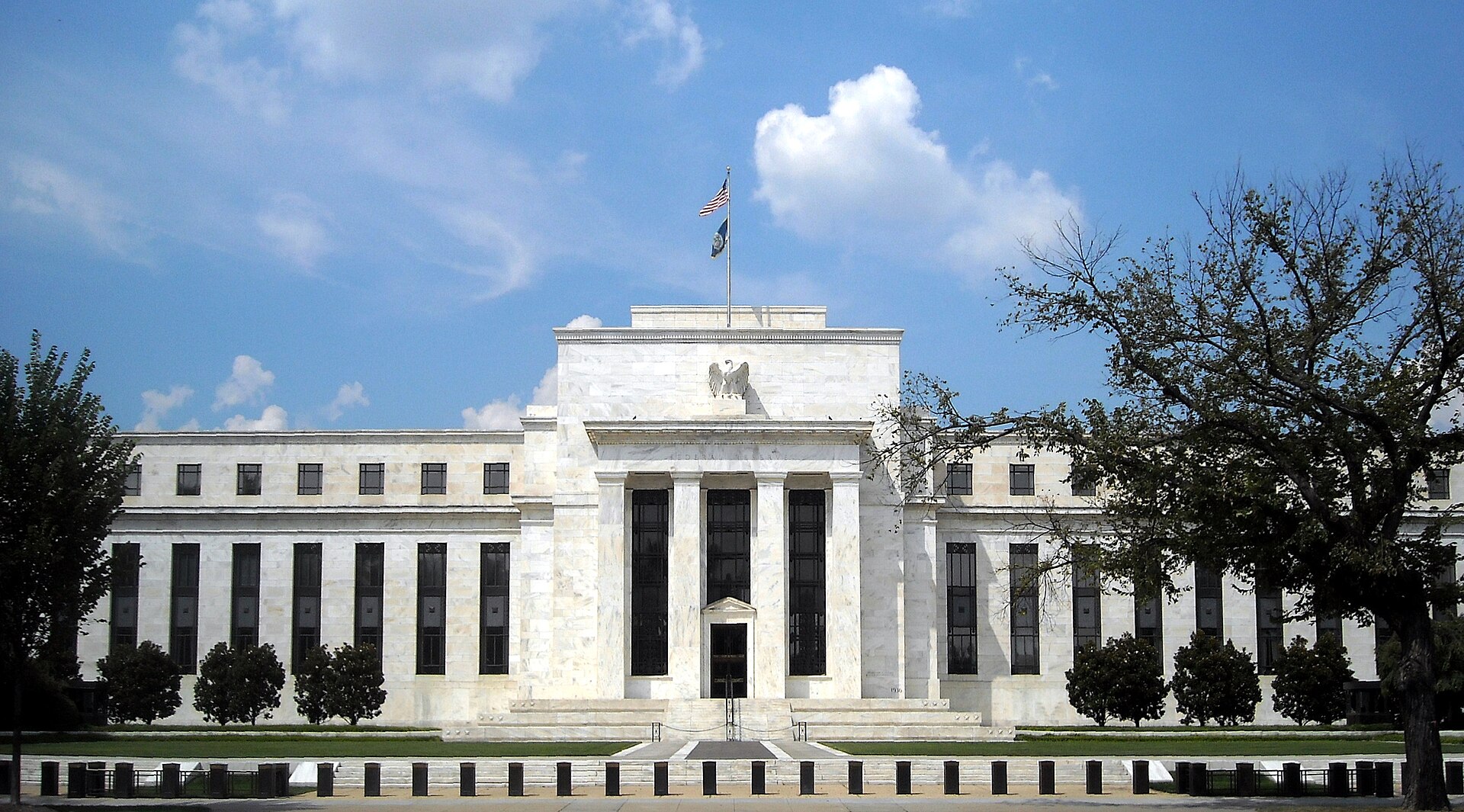
Reference view of the Marriner S. Eccles Federal Reserve Board Building in Washington, D.C. US monetary-policy decisions can influence dollar asset returns, capital flows and emerging-market currencies such as the rupee.
Image: AgnosticPreachersKid · CC BY-SA 3.0
Why in news
The Fed retained rates after its September increase, with two members favouring another hike. The supplied reports link the prospect of prolonged elevated US rates and escalating West Asian tensions to emerging-market volatility, while noting that India’s immediate market reaction was limited because the decision was expected.
3.75–4.00%
Fed policy-rate target range
10–2
FOMC vote to hold rates
3.7%
US consumer inflation in September
25 basis points
Rate increase sought by dissenters
₹95.30–95.36 per US doll
Reported rupee trading range on October 29
Background
The Federal Open Market Committee determines US monetary policy under the Federal Reserve’s mandate of maximum employment and price stability. Its decisions have international spillovers because the dollar is central to trade invoicing, cross-border borrowing and reserve holdings, while US Treasuries provide a major benchmark for financial markets. In India, the Monetary Policy Committee determines the policy rate under the Reserve Bank of India Act, with price stability as the primary objective while keeping growth in mind. India’s exchange rate is market-determined, with RBI intervention aimed at containing excessive volatility rather than defending a permanently fixed rate.
The decision: A pause, not a pivot towards easing
According to the supplied reports, the Fed maintained its target range after raising rates in September. Persistent inflation and the need for additional data shaped the decision; the dissenters preferred an immediate increase rather than a cut.
An unchanged policy rate is not equivalent to monetary easing. It leaves the existing interest-rate setting in place, while the financial impact depends on how the decision changes expectations about future rates. The report’s reference to a possible December hike describes market pricing, not a commitment by the Fed.
- US consumer inflation was reported at 3.7% in September, above the Fed’s longer-term inflation goal.
- The absence of explicit forward guidance leaves investors more dependent on incoming inflation and activity data.
- Energy disruption, tariffs and strong investment demand were identified in the reports as contributors to US price pressures.
Infographic
Capital
Attractive dollar returns can redirect portfolio investment.
Currency
Dollar demand and risk aversion can pressure the rupee.
Prices
Depreciation can amplify energy and other import costs.
Credit
External financing and unhedged debt servicing can become costlier.
Policy
RBI balances inflation and growth with flexible, targeted tools.
AI-assisted infographic by Pragnya IAS Academy, based on the cited sources.
Capital flows and the rupee: Relative returns meet risk aversion
Elevated US interest rates can make dollar assets more attractive relative to emerging-market assets. Investors assess not only interest-rate differentials but also expected currency movements, hedging costs, credit risk and domestic growth prospects. Consequently, higher US rates can encourage portfolio reallocation without guaranteeing capital outflows from every emerging economy.
If foreign investors sell Indian assets and convert rupee proceeds into dollars, demand for dollars rises and the rupee can depreciate. Geopolitical uncertainty can reinforce this channel through safe-haven demand. However, the supplied report attributes the rupee’s immediate weakness primarily to broader risk aversion and fundamental concerns, rather than to the anticipated Fed decision alone.
- Portfolio flows generally react more quickly to global financial conditions than long-term direct investment.
- An expected policy announcement may produce little immediate market movement even while elevated rates continue to exert pressure.
- Domestic fundamentals, foreign-exchange buffers and investor confidence influence the intensity of the spillover.
Inflation and borrowing costs: The external shock enters India
Rupee depreciation raises the domestic-currency cost of dollar-priced imports, other things remaining equal. For an oil-importing economy such as India, simultaneous increases in global energy prices and dollar strength can compound pressure on fuel costs, transport, production inputs and the trade balance. Pass-through to consumer prices is neither immediate nor complete; it depends on taxes, administered prices, margins and demand conditions.
Elevated global benchmarks can raise the cost of new external borrowing and floating-rate foreign-currency debt. Risk aversion may also widen credit spreads. Rupee depreciation increases the rupee value of servicing unhedged dollar liabilities, while existing fixed-rate debt does not automatically reprice before refinancing.
There are offsetting channels. Currency depreciation can improve some exporters’ price competitiveness and increase the rupee value of foreign-currency earnings. Yet imported inputs, currency hedges and weaker global demand can limit these benefits.
- Imported inflation and costlier credit can simultaneously squeeze household purchasing power and corporate margins.
- Domestic bond yields may face upward pressure through portfolio sales and inflation expectations, but RBI liquidity conditions also matter.
- Higher US rates can eventually weaken global demand and commodity prices, partly offsetting inflationary spillovers.
RBI’s policy dilemma: Preserve autonomy, manage spillovers
The RBI need not match the Fed’s interest-rate decisions. Its policy choice should reflect India’s inflation outlook, growth conditions, inflation expectations and financial stability. Nevertheless, exchange-rate depreciation and external financing conditions can alter the domestic outlook against which the MPC decides.
Premature easing could, other things equal, narrow the interest-rate differential and add to currency pressure. Conversely, raising rates merely to support the rupee could weaken domestic demand without resolving an external energy-supply shock. The appropriate response is therefore a coordinated mix of monetary policy, exchange-rate flexibility, liquidity management and targeted supply-side action.
- Foreign-exchange intervention can smooth disorderly movements but cannot sustainably substitute for adjustment to persistent external pressures.
- RBI dollar sales absorb rupee liquidity; separate liquidity operations may be needed if domestic funding conditions tighten excessively.
- Clear communication should distinguish temporary imported price shocks from persistent inflation and second-round effects.
- External-debt monitoring and currency-risk management can reduce the need to use interest rates as the sole stabilisation instrument.
| Channel | Transmission mechanism | India implication and qualification |
|---|---|---|
| Capital flows | Dollar assets become relatively attractive | Portfolio outflow risk rises, but domestic fundamentals and expected returns remain important |
| Exchange rate | Portfolio conversion and safe-haven demand increase dollar demand | The rupee may weaken; depreciation is not determined by interest rates alone |
| Imported inflation | A weaker rupee raises the rupee cost of dollar-priced imports | Energy and input costs can rise; consumer-price pass-through is partial and variable |
| External borrowing | Global benchmarks and risk premiums affect financing costs | New, floating-rate and refinanced debt are exposed; unhedged borrowers also face currency risk |
| Domestic monetary policy | External pressures alter inflation and financial conditions | RBI must reassess its domestic outlook rather than mechanically replicate Fed decisions |
- 1. US rates remain elevated and expectations of early easing recede
- 2. Dollar assets become relatively attractive, especially during global risk aversion
- 3. Emerging markets face portfolio reallocation and currency pressure
- 4. Rupee depreciation raises import costs and unhedged dollar-debt servicing burdens
- 5. Inflation risks and tighter financing conditions complicate India’s growth outlook
- 6. RBI reassesses domestic inflation and growth, using monetary, liquidity and foreign-exchange tools as appropriate
September 2026
According to the supplied report, the Fed raised rates at the meeting preceding its October pause.
October 28, 2026
The FOMC voted to retain the policy-rate target range at 3.75–4.00%, citing the need for more information.
October 29, 2026
Indian markets showed no dramatic immediate reaction to the expected decision, while the rupee weakened amid continued dollar demand.
Significance, challenges & way forward
Significance
- The episode demonstrates how monetary policy in a major reserve-currency economy can affect countries beyond its jurisdiction.
- India can face a combined energy-price and exchange-rate shock even when the Fed announces no fresh rate increase.
- External financial conditions influence the scope and timing of domestic monetary easing without eliminating policy autonomy.
- The distinction between an anticipated announcement and a prolonged elevated-rate environment helps explain muted immediate reactions alongside continuing vulnerability.
Challenges
- The duration of elevated US rates remains uncertain, complicating borrowing, hedging and investment decisions.
- Escalating West Asian tensions can simultaneously increase energy costs and safe-haven demand for dollars.
- Supporting the exchange rate through interest rates alone risks imposing excessive costs on domestic growth.
- Persistent reserve sales can consume buffers and tighten rupee liquidity unless liquidity effects are managed.
- Foreign-currency borrowers with inadequate hedges face currency mismatches and potentially higher refinancing costs.
Way forward
- Keep monetary policy anchored in India’s inflation outlook and growth conditions rather than in a fixed response to Fed decisions.
- Allow exchange-rate adjustment while using foreign-exchange intervention to contain disorderly volatility.
- Monitor external-debt maturity profiles, floating-rate exposure and unhedged foreign-currency liabilities across vulnerable borrowers.
- Encourage appropriate hedging while recognising that hedging has costs and cannot eliminate every financing risk.
- Address energy vulnerability through diversified sourcing, efficiency and a sustained clean-energy transition.
- Use targeted supply-side measures and credible communication to limit second-round inflation without weakening fiscal discipline.
Key terms
- Federal Open Market Committee
- The Federal Reserve body responsible for determining US monetary policy.
- Interest-rate differential
- The difference between interest rates across economies or financial instruments, relevant to cross-border investment decisions.
- Exchange-rate pass-through
- The extent to which exchange-rate changes affect import prices and subsequently domestic prices.
- Imported inflation
- Domestic price pressure arising from higher import prices, including those caused by currency depreciation.
- Currency mismatch
- A situation in which liabilities and the income or assets available to service them are denominated in different currencies.
- Sterilisation
- Central-bank operations that offset the domestic liquidity impact of foreign-exchange intervention.
- Monetary-policy trilemma
- The constraint that a fixed exchange rate, unrestricted capital mobility and independent monetary policy cannot all be fully maintained together.
- Forward guidance
- Central-bank communication intended to shape expectations about the future course of monetary policy.
Link with static syllabus
Prelims practice MCQs
Q1. With reference to spillovers from elevated US interest rates, consider the following statements: 1. They can increase the relative attractiveness of dollar-denominated assets. 2. They necessarily cause depreciation of every emerging-market currency. 3. Expectations of future interest rates can influence markets even when the current policy rate is unchanged. Which of the statements given above are correct?
Q2. Consider the following pairs: 1. Imported inflation: Domestic price pressure from costlier imports 2. Currency mismatch: Liabilities and servicing income denominated in different currencies 3. Sterilisation: Central-bank action to permanently fix the exchange rate Which of the pairs given above are correctly matched?
Q3. Other things remaining equal, what is the immediate domestic liquidity effect when the RBI sells US dollars to banks in exchange for rupees?
Q4. With reference to an Indian company with unhedged US-dollar debt, consider the following statements: 1. Rupee depreciation increases the rupee cost of servicing unchanged dollar obligations. 2. A Fed rate increase immediately raises the contractual interest rate on all existing fixed-rate dollar loans. 3. Floating-rate borrowing can expose the company to increases in the relevant external interest-rate benchmark. Which of the statements given above are correct?
Mains practice questions
GS 3 · 15 marks · 250 words
Explain how elevated US interest rates affect India through capital flows, exchange rates and borrowing costs. Discuss the policy choices available to the RBI.
Frequently asked questions
Why can a Fed rate hold still matter for India?
A hold maintains existing interest-rate conditions and can delay expectations of easing. Elevated dollar returns may therefore continue to influence capital flows, exchange rates and borrowing costs.
Must the RBI raise rates when US rates remain elevated?
No. The RBI must assess domestic inflation and growth, while incorporating the effects of exchange-rate movements and external financial conditions.
Does a weaker rupee always increase consumer inflation immediately?
No. It raises the rupee cost of imports, other things equal, but consumer-price pass-through depends on contracts, taxes, administered prices, margins and demand.
Was the Fed decision alone responsible for the reported rupee weakness?
The supplied report does not support that conclusion. It notes that the decision was expected and attributes the rupee’s immediate weakness mainly to broader fundamental concerns and geopolitical risk aversion.
Sources
- The Hindu: U.S. Fed holds rates steady; pressure on emerging markets expected with stronger dollar outlook
- The Hindu: U.S. Fed holds interest rates steady despite surging inflation
Analysis prepared by the Pragnya IAS Academy current-affairs desk with AI assistance from the cited reports. Verify figures with the original sources.
Turn current affairs into marks
Join Pragnya IAS Academy's mentorship for daily answer-writing evaluation on stories like this — classroom programmes from a trusted name in IAS coaching in Hyderabad.