
India–Azerbaijan Reset: Connectivity, Energy and the Pakistan–Kashmir Challenge
Revise the static topic: UPSC International Relations notes
In short: External Affairs Minister S. Jaishankar met Azerbaijan’s President Ilham Aliyev and Foreign Minister Jeyhun Bayramov in Baku on October 23, 2026, to rebuild ties strained by Azerbaijan’s response to Operation Sindoor and its position on Kashmir. The engagement prioritised connectivity, energy, trade and political consultations, signalling pragmatic cooperation without an announced resolution of strategic differences.
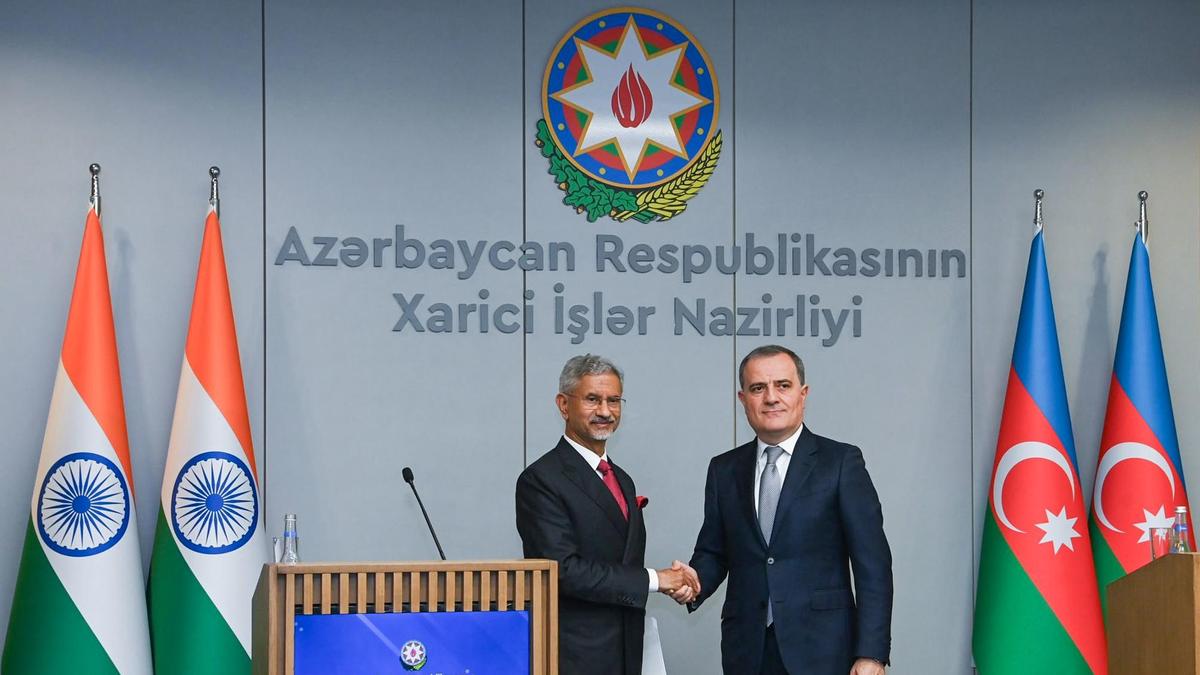
S. Jaishankar’s engagement with Azerbaijan’s leadership in Baku focused on rebuilding ties through connectivity, energy and trade, while differences over Pakistan and Kashmir remained unresolved.
Image: The Hindu
Why in news
India and Azerbaijan agreed to strengthen political dialogue, economic engagement and coordination on the International North-South Transport Corridor. The visit also brought discussions on regional peace, terrorism and Azerbaijan’s interest in joining the Shanghai Cooperation Organisation.
7,200 km
Reported length of the INSTC
Background
Azerbaijan is a South Caucasus country on the western shore of the Caspian Sea, bordering Russia, Georgia, Armenia and Iran; its Nakhchivan exclave also borders Türkiye. Its location gives it strategic relevance for transport between Iran and Russia, while its hydrocarbon sector creates opportunities for energy cooperation. The International North-South Transport Corridor is a multimodal connectivity framework linking India with Eurasian markets through sea, rail and road networks. India’s engagement with Azerbaijan therefore intersects with connectivity, energy diversification, regional stability and relations with other South Caucasus countries.
What the diplomatic reset involves
The Baku meetings sought to restore a forward-looking agenda after political friction. Jaishankar and Bayramov discussed trade, investment, energy, connectivity, tourism and cultural exchanges, while agreeing to deepen political consultations and exchange visits.
The reported outcomes are primarily commitments to dialogue and closer coordination. The supplied reports do not establish a new trade agreement, a completed transport link or an Azerbaijani reversal on Kashmir. The reset should therefore be understood as renewed engagement, not a comprehensive strategic reconciliation.
- India and Azerbaijan agreed to coordinate more closely on the International North-South Transport Corridor.
- The discussions covered deeper oil and energy cooperation and possible expansion into other areas.
- India proposed greater participation by Azerbaijani professionals in the Indian Technical and Economic Cooperation programme.
- Jaishankar acknowledged Azerbaijan’s assistance in evacuating Indian nationals, particularly students, from Iran earlier in the year.
Infographic
Connectivity
Coordinate on the INSTC and improve logistics reliability.
Energy and trade
Build on existing interests without assuming new supply commitments.
People and skills
Strengthen aviation, student welfare, tourism and ITEC exchanges.
Security guardrails
Maintain clear positions on terrorism, sovereignty and Kashmir.
Regional balance
Support Armenia–Azerbaijan peace and preserve independent partnerships.
AI-assisted infographic by Pragnya IAS Academy, based on the cited sources.
Connectivity: Azerbaijan’s importance for India’s Eurasian outreach
Azerbaijan is relevant to the western route of the INSTC, connecting Iran with Russia through the South Caucasus. For India, this offers a potential route to Eurasian markets without requiring transit through Pakistan. Its strategic value lies in widening transport choices rather than creating an exclusive replacement for existing maritime routes.
Political coordination must translate into reliable logistics. Freight competitiveness depends on interoperable transport links, predictable customs procedures, affordable transit charges, cargo availability and dependable delivery schedules. A corridor’s mapped length alone does not establish its commercial viability.
- Connectivity diversification can reduce dependence on a narrow set of transit routes.
- Businesses require end-to-end reliability rather than isolated improvements in individual transport segments.
- Regional instability and cross-border procedural friction can weaken the benefits of physical infrastructure.
Energy, trade and people-to-people ties as stabilisers
Bayramov highlighted Indian investment in Azerbaijan’s energy sector, while Jaishankar identified trade, investment and energy as central to bilateral relations. Sustained engagement could help protect existing commercial interests and explore diversification, but the reports provide no new investment amount, supply commitment or bilateral trade target.
Air connectivity, tourism, education and professional training offer a wider foundation for relations. The discussions noted daily flights and the presence of Indian students in Azerbaijan. These links can build constituencies for cooperation, although they cannot substitute for political trust.
- Energy cooperation can support diversification of India’s overseas commercial engagement.
- Improved air connectivity can facilitate tourism, business travel and educational exchanges.
- Professional training through ITEC can strengthen institutional familiarity and development partnerships.
- Consular cooperation provides a practical area of shared interest during regional crises.
Managing differences over Pakistan and Kashmir
Relations deteriorated after Azerbaijan condemned Indian strikes against Pakistan-based terror targets during Operation Sindoor in May 2025. Azerbaijan also reiterated its position on Kashmir at the OIC Contact Group meeting on September 22, 2026. These differences concern core Indian security and sovereignty sensitivities, not merely diplomatic messaging.
India’s established position is that Jammu and Kashmir is an integral part of India and that issues with Pakistan should be addressed bilaterally, without third-party intervention. Engagement with Baku need not dilute this position: functional cooperation can proceed alongside clear communication of disagreements.
The Hindu reports that Indian officials see closer engagement with Azerbaijan as a means of exerting pressure on Pakistan and Türkiye. This is a reported strategic calculation, not evidence that Azerbaijan has distanced itself from either country. India should assess the reset through observable conduct rather than assume a geopolitical realignment.
- Dialogue can prevent disagreement in one domain from paralysing the entire relationship.
- The shared language on terrorism does not establish agreement on every specific security issue.
- A durable reset requires sensitivity to sovereignty concerns alongside practical economic cooperation.
Regional peace and multilateral diplomacy
Jaishankar welcomed the initialling of the Armenia–Azerbaijan peace agreement in August and expressed hope for lasting peace. Initialling should not be treated as proof that every legal or implementation stage has been completed. For India, a stable South Caucasus would improve the environment for connectivity and allow constructive relations with both countries.
Azerbaijan’s interest in joining the SCO introduces a multilateral dimension. India’s External Affairs Ministry stated that the matter would be discussed within the grouping; the visit therefore does not establish an Indian commitment to secure Azerbaijan’s admission. NAM contacts also demonstrate how multilateral forums can preserve communication during bilateral friction.
As a static constitutional link, Article 51 directs the Indian State to endeavour to promote international peace and security and encourage settlement of international disputes by arbitration. It provides a broader normative context for peaceful diplomacy, rather than a specific legal mandate for this bilateral reset.
- Support for regional peace need not imply an exclusive alignment with either Azerbaijan or Armenia.
- SCO admission is a matter for the organisation’s collective processes, not bilateral assurance alone.
- India can combine strategic autonomy with issue-based cooperation across competing regional relationships.
| Area | Reported development | What should not be inferred |
|---|---|---|
| Political dialogue | Agreement to deepen consultations and exchange visits | All strategic disagreements have been resolved |
| INSTC | Closer coordination on the transport corridor | All links are complete or seamless freight movement is assured |
| Energy | Intent to deepen oil and energy cooperation | A new quantified investment or supply agreement has been concluded |
| Kashmir and Pakistan | Differences acknowledged while engagement continued | Azerbaijan has reversed its stated positions |
| Regional peace | India welcomed initialling of the Armenia–Azerbaijan agreement | The peace process is fully implemented |
| SCO | Azerbaijan’s membership interest is to be discussed within the grouping | India has guaranteed Azerbaijan’s admission |
- 1. Freight departs from India by sea.
- 2. Iranian ports provide entry into the overland transport network.
- 3. Road and rail connections carry cargo through Iran towards Azerbaijan.
- 4. Azerbaijan provides onward connectivity towards Russia.
- 5. Connected networks enable access to wider Eurasian markets.
April 2018
External Affairs Minister Sushma Swaraj visited Azerbaijan for a NAM ministerial meeting.
January 2024
Jaishankar and Bayramov met on the sidelines of the NAM ministerial meeting in Kampala.
May 7, 2025
Azerbaijan condemned Indian strikes against Pakistan during Operation Sindoor, contributing to bilateral friction.
September 2026
Narendra Modi and Ilham Aliyev met on the sidelines of the SCO summit in Bishkek, according to the supplied reports.
September 22, 2026
Bayramov reiterated Azerbaijan’s position on Kashmir at the OIC Contact Group meeting.
October 23, 2026
Jaishankar met Aliyev and Bayramov in Baku and outlined a pathway for renewed bilateral cooperation.
Significance, challenges & way forward
Significance
- The reset preserves India’s access to a strategically located South Caucasus partner despite serious political differences.
- Closer INSTC coordination could broaden India’s options for reaching Eurasian markets without transit through Pakistan.
- Energy engagement can protect existing Indian commercial interests and support diversification.
- Regional peace would create a more favourable environment for transport, investment and people-to-people exchanges.
- The engagement illustrates strategic autonomy through issue-based cooperation rather than rigid diplomatic camps.
Challenges
- Azerbaijan’s positions on Pakistan and Kashmir remain a source of mistrust for India.
- Political commitments may not produce commercially viable freight movement without coordinated infrastructure and procedures.
- Regional conflicts can disrupt transport, energy markets and the safety of Indian nationals.
- Expectations of an Azerbaijani shift away from Pakistan or Türkiye could exceed the evidence available.
- India must deepen engagement with Azerbaijan without treating relations with Armenia as expendable.
- The absence of quantified new commercial commitments makes implementation more important than diplomatic signalling.
Way forward
- Institutionalise political consultations with a clear agenda covering sovereignty concerns, security and economic cooperation.
- Develop an INSTC implementation work programme focused on customs coordination, transport interoperability and predictable transit procedures.
- Encourage commercially assessed energy and trade projects rather than announcing targets without an implementation basis.
- Strengthen student welfare, consular coordination and crisis-evacuation arrangements.
- Expand professional exchanges through ITEC and facilitate sustainable tourism and business connectivity.
- Support the Armenia–Azerbaijan peace process while maintaining independent relations with both countries.
- Evaluate SCO-related proposals through the grouping’s procedures and India’s wider regional interests.
Key terms
- Diplomatic reset
- An effort to rebuild engagement and establish a workable agenda after a period of strained relations.
- INSTC
- The International North-South Transport Corridor is a multimodal framework connecting India with Eurasian markets through maritime and overland routes.
- Strategic autonomy
- The capacity to make foreign-policy choices according to national interests without automatic alignment with another power or bloc.
- Compartmentalisation
- Pursuing cooperation in selected areas while managing unresolved disagreements in others.
- ITEC
- The Indian Technical and Economic Cooperation programme supports capacity-building and technical cooperation with partner countries.
- Initialling an agreement
- A step generally authenticating a negotiated text, which does not by itself establish entry into force or full implementation.
- South Caucasus
- The region comprising Armenia, Azerbaijan and Georgia, situated between the Black Sea and the Caspian Sea.
Link with static syllabus
Prelims practice MCQs
Q1. With reference to the International North-South Transport Corridor, consider the following statements: 1. It is a multimodal connectivity framework involving maritime and overland transport. 2. Azerbaijan is relevant to its western route connecting Iran and Russia. 3. Its operation necessarily requires transit through Pakistan. Which of the statements given above are correct?
Q2. Consider the following pairs: 1. Azerbaijan — Caspian Sea littoral state 2. Armenia — South Caucasus country 3. Nakhchivan — Azerbaijani exclave bordering Türkiye How many of the above pairs are correctly matched?
Q3. With reference to the October 2026 India–Azerbaijan engagement, consider the following statements: 1. The countries agreed to coordinate more closely on the INSTC. 2. Azerbaijan announced a reversal of its position on Kashmir. 3. India guaranteed Azerbaijan’s admission to the SCO. Which of the statements given above is/are correct?
Q4. Which of the following correctly describes Article 51 of the Constitution of India?
Mains practice questions
GS 2 · 15 marks · 250 words
The India–Azerbaijan diplomatic reset illustrates the need to pursue connectivity and economic interests without diluting core security concerns. Discuss.
Frequently asked questions
Why is Azerbaijan strategically important to India?
Azerbaijan’s location between Iran and Russia makes it relevant to the INSTC’s western route. Its energy sector and links in trade, tourism and education provide additional grounds for engagement.
Has the reset resolved differences over Pakistan and Kashmir?
No such resolution is established by the supplied reports. The visit signals a willingness to cooperate despite differences, not an announced Azerbaijani reversal.
Did India promise to support Azerbaijan’s SCO membership?
The reports do not establish a firm Indian commitment. India’s External Affairs Ministry said the matter would be discussed within the SCO.
Does closer engagement with Azerbaijan require India to distance itself from Armenia?
No. India can maintain independent relations with both countries while supporting dialogue, regional peace and mutually beneficial connectivity.
Sources
- The Hindu: Jaishankar meets Azerbaijan President, Foreign Minister as India attempts reset of ties
- Indian Express: India, Azerbaijan seek diplomatic reset after ‘Operation Sindoor’ fallout
- Times of India: After Operation Sindoor friction, Delhi & Baku reset ties with EAM Jaishankar's visit
- Times of India: After Sindoor friction, India & Azerbaijan reset ties with EAM visit
Analysis prepared by the Pragnya IAS Academy current-affairs desk with AI assistance from the cited reports. Verify figures with the original sources.
Turn current affairs into marks
Join Pragnya IAS Academy's mentorship for daily answer-writing evaluation on stories like this — classroom programmes from a trusted name in IAS coaching in Hyderabad.