
Nepal’s First Loss and Damage Fund Allocation: Climate Justice and Finance Gaps
Revise the static topic: UPSC Environment notes
In short: The Fund for Responding to Loss and Damage has provisionally earmarked $21.6 million for Nepal following its August 2026 floods, marking its first country-specific allocation. This is not a completed payout: Nepal must submit a funding request for further Board approval before money is released. The decision advances climate justice but exposes major gaps between disaster recovery needs, available finance and the speed of access.
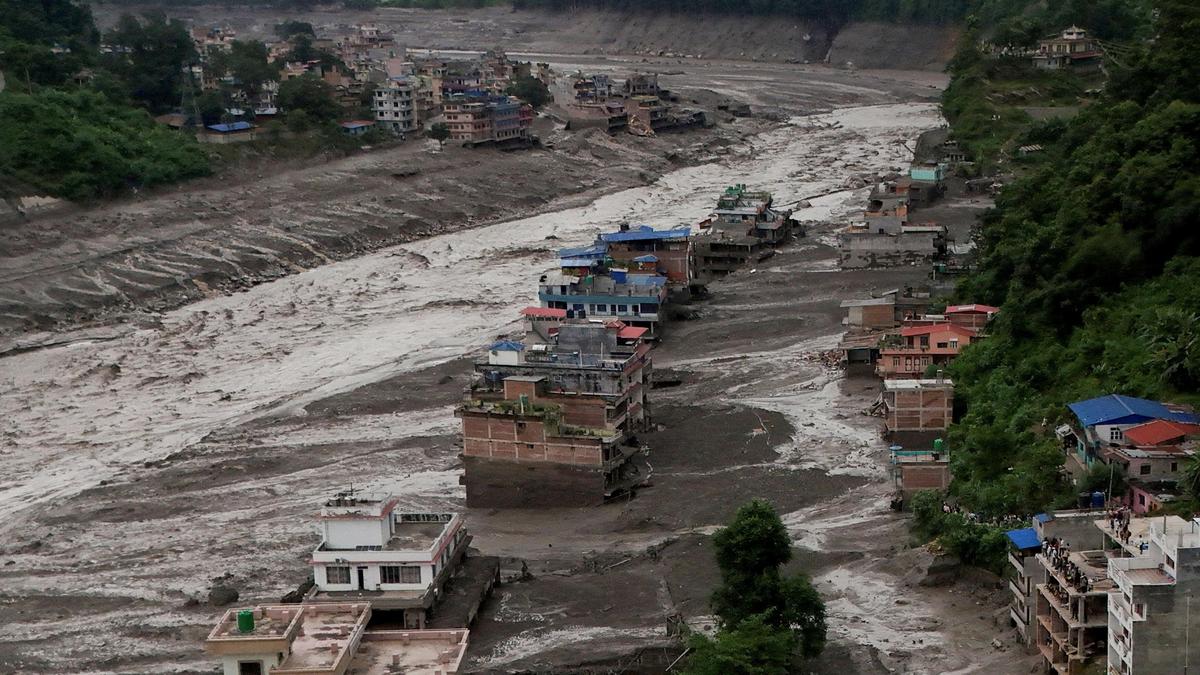
Reference image accompanying reporting on Nepal’s loss-and-damage funding allocation, not a verified view of the August 2026 floods. The $21.6 million earmark requires a funding request and further Board approval before disbursement.
Image: The Hindu
Why in news
At an extraordinary virtual meeting on October 22, 2026, the Fund’s Board approved Nepal’s provisional allocation and allowed it to submit a request outside the closed submission window. The request is to be considered at the Board’s December meeting in Manila.
$21.6 million
Nepal’s provisional allocation
$1.6 million
Oversight fees within allocation
$4.71 billion
Minimum estimated recovery needs
$822.06 million
Pledges as of March 15, 2026
$342 million
Fund’s start-up allocation
$2.8 billion
Value of first-call requests
Background
The UN Framework Convention on Climate Change provides the institutional framework for international climate cooperation, guided by equity and common but differentiated responsibilities and respective capabilities. Mitigation addresses the causes of climate change, adaptation reduces vulnerability to its impacts, and loss-and-damage responses address harms that are not avoided through mitigation and adaptation. Governments agreed to establish the Fund for Responding to Loss and Damage at COP27 in 2022, and adopted its Governing Instrument at COP28 in 2023. It operates under the UNFCCC financial mechanism to support developing countries particularly vulnerable to climate change, covering economic and non-economic losses from extreme weather and slow-onset events.
What the Board decided: earmarking is not disbursement
The Board provisionally earmarked $21.6 million for Nepal, including $1.6 million in oversight fees paid to implementing organisations for supervising the use of funds. Nepal has been invited to submit a funding request, which requires further Board approval before disbursement.
The Board also authorised a start-up-phase pilot allowing Nepal to apply outside the closed submission window. Further exceptional submissions require separate Board decisions, while the Secretariat will assess lessons for the Fund’s long-term model. Thus, the decision demonstrates flexibility but does not establish an automatic emergency-access entitlement.
- The allocation is the Fund’s first earmarking for a specific country, not evidence that Nepal has already received the money.
- Oversight fees are included within the announced allocation and are not an additional payment above it.
- The December Board consideration remains a pending step as of October 24, 2026.
Infographic
Milestone
First country-specific allocation under the Fund.
Status
Provisionally earmarked; disbursement awaits further approval.
Purpose
Respond to climate harms beyond risk-reduction efforts.
Adequacy
Support in millions against recovery needs in billions.
Access
Exceptional permission, not a standing emergency entitlement.
Reform
Predictable grants, faster access and transparent oversight.
AI-assisted infographic by Pragnya IAS Academy, based on the cited sources.
Why Nepal illustrates the climate justice case
On August 26, 2026, an ice-and-rock avalanche triggered debris flow and flooding along the Bhotekoshi–Trishuli–Narayani river system. Experts cited in the reporting link the event to human-driven warming. Nepal estimates economic losses of at least $2.69 billion and recovery needs of at least $4.71 billion; these are distinct measures and should not be conflated.
Nepal’s appeal emphasised its negligible contribution to global emissions alongside its escalating exposure to climate impacts. The climate justice argument is that vulnerable countries should not bear disproportionate recovery burdens merely because the damage occurs within their borders.
The Fund’s mandate extends beyond damaged roads, homes and livelihoods to non-economic losses, such as harm to cultural heritage, ecosystems and community identity. These examples explain the mandate; they are not a verified inventory of losses from Nepal’s disaster.
- Distributive justice concerns who bears the costs of climate impacts.
- Procedural justice requires affected countries and communities to have meaningful access to decisions and finance.
- Recognition of non-economic loss prevents recovery assessments from being reduced to market-valued assets alone.
Loss-and-damage finance is distinct from adaptation funding
Adaptation seeks to reduce climate risks through measures such as early-warning systems, resilient infrastructure and livelihood diversification. Loss-and-damage finance addresses harms that materialise despite, or in the absence of, effective mitigation and adaptation, including where adaptation limits are reached.
The distinction is functional rather than a rigid before-and-after division. Post-disaster reconstruction may incorporate adaptation by rebuilding more safely, while responses to slow-onset losses can require planned support over time. Nevertheless, relabelling existing adaptation assistance as loss-and-damage finance would weaken additional support for affected countries.
- Mitigation reduces greenhouse gas emissions or strengthens sinks.
- Adaptation reduces exposure and vulnerability to climate impacts.
- Loss-and-damage responses support people and systems confronting climate-related harms that have not been avoided.
- Finance should permit integrated recovery while transparently distinguishing its objectives and avoiding double counting.
Adequacy, predictability and access remain the central tests
As of March 15, 2026, 27 countries had pledged $822.06 million, with $629.70 million in grant contributions reported. These figures should not be treated as the Fund’s current cash balance: the source states that publicly available information does not establish how much cash it holds. Disbursement depends on donors honouring commitments.
The start-up allocation is $342 million, with at least half reserved for small island developing States and least developed countries. The first call drew 176 requests from 119 countries worth about $2.8 billion, demonstrating demand substantially beyond the start-up envelope. Nepal’s allocation is similarly small relative to its estimated recovery needs.
Access is also an institutional-design problem. A climate-finance specialist cited in the reporting describes a conventional development-fund process with multiple review stages rather than a standing emergency mechanism. Nepal’s exceptional route shows that flexibility is possible, but reliance on separate Board decisions can make access uncertain for other disaster-affected countries.
- Pledges, signed contributions, available cash, allocations and disbursements represent different stages of finance.
- Fiduciary oversight is necessary, but procedures must be proportionate to the urgency and scale of support.
- The World Bank serves as interim trustee; this role should not be confused with the Fund Board’s allocation decisions.
- Grant-based support is important to avoid adding recovery-related debt burdens to already vulnerable economies.
| Dimension | Mitigation | Adaptation | Loss and damage |
|---|---|---|---|
| Core purpose | Address the causes of climate change | Reduce vulnerability to climate impacts | Respond to climate-related harms not avoided |
| Illustrative measures | Renewable energy and protection of carbon sinks | Early warning and climate-resilient infrastructure | Recovery support and restoration of affected livelihoods |
| Main limitation | Cannot immediately eliminate accumulated climate risks | Cannot prevent every impact and has limits | Finance cannot fully restore every irreversible loss |
| Relationship to Nepal’s case | Limits future warming and associated risks | Can reduce future exposure to mountain hazards | Supports responses to damage from the August floods |
- 1. Disaster generates recovery needs and a government appeal.
- 2. The Board provisionally earmarks support and permits an out-of-window application.
- 3. Nepal submits its funding request.
- 4. The Board considers the request for approval in December.
- 5. Money may be released after approval, subject to funding availability, with implementation oversight.
2022
Governments agreed at COP27 to establish the Loss and Damage Fund.
2023
The Fund’s Governing Instrument was adopted at COP28.
March 15, 2026
Reported pledges stood at $822.06 million from 27 countries.
July 2026
The Board deferred decisions on first-call funding requests to December.
August 26, 2026
An ice-and-rock avalanche triggered flooding along Nepal’s Bhotekoshi–Trishuli–Narayani river system.
August 31, 2026
Nepal wrote to the Board’s co-chairs seeking a special decision for rapid support.
October 22, 2026
The Board provisionally earmarked $21.6 million for Nepal and permitted an out-of-window funding request.
December 2026, scheduled
The Board is to consider Nepal’s funding request at its meeting in Manila; disbursement remains conditional on approval.
Significance, challenges & way forward
Significance
- The first country-specific allocation moves the Fund from institution-building towards support for an identified disaster-affected country.
- The decision gives practical expression to climate justice by recognising the recovery burdens faced by a vulnerable developing country.
- Nepal’s exceptional access route offers lessons for designing a permanent rapid-response mechanism.
- For India, the case reinforces the relevance of Himalayan risk monitoring, regional early warning and equitable climate-finance governance.
Challenges
- The allocation is far below Nepal’s estimated recovery needs, limiting its contribution to reconstruction.
- Donor pledges do not automatically translate into available cash or timely disbursement.
- Application and approval requirements can delay support when affected communities need urgent assistance.
- Case-by-case exceptions can disadvantage countries with weaker administrative capacity or diplomatic leverage.
- Non-economic and irreversible losses are difficult to assess and cannot always be repaired through monetary transfers.
- Unclear accounting boundaries can permit existing development or adaptation assistance to be relabelled as new loss-and-damage support.
Way forward
- Create a standing rapid-response window with clear eligibility criteria and delegated authority for urgent support.
- Secure predictable grant contributions and publish comparable information on pledges, receipts, allocations and disbursements.
- Use simplified applications and proportionate safeguards while retaining transparent audits and grievance mechanisms.
- Strengthen national and local capacity to prepare requests and enable community participation in recovery priorities.
- Preserve additional loss-and-damage resources rather than diverting funding from mitigation and adaptation.
- Combine immediate recovery support with resilient reconstruction, without making comprehensive long-term planning a barrier to urgent assistance.
- Develop participatory methods to identify non-economic losses and support culturally appropriate responses.
Key terms
- Fund for Responding to Loss and Damage
- A fund under the UNFCCC financial mechanism supporting particularly vulnerable developing countries in responding to climate-related losses and damage.
- Economic loss
- Damage that can be assigned a monetary value, such as destruction of infrastructure or loss of income.
- Non-economic loss
- Harm not adequately captured by market valuation, including loss of cultural heritage, biodiversity or community identity.
- Adaptation limits
- Constraints beyond which adaptation cannot prevent intolerable risks or achieve specified objectives.
- Climate justice
- An equity-based approach that considers unequal responsibility for climate change, unequal impacts and unequal capacity to respond.
- Additionality
- The principle that new climate-finance commitments should not merely relabel or displace existing support.
- Oversight fees
- Payments to implementing organisations to cover supervision of how project funds are used.
- Disbursement
- The actual release of funds, distinct from a pledge, earmarking or approval.
Link with static syllabus
Prelims practice MCQs
Q1. With reference to Nepal’s October 2026 allocation from the Fund for Responding to Loss and Damage, consider the following statements: 1. It was the Fund’s first country-specific allocation. 2. The entire allocation had already been disbursed following the extraordinary Board meeting. 3. The announced allocation includes oversight fees. Which of the statements given above are correct?
Q2. Consider the following statements about the Fund for Responding to Loss and Damage: 1. Its establishment was agreed at COP27. 2. Its Governing Instrument was adopted at COP28. 3. Its mandate is restricted to economic losses caused by sudden-onset disasters. Which of the statements given above are correct?
Q3. Which of the following best distinguishes adaptation finance from loss-and-damage finance?
Q4. With reference to the start-up phase of the Fund for Responding to Loss and Damage, consider the following statements: 1. At least half of the start-up allocation is reserved for small island developing States and least developed countries. 2. Nepal’s exceptional access decision automatically allows every country to submit requests outside the closed window. 3. The World Bank serves as the Fund’s interim trustee. Which of the statements given above are correct?
Mains practice questions
GS 3 · 15 marks · 250 words
Nepal’s first country-specific allocation from the Fund for Responding to Loss and Damage is a milestone, but not yet a guarantee of climate justice. Discuss with reference to funding adequacy, access and the distinction from adaptation finance.
Frequently asked questions
Has Nepal already received the Loss and Damage Fund money?
As of October 24, 2026, the reported decision is a provisional earmarking, not a completed disbursement. Nepal’s funding request requires further Board approval before money can be released.
Why do reports refer to both $20 million and $21.6 million?
The total provisional allocation is $21.6 million, including $1.6 million in oversight fees. The $20 million figure refers to the reconstruction component excluding those fees.
How is loss-and-damage finance different from adaptation funding?
Adaptation finance helps reduce climate vulnerability and risk, while loss-and-damage finance addresses harms that have not been avoided. They may overlap in resilient reconstruction but should not be treated as interchangeable funding categories.
Does Nepal’s allocation create a permanent emergency-access mechanism?
No. Nepal’s out-of-window application is a start-up-phase pilot, and further exceptional submissions require separate Board decisions.
Sources
- The Hindu: What is the importance of the UN Loss and Damage Fund’s payout to Nepal? | Explained
- The Hindu: Nepal to receive first-ever loss and damage fund payout after devastating floods
- The Hindu: UN climate damages fund earmarks $20 million to Nepal for August disaster
Analysis prepared by the Pragnya IAS Academy current-affairs desk with AI assistance from the cited reports. Verify figures with the original sources.
Turn current affairs into marks
Join Pragnya IAS Academy's mentorship for daily answer-writing evaluation on stories like this — classroom programmes from a trusted name in IAS coaching in Hyderabad.