
UN Disaster Risk Financing Platform: Anticipatory Action and the $3 Billion Goal
Revise the static topic: UPSC Geography notes · UPSC Disaster Management notes
In short: UN agencies launched the Disaster Risk Financing Platform at COP31 in Antalya, Türkiye, aiming to secure access to more than $3 billion in risk financing to protect 75 million people and their livelihoods by 2030. It seeks to connect predictive analysis with pre-arranged funds so that protective action can begin before disasters strike, rather than depend entirely on post-disaster appeals.
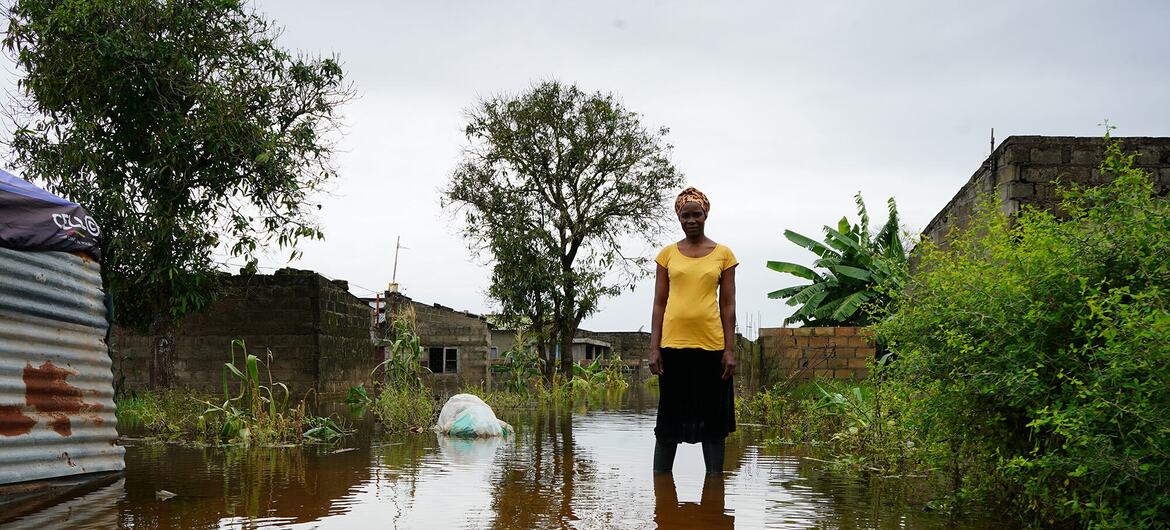
Reference photo: Floodwater surrounds homes in Maputo’s Magoanine neighborhood, Mozambique, in January 2026. Such impacts illustrate why the platform seeks to make financing available for protective action before disasters strike.
Image: UN News
Why in news
The platform brings together six UN bodies to coordinate disaster-risk financing, data and expertise. Its first reported results include insurance policies supporting OCHA and UNICEF anticipatory action programmes, arranged with assistance from WFP’s specialist insurance teams.
More than $3 billion
Targeted access to risk financing
75 million people
Target population to protect
2030
Platform target year
Less than 2%
Pre-arranged share of humanitarian financing
Nearly $211 million
Pre-arranged finance secured with WFP support this year
Up to 9.6 million people
Potential reach of WFP-supported financing this year
Background
Disaster risk arises from the interaction of hazards, exposure and vulnerability, moderated by coping capacity. Early warning systems combine risk knowledge, monitoring and forecasting, warning communication, and preparedness to respond. Anticipatory action connects warnings to protective measures before a forecast hazard causes major harm. Pre-arranged financing establishes access to resources and rules for their release in advance. These approaches complement the Sendai Framework for Disaster Risk Reduction, which stresses risk understanding, governance, investment and preparedness. In India, the Disaster Management Act, 2005 provides the statutory foundation for disaster-management institutions at national, state and district levels.
What the platform proposes
The UN Disaster Risk Financing Platform brings together FAO, IOM, OCHA, UNICEF, UNHCR and WFP. Agencies will share expertise, pool data and coordinate solutions that pair predictive analysis with financing.
Its objective is to secure access to more than $3 billion in risk financing to protect 75 million people and their livelihoods by 2030. This is a financing-access and protection target, not an announcement that the entire amount has already been raised, disbursed or placed in a common fund.
The source identifies collaboration with the insurance industry and financial markets as important for keeping costs down as financing expands. It does not specify the platform’s complete governance arrangements, country allocations or the contractual payout conditions of the reported insurance policies.
- WFP’s specialist insurance teams supported insurance arrangements for OCHA and UNICEF anticipatory action programmes.
- WFP has helped secure nearly $211 million in pre-arranged finance this year, intended to protect up to 9.6 million people in more than 50 countries.
- The platform’s institutional value lies in linking agencies’ expertise rather than treating forecasts, financing and field delivery as separate functions.
Infographic
Predict
Combine forecasts with exposure and vulnerability data.
Pre-arrange
Establish finance, decision rules and responsibilities in advance.
Act early
Deliver protective support before major impacts.
Include
Reach vulnerable households and displaced communities.
Verify
Track usable finance, timely reach and protection outcomes.
AI-assisted infographic by Pragnya IAS Academy, based on the cited sources.
Anticipatory action: from warning to protection
Anticipatory action means implementing pre-agreed protective measures when credible forecasts indicate an impending hazard, before its major impacts occur. Depending on the hazard, useful forecast lead time may extend from days to weeks.
Illustrative measures include moving livestock before floods, distributing safe-water supplies, supporting evacuation, or providing cash so households can secure food and transport. Such interventions require not only a forecast, but also agreed decision rules, available finance and operational readiness.
- An early warning communicates risk; anticipatory action uses that warning to reduce expected harm.
- Preparedness builds general readiness, while anticipatory action activates specific measures for an impending event.
- Anticipatory action cannot replace emergency relief for people who remain affected or for events without adequate warning.
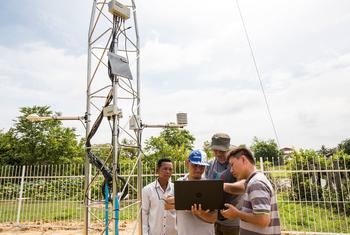
Reference image: Installation of early warning systems in Cambodia. Warnings are one part of anticipatory action; pre-arranged funding is needed to turn forecasts into timely protection.
Image: UN News
Pre-arranged financing: instruments and trade-offs
Pre-arranged financing establishes funding arrangements before a crisis. It can include contingency funds, contingent credit and insurance, although the source specifically reports insurance policies for the platform’s initial results. These instruments differ in cost, release conditions and who ultimately bears the financial risk.
Pre-arrangement alone does not make financing anticipatory: funds must become usable early enough for protective action. Conventional post-loss insurance may support recovery without enabling pre-impact intervention. The reported policies support anticipatory programmes, but their detailed triggers are not disclosed.
According to the source, pre-arranged financing accounts for less than two per cent of global humanitarian financing. Expanding it therefore requires both additional resources and changes to decision-making, procurement and delivery systems.
- Insurance transfers defined financial risks in exchange for a premium; it does not eliminate physical risk.
- Risk layering matches different financing instruments to the frequency and severity of losses.
- Where index-based insurance is used, basis risk can create a mismatch between payouts and actual needs.
Assessing the ambition and its relevance for India
The platform’s central promise is to close the warning-to-action gap. Shared data and coordinated financing could reduce fragmentation, while timely support could protect food security, children’s welfare and livelihoods, including those of refugees and displaced communities.
Success should be judged by timely, usable and equitable protection, not only by nominal financing commitments. Access to finance is not equivalent to disbursement, and a population coverage target is not proof that every person receives effective support. Simultaneous disasters can strain financing arrangements and operational capacity.
For India, the relevant lesson is to connect IMD forecasts and other hazard-monitoring systems with actionable district plans, local institutions and accessible assistance. Heatwaves, floods and cyclones illustrate the value of forecast-based decisions. The source does not announce India’s participation in the platform.
- Decentralised plans should specify who decides, what action follows and how funds become available.
- Assistance should reach people facing documentation, mobility, disability or digital-access barriers.
- Anticipatory finance should complement resilient infrastructure, ecosystem protection and long-term vulnerability reduction.
| Dimension | Early warning | Anticipatory action | Post-disaster response |
|---|---|---|---|
| Core function | Communicate impending risk | Reduce expected harm before major impacts | Address losses and urgent needs after impact |
| Decision basis | Monitoring, forecasts and risk assessment | Forecasts, agreed triggers and intervention plans | Observed impacts and needs assessments |
| Financing requirement | Sustained investment in warning capabilities | Funds accessible within the forecast lead time | Resources for relief and recovery |
| Illustrative output | Flood or heatwave alert | Early cash support or movement of livestock | Emergency shelter and restoration of services |
| Key limitation | A warning may not translate into action | Forecast uncertainty and delivery delays | Some losses have already occurred |
- 1. Map hazards, exposed populations and vulnerabilities.
- 2. Agree forecast triggers, protective measures and implementing responsibilities.
- 3. Arrange finance and delivery systems before the hazard season.
- 4. Monitor forecasts and determine whether agreed conditions are met.
- 5. Make finance usable and implement measures before major impacts.
- 6. Assess timeliness, inclusion and avoided losses to improve future action.
COP31 launch
UN agencies announce the Disaster Risk Financing Platform in Antalya, Türkiye; insurance arrangements for OCHA and UNICEF programmes are reported as initial results.
End of 2027
The UN Secretary-General’s separately stated goal is to protect every person on Earth through early warning systems.
2030
The platform aims to secure access to more than $3 billion in risk financing to protect 75 million people and their livelihoods.
Significance, challenges & way forward
Significance
- The platform seeks to shift disaster financing from predominantly reactive mobilisation towards planned protection.
- Pre-arranged resources can make early warnings operationally useful rather than merely informational.
- Timely interventions can help prevent livelihood losses, food insecurity and further displacement.
- Inter-agency coordination can connect humanitarian delivery capacity with specialised risk analysis and financing expertise.
- The initiative links climate adaptation with disaster-risk reduction while recognising that exposed communities need actionable support.
Challenges
- Forecast uncertainty creates risks of missed events, false alarms and poorly targeted interventions.
- Premium costs and financing conditions may limit affordable protection for highly exposed populations.
- Where index-based products are used, payouts may not adequately match actual needs.
- Disasters occurring together can put pressure on financial arrangements, supply chains and field capacity.
- Weak local institutions or inaccessible payment systems can delay support despite available funding.
- Fragmented reporting can obscure duplicate beneficiary counts and whether financing commitments translate into effective protection.
Way forward
- Publish clear governance, eligibility, financing and accountability arrangements for the platform.
- Combine financing instruments according to risk characteristics rather than treating insurance as a universal solution.
- Design forecast triggers jointly with scientific agencies, local authorities and affected communities.
- Maintain contingency resources for forecast failures, insufficient payouts and needs beyond insured coverage.
- Invest in last-mile warnings, accessible payment channels, pre-positioned supplies and local response capacity.
- Measure finance actually available before impact, unique people reached, timeliness and protection outcomes.
- Keep anticipatory financing additional to, and coordinated with, emergency relief and long-term risk-reduction investment.
Key terms
- Anticipatory action
- Protective action taken before a forecast hazard causes major harm, based on agreed risk information and plans.
- Pre-arranged financing
- Financing organised before a crisis, with access arrangements and release conditions established in advance.
- Disaster-risk financing
- Financial strategies and instruments used to manage the costs associated with disaster risks and impacts.
- Forecast trigger
- An agreed forecast condition that initiates a decision, financing release or protective action.
- Risk layering
- Matching financing instruments to different levels of loss frequency and severity.
- Basis risk
- The risk that an index-based insurance payout does not match the loss or need experienced.
- Lead time
- The interval between a warning and the expected hazard or impact, during which protective action may be possible.
Link with static syllabus
Prelims practice MCQs
Q1. With reference to the UN Disaster Risk Financing Platform, consider the following statements: 1. It aims to secure access to more than $3 billion in risk financing by 2030. 2. Its launch establishes that the entire targeted amount has already been disbursed. 3. Its approach connects predictive analysis with financing for anticipatory action. Which of the statements given above are correct?
Q2. Which of the following groups consists entirely of participants in the UN Disaster Risk Financing Platform as reported?
Q3. Consider the following statements: 1. Pre-arranged financing can support either anticipatory action or post-disaster response, depending on its design. 2. Insurance eliminates the physical risk posed by a natural hazard. 3. An early warning alone guarantees that vulnerable households can take protective action. Which of the statements given above is/are correct?
Q4. With reference to disaster-risk financing, consider the following pairs: 1. Risk layering: Matching financing instruments to different risk levels 2. Basis risk: Mismatch between an index-based payout and actual loss or need 3. Lead time: Interval between completion of reconstruction and the next budget cycle How many of the above pairs are correctly matched?
Mains practice questions
GS 3 · 15 marks · 250 words
Early warnings save lives only when backed by timely finance and delivery capacity. Examine this statement in the context of the UN Disaster Risk Financing Platform and discuss lessons for India.
Frequently asked questions
What is the UN Disaster Risk Financing Platform?
It is a joint initiative of FAO, IOM, OCHA, UNICEF, UNHCR and WFP launched at COP31 to connect predictive analysis with disaster-risk financing. It aims to secure access to more than $3 billion to protect 75 million people and their livelihoods by 2030.
Is the platform’s $3 billion target an already-funded relief corpus?
No. The source describes a goal of securing access to more than $3 billion in risk financing, not an already-funded or fully disbursed common corpus.
How does anticipatory action differ from an early warning?
An early warning communicates impending risk. Anticipatory action uses that information, together with plans and resources, to take protective measures before major impacts occur.
Does insurance replace disaster relief or climate adaptation?
No. Insurance addresses specified financial risks, while relief remains necessary for unmet needs and adaptation reduces underlying vulnerability over time.
Sources
Analysis prepared by the Pragnya IAS Academy current-affairs desk with AI assistance from the cited reports. Verify figures with the original sources.
Turn current affairs into marks
Join Pragnya IAS Academy's mentorship for daily answer-writing evaluation on stories like this — classroom programmes from a trusted name in IAS coaching in Hyderabad.