
ISRO Tests Modified PSLV Third Stage: Propulsion, Design Margins and Reliability
Revise the static topic: UPSC Science & Technology notes
In short: ISRO successfully ground-tested the modified PSLV third stage at Sriharikota on November 12, 2026, after third-stage anomalies in the PSLV-C61/EOS-09 and PSLV-C62/EOS-N1 missions. The changes address nozzle design, mechanical interfaces, sealing, material acceptance and quality checks, but further testing and data reviews remain necessary.
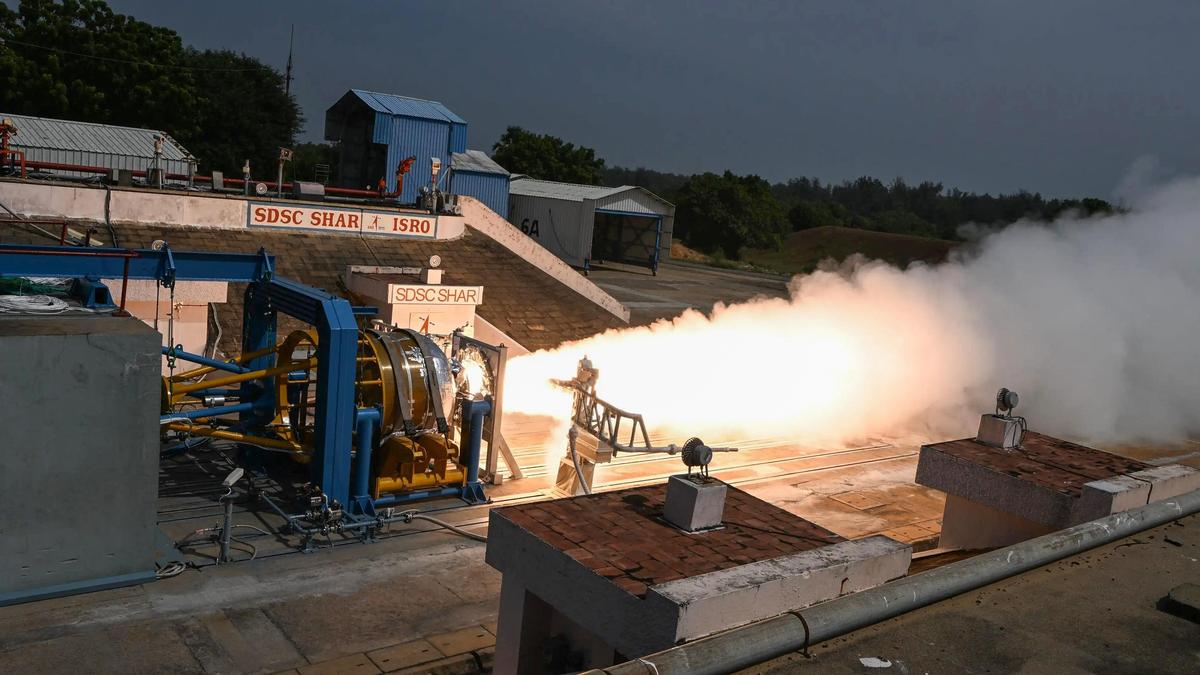
Photo from the source report: ISRO Tests Modified PSLV Third Stage: Propulsion, Design Margins and Reliability
Image: The Hindu
Why in news
ISRO has successfully tested a strengthened version of the PSLV's PS3 solid motor stage at the Static Test Facility, Satish Dhawan Space Centre. The agency has indicated that further tests are planned based on detailed analysis and review of the test data.
November 12, 2026
Successful PS3 ground static test
Background
The Polar Satellite Launch Vehicle is ISRO's four-stage launch vehicle, with alternating solid and liquid propulsion: solid first stage, liquid second stage, solid third stage and liquid fourth stage. Staging allows a launcher to discard spent hardware and reduce the mass carried forward. PSLV is associated particularly with polar and Sun-synchronous satellite launches, although its missions are not confined to these orbits. Sriharikota, on the Andhra Pradesh coast, houses the Satish Dhawan Space Centre.
What ISRO changed and tested
Following anomalies observed in the third stage during the PSLV-C61/EOS-09 and PSLV-C62/EOS-N1 missions, ISRO comprehensively revisited the PS3 configuration. The review covered design margins, raw material acceptance criteria, assembly procedures and quality checks.
According to the supplied report, the modified PS3 underwent a successful ground static test on November 12, 2026. ISRO stated that the adequacy of design margins had been verified and that further tests would follow detailed analysis and reviews of the test data.
- The nozzle configuration was improved to increase design margins.
- Mechanical interfaces were strengthened, with redundancy introduced in sealing systems.
- Raw material acceptance and assembly procedures were updated.
- Non-destructive tests were implemented during different phases of integration and transportation.
Infographic
Design margins
Improved nozzle configuration and strengthened interfaces.
Material assurance
Updated raw material acceptance criteria.
Assembly discipline
Revised procedures and redundant sealing.
Inspection
Non-destructive checks during integration and transportation.
Validation
Successful static firing, followed by data review and further tests.
AI-assisted infographic by Pragnya IAS Academy, based on the cited sources.
PSLV propulsion: Why the third stage matters
PSLV combines solid and liquid propulsion across successive stages. Solid motors contain fuel and oxidiser within a solid propellant grain and offer relatively simple propulsion architecture. Liquid engines feed propellants from tanks into a combustion chamber and can offer greater operational control, depending on engine design.
PS3 is the solid-propellant third stage, positioned between the liquid-propellant second and fourth stages. Its performance contributes to the velocity and flight conditions needed for the upper stage to complete the mission. A solid motor generally cannot be throttled, stopped and restarted like a suitably designed liquid engine.
The nozzle expands and accelerates hot combustion gases to generate thrust. Its structural integrity, thermal protection and connections are therefore critical to maintaining the intended propulsion performance.
- Remember the core-stage sequence for Prelims: solid–liquid–solid–liquid.
- Strap-on boosters, where used, are additional boosters and should not be confused with the four core stages.
- Solid propellants carry their own oxidiser; they do not require atmospheric oxygen for combustion.
How design margins and quality controls improve reliability
A design margin is the reserve between expected operating demands and an allowable design limit. In a rocket motor, pressure, temperature, vibration and mechanical loads must remain within validated limits. Better margins can make a component more tolerant of operational variation, but the supplied sources do not quantify the revised margins.
Material acceptance criteria determine whether incoming material meets specified requirements before it enters production. Assembly procedures address how components are fitted, joined, sealed and checked. These controls help ensure that manufactured hardware consistently matches the validated design.
Redundant seals provide an additional barrier against leakage, while non-destructive testing can identify certain defects without making the inspected component unusable. Neither measure guarantees reliability by itself: redundant seals can share common failure causes, and every inspection method has limits.
- Design assurance addresses whether the configuration can withstand its intended operating environment.
- Material assurance reduces the risk of unsuitable or inconsistent inputs entering production.
- Assembly assurance reduces deviations introduced while components are integrated.
- Inspection across integration and transportation helps detect defects or damage before subsequent operations.
What the successful static test establishes—and what it does not
A ground static test fires a motor while it is restrained on a test stand. It enables assessment of propulsion behaviour and hardware response under controlled conditions. Its significance lies in generating evidence about the modified configuration, rather than merely demonstrating ignition.
A successful static firing is not equivalent to a successful launch. It cannot by itself demonstrate every interaction involving flight aerodynamics, stage separation, guidance and the complete integrated vehicle. The sources do not provide the detailed test measurements, quantified reliability gains, definitive anomaly causes or a next-launch date.
- Treat the result as an important validation milestone, not a guarantee of mission success.
- Distinguish reported corrective measures from proven root causes; the supplied report does not establish the latter.
- Further tests and review of recorded data are part of the validation process announced by ISRO.
| Stage | Propulsion | Key point |
|---|---|---|
| PS1 | Solid | Provides initial core-stage thrust; strap-on boosters depend on the vehicle configuration. |
| PS2 | Liquid | Uses the Vikas engine and continues powered ascent after the first stage. |
| PS3 | Solid | The stage modified and ground-tested following the reported anomalies. |
| PS4 | Liquid | Final propulsion stage used to achieve the intended orbital conditions. |
- 1. Review observed anomalies and the existing stage configuration.
- 2. Revise nozzle design, mechanical interfaces and sealing arrangements.
- 3. Update raw material acceptance criteria and assembly procedures.
- 4. Apply non-destructive testing during integration and transportation.
- 5. Conduct the ground static firing and analyse the recorded data.
- 6. Use detailed reviews to guide further tests and validation.
Before the modified-stage test
Third-stage anomalies were observed during the PSLV-C61/EOS-09 and PSLV-C62/EOS-N1 missions.
Following the anomalies
ISRO comprehensively reviewed PS3 design margins, raw material acceptance criteria, assembly procedures and quality checks.
Before the static firing
Nozzle and interface improvements, redundant sealing and updated inspection procedures were incorporated into the modified PS3.
November 12, 2026
The modified PS3 successfully underwent a ground static test at Satish Dhawan Space Centre, Sriharikota.
Significance, challenges & way forward
Significance
- The test provides evidence for evaluating modifications to a critical stage of India's indigenous PSLV launcher.
- Improving launcher reliability supports dependable access to space for scientific, Earth-observation and commercial missions.
- The combined emphasis on design, materials, assembly and inspection recognises that reliability is a system-wide outcome.
- The development illustrates how feedback from mission anomalies can strengthen engineering standards and production processes.
Challenges
- A successful ground test must be assessed alongside the broader demands of integrated vehicle operation and flight.
- Consistent implementation of revised material and assembly standards is necessary across suppliers and production batches.
- Non-destructive testing cannot detect every defect; its effectiveness depends on the method, coverage and acceptance criteria.
- Redundant seals may remain vulnerable to a common material, design or assembly defect.
- Without detailed test data, the magnitude of the reliability improvement cannot be independently quantified from the supplied sources.
Way forward
- Complete detailed test-data reviews and further testing before drawing conclusions about operational readiness.
- Maintain traceability from raw material batches through fabrication, assembly, inspection and transportation.
- Define clear inspection acceptance criteria and document the closure of any deviations before integration.
- Assess redundant sealing against common-cause failures rather than relying solely on additional barriers.
- Communicate validated findings while clearly distinguishing static-test success from integrated flight qualification.
Key terms
- Ground static test
- A test in which a restrained rocket motor or engine is fired on the ground to assess its behaviour.
- Design margin
- The reserve between expected operating demands and an allowable design limit.
- Solid rocket motor
- A propulsion unit whose fuel and oxidiser are incorporated into a solid propellant grain.
- Nozzle
- A passage that expands and accelerates combustion gases to produce thrust.
- Non-destructive testing
- Inspection that evaluates material or component integrity without making the item unusable.
- Redundancy
- The provision of additional elements or pathways to reduce dependence on a single element.
- Material acceptance criteria
- Specified requirements that incoming materials must satisfy before use.
- Common-cause failure
- Failure of multiple components due to a shared cause, potentially defeating redundancy.
Link with static syllabus
Prelims practice MCQs
Q1. Which of the following correctly represents the propulsion sequence of PSLV's four core stages, from first to fourth?
Q2. With reference to a rocket motor's ground static test, consider the following statements: 1. The motor is fired while restrained on a ground test stand. 2. A successful test by itself establishes the reliability of every stage-separation and guidance function during flight. 3. The test generates evidence for assessing the motor's propulsion behaviour. Which of the statements given above are correct?
Q3. Consider the following pairs: 1. Design margin: Reserve between expected operating demands and an allowable design limit 2. Non-destructive testing: Inspection that does not make the tested component unusable 3. Redundant sealing: A measure that eliminates every possible common-cause failure Which of the pairs given above are correctly matched?
Q4. With reference to the modified PSLV third stage reported in November 2026, consider the following statements: 1. It was converted from solid propulsion to liquid propulsion. 2. Its nozzle configuration was improved to increase design margins. 3. Updated procedures included non-destructive testing during integration and transportation. Which of the statements given above are correct?
Mains practice questions
GS 3 · 15 marks · 250 words
Launch-vehicle reliability is an outcome of design assurance, manufacturing quality and systematic validation. Discuss with reference to ISRO's modified PSLV third-stage test.
Frequently asked questions
What exactly did ISRO test?
ISRO ground-tested a modified PS3 solid motor stage at Satish Dhawan Space Centre, Sriharikota, on November 12, 2026. The test followed changes to design margins, interfaces, sealing and quality procedures.
Why does nozzle design matter for launch reliability?
The nozzle expands and accelerates hot gases to generate thrust while facing severe thermal and mechanical demands. Its integrity is essential for the motor to deliver its intended performance.
Does this test mean PSLV has been cleared for its next launch?
The supplied sources do not establish launch clearance or announce a next-launch date. They state that further tests are planned based on detailed analysis and review of the test data.
What is the difference between a design margin and a quality check?
A design margin concerns the reserve built into a component against operating demands. A quality check assesses whether materials, components or processes meet specified requirements.
Sources
- The Hindu: ISRO successfully carries out ground static test of PSLV third stage
- Times of India: After back-to-back failures, Isro successfully tests modified PSLV 3rd stage
Analysis prepared by the Pragnya IAS Academy current-affairs desk with AI assistance from the cited reports. Verify figures with the original sources.
Turn current affairs into marks
Join Pragnya IAS Academy's mentorship for daily answer-writing evaluation on stories like this — classroom programmes from a trusted name in IAS coaching in Hyderabad.