
CEC Roadmap on River Sand Mining: Ecological Risks, Regulation and Alternatives
Revise the static topic: UPSC Environment notes
In short: The Central Empowered Committee has proposed a three-year roadmap to progressively phase out unsustainable sand extraction from active river channels while developing alternative construction materials. Its report to the Supreme Court links excessive extraction to riverbed degradation, groundwater depletion and habitat loss, and calls for scientific extraction limits, digital tracking and stronger enforcement.
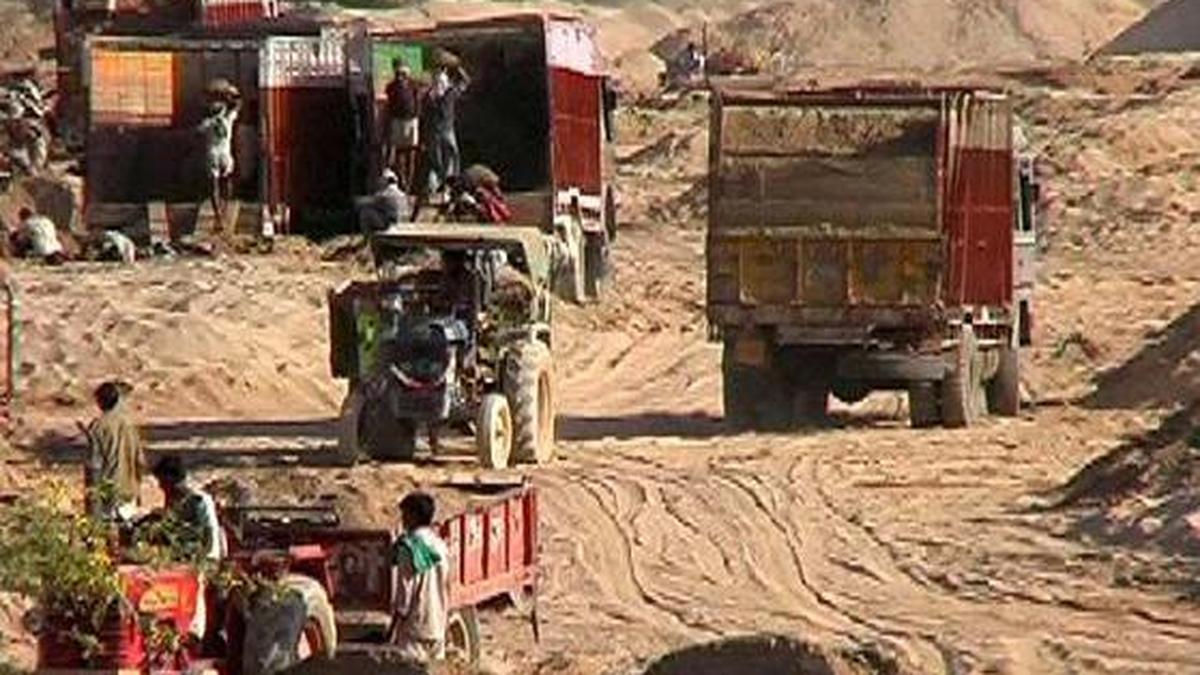
Reference image accompanying coverage of the CEC’s proposed three-year roadmap to phase out unsustainable sand extraction from active river channels—not a photograph of the committee’s proceedings.
Image: The Hindu
Why in news
The CEC submitted its recommendations to the Supreme Court on November 2 in a suo motu case concerning illegal sand mining in the National Chambal Sanctuary. The report proposes a phased transition towards manufactured sand, recycled construction and demolition waste, and scientifically recovered reservoir sediment.
3 years
Proposed phase-out roadmap
2002
CEC originally constituted
2023
CEC became a statutory body
Background
River sand forms part of a dynamic sediment system shaped by erosion, transport and deposition. It supports riverbed stability, aquatic habitats and exchanges between rivers and adjoining groundwater systems; it is not merely a construction input. Sand is a minor mineral under the Mines and Minerals (Development and Regulation) Act, 1957, with state governments empowered to make rules governing minor-mineral concessions. Mining permission does not displace applicable environmental and wildlife safeguards. The CEC, originally constituted in 2002 on the Supreme Court’s order and made a statutory body in 2023, examines environmental matters, including those referred to it by the Court.
What the CEC has proposed
The central recommendation is a time-bound roadmap to progressively phase out unsustainable extraction from active river channels over the next three years. It is not a reported blanket prohibition on all sand mining, nor does the supplied report establish that the Supreme Court has adopted the recommendations.
The proposed transition combines tighter regulation of extraction from permissible areas with adequate alternative supplies. Its underlying principle is to meet legitimate construction requirements without continuing ecologically damaging dependence on active river channels.
- Scientifically identify mineable stretches and conduct regular replenishment studies.
- Set sustainable extraction limits and enforce environmental safeguards.
- Digitally track mineral transportation and end-use.
- Promote M-sand through incentives and quality certification, and establish C&D waste-processing facilities.
- Initiate a national programme for scientific desiltation through coordination among the Centre, states, dam-owning agencies and the Ministry of Jal Shakti.
Infographic
Protect river functions
Safeguard sediment balance, groundwater links and habitats.
Set scientific limits
Use replenishment studies and site-specific ecological assessments.
Trace material flows
Verify extraction, transport and end-use through digital and field checks.
Scale safe substitutes
Develop certified M-sand, recycled aggregates and suitable reservoir material.
Manage the transition
Phase out unsustainable active-channel extraction through the proposed three-year roadmap.
AI-assisted infographic by Pragnya IAS Academy, based on the cited sources.
Why excessive extraction damages river systems
A river maintains a changing balance between water flow, sediment supply and channel form. When extraction exceeds sediment replenishment or occurs at sensitive locations, it can deepen the riverbed, destabilise banks and alter the channel. Such changes can also increase the vulnerability of bridges and other riverine infrastructure.
The CEC identifies groundwater depletion, aquifer loss and destruction of aquatic and riparian habitats among the impacts. Riverbed lowering can disturb river–aquifer exchanges, while removal of sandbars and disturbance of the bed can affect breeding, nesting and feeding habitats.
The National Chambal Sanctuary context adds a wildlife-conservation dimension. The Chambal is important habitat for species such as the gharial and Gangetic dolphin; protecting ecological processes and habitat continuity is therefore as important as controlling the volume removed.
- Sediment imbalance can cause riverbed degradation and bank instability.
- Changes in river morphology can alter flow patterns and infrastructure exposure.
- Disturbed river–groundwater interactions can affect adjoining water availability.
- Extraction can damage both aquatic habitats and vegetation along riverbanks.
Regulation must move from permits to ecological limits
The CEC states that there is no consolidated, reliable national database quantifying the volume or value of illegally extracted river sand. This limits the ability to assess the scale of violations, target enforcement and measure whether policy is reducing ecological damage.
A replenishment study should inform extraction limits rather than merely justify a lease. River stretches differ in sediment supply, seasonal behaviour and ecological sensitivity; decisions should therefore consider location, extraction depth, timing and cumulative impacts, not just an annual quantity.
The constitutional framework supports this approach through Article 21’s judicially recognised environmental dimension, Article 48A’s direction to the State to protect the environment, and Article 51A(g)’s environmental duty of citizens. A minor-mineral concession cannot override applicable environmental or wildlife-protection requirements.
- Link permissions to verified sediment replenishment and habitat sensitivity.
- Reconcile authorised extraction, dispatch, transport and recorded end-use.
- Combine digital records with field inspections and independent verification.
- Assess cumulative impacts across connected river stretches rather than treating every lease in isolation.
Alternatives need quality control and environmental scrutiny
Manufactured sand and recycled C&D materials can reduce pressure on river systems, but their suitability depends on processing, grading and quality assurance. Incentives should support reliable substitutes rather than simply shifting environmental costs to quarrying, crushing or waste-processing sites.
Scientific reservoir desiltation may provide usable construction material and support reservoir management. However, sediment suitability, contamination, extraction methods and downstream ecological effects require assessment; not all reservoir sediment is construction-grade sand.
The CEC also suggests permitting recovery of sand and other materials from floodplains. This must be read alongside its warning that excessive floodplain extraction damages river systems. Floodplains should not become an unrestricted substitute extraction zone.
- Use quality certification to build confidence in M-sand and recycled aggregates.
- Segregate C&D waste and test processed products for their intended construction uses.
- Evaluate reservoir sediment before recovery, processing and commercial use.
- Subject floodplain recovery to site-specific hydrological and ecological safeguards.
| Source | Potential contribution | Essential safeguard |
|---|---|---|
| Permissible river stretches | Regulated supply during the transition | Replenishment-based limits, habitat protection and verified compliance |
| Manufactured sand | Reduced dependence on river sand | Responsible sourcing, dust control and product certification |
| Recycled C&D waste | Recovery of sand and aggregates within a circular economy | Segregation, contaminant control and use-specific quality testing |
| Reservoir sediment | Alternative material through scientific desiltation | Sediment characterisation and assessment of operational and ecological effects |
| Floodplain material | Site-specific recovery proposed by the CEC | Protection of flood conveyance, groundwater functions and riparian habitats |
- 1. Map sediment conditions, ecological sensitivity and construction-material demand.
- 2. Identify permissible stretches and exclude ecologically incompatible extraction.
- 3. Use replenishment studies to set and periodically review extraction limits.
- 4. Track extraction, transport and end-use through verifiable digital records.
- 5. Scale certified M-sand, recycled C&D products and suitable reservoir sediment.
- 6. Audit ecological outcomes and adjust permissions and transition measures.
2002
The CEC was originally constituted on the Supreme Court’s order.
2023
The CEC became a statutory body.
November 2
The CEC submitted its report in the Supreme Court case concerning illegal sand mining in the National Chambal Sanctuary.
Proposed next three years
The recommended roadmap would progressively phase out unsustainable active-channel extraction while developing adequate alternatives.
Significance, challenges & way forward
Significance
- The proposal treats sand as part of river ecology rather than merely a marketable mineral.
- A phased transition seeks to reconcile river conservation with legitimate construction demand.
- Replenishment-based regulation can connect extraction permissions to the actual behaviour of river systems.
- Recycling C&D waste can reduce virgin-material demand and improve urban waste management.
- A coordinated approach can link mineral governance, wildlife protection, infrastructure safety and water security.
Challenges
- The absence of a reliable national estimate of illegal extraction weakens policy baselines and enforcement assessment.
- Sediment replenishment varies across locations and seasons, making uniform extraction norms inadequate.
- Digital tracking cannot establish sustainability if permits rely on weak ecological assessments or records are not independently verified.
- Alternative materials require dependable supply, processing capacity, quality assurance and acceptance by construction users.
- Unscientific reservoir desiltation or floodplain extraction could transfer ecological damage rather than prevent it.
- Coordination is required across mining, environment, water-resources, local-government and enforcement authorities.
Way forward
- Translate the proposed roadmap into state-specific milestones, without assuming that the recommendations are already binding directions.
- Create interoperable datasets on permits, permitted quantities, actual dispatch and verified end-use while strengthening estimates of illegal extraction.
- Institutionalise independently reviewed replenishment studies and cumulative river-stretch assessments.
- Use digital tracking alongside field inspections, community reporting and transparent disclosure of compliance.
- Expand certified substitutes through appropriate procurement specifications, processing facilities and market-development support.
- Apply site-specific safeguards to reservoir and floodplain recovery rather than treating either source as automatically sustainable.
- Measure progress through riverbed stability, habitat condition and groundwater interactions as well as enforcement activity.
Key terms
- Active river channel
- The part of a river system where flowing water actively transports and redistributes sediment.
- Sediment budget
- The balance between sediment entering, being stored in and leaving a river reach.
- Replenishment study
- An assessment of sediment renewal used to inform whether, where and how much material may be extracted.
- River morphology
- The physical form and structure of a river, including its bed, banks, bars and channel pattern.
- Riparian habitat
- The ecologically connected habitat along the banks of a river or other watercourse.
- Manufactured sand
- Sand produced by processing suitable rock into appropriately graded particles for construction.
- C&D waste
- Waste generated by construction and demolition activities that may yield usable materials after suitable processing.
Link with static syllabus
Prelims practice MCQs
Q1. With reference to the CEC’s recommendations on river sand mining, consider the following statements: 1. It proposed progressively phasing out unsustainable extraction from active river channels over three years. 2. It reported the availability of a consolidated, reliable national database quantifying illegal river-sand extraction. 3. It recommended digital tracking of mineral transportation and end-use. Which of the statements given above are correct?
Q2. Consider the following pairs: 1. Article 48A — Directive to the State to protect and improve the environment 2. Article 51A(g) — Fundamental duty concerning protection of the natural environment 3. Article 21 — Constitutional provision exclusively dealing with mineral concessions Which of the pairs given above are correctly matched?
Q3. With reference to sand as a mineral resource in India, consider the following statements: 1. Sand is classified as a minor mineral under the MMDR Act, 1957. 2. State governments are empowered to make rules governing minor-mineral concessions. 3. A minor-mineral concession automatically overrides applicable wildlife-protection requirements. Which of the statements given above are correct?
Q4. Which of the following best explains why replenishment studies are important for regulating river sand mining?
Mains practice questions
GS 3 · 15 marks · 250 words
Excessive river sand extraction is a problem of both ecological degradation and construction-material governance. Discuss with reference to the CEC’s proposed roadmap.
Frequently asked questions
Has the CEC proposed a complete ban on river sand mining?
The report proposes progressively phasing out unsustainable extraction from active river channels over three years while regulating extraction from permissible areas. The supplied source does not establish that the Supreme Court has adopted these recommendations.
Why can sand mining affect groundwater?
Excessive extraction can lower or disturb the riverbed and alter exchanges between the river and adjoining aquifers. The CEC identifies groundwater depletion and aquifer loss among the potential impacts.
Which alternatives to river sand does the report promote?
The CEC promotes manufactured sand, recycled C&D waste and material recovered through scientific reservoir desiltation. Their suitability depends on quality testing and source-specific environmental safeguards.
Is floodplain extraction automatically sustainable?
No. Although the CEC suggests permitting recovery of floodplain materials, it also warns that excessive floodplain extraction disrupts river systems; site-specific ecological and hydrological scrutiny remains necessary.
Sources
Analysis prepared by the Pragnya IAS Academy current-affairs desk with AI assistance from the cited reports. Verify figures with the original sources.
Turn current affairs into marks
Join Pragnya IAS Academy's mentorship for daily answer-writing evaluation on stories like this — classroom programmes from a trusted name in IAS coaching in Hyderabad.