
CEC’s River Sand Mining Roadmap: Sediment Balance, Enforcement and Alternatives
Revise the static topic: UPSC Environment notes
In short: The Central Empowered Committee has recommended a three-year roadmap to phase out unsustainable sand extraction from active river channels while developing alternative construction materials. Submitted to the Supreme Court, the proposal links river conservation with scientific extraction limits, stronger monitoring and reliable supplies of manufactured sand, reservoir sediment and recycled construction waste.
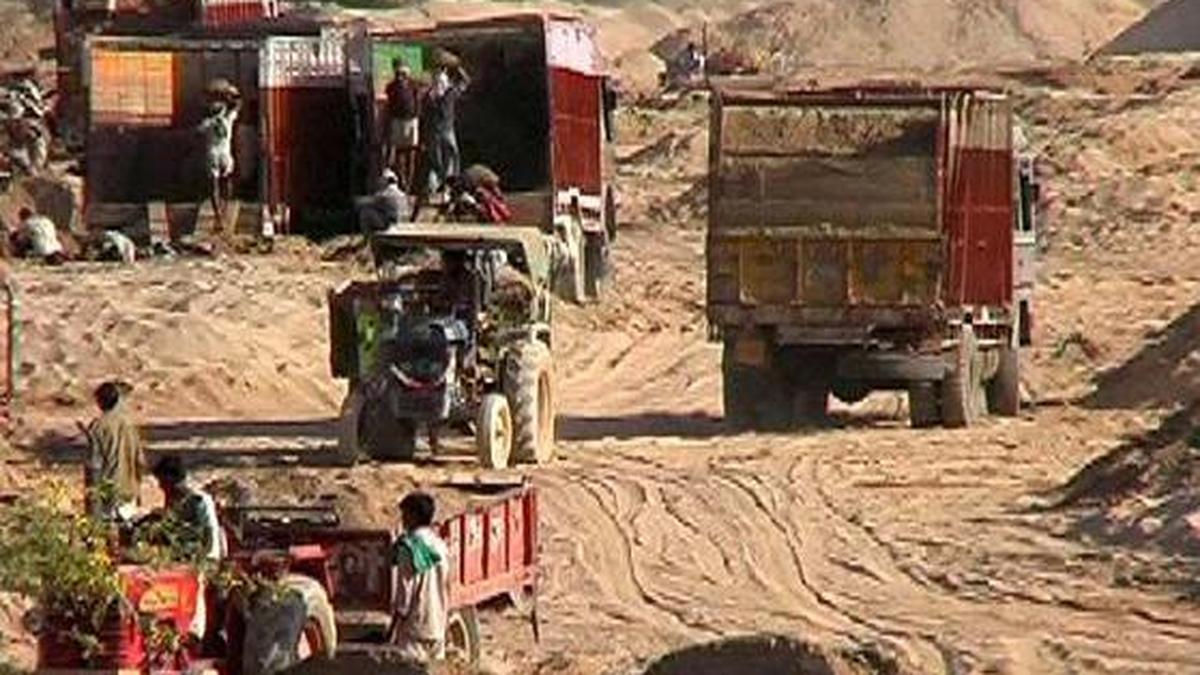
Reference view of river sand mining. The CEC’s proposed three-year roadmap links limits on unsustainable extraction with stronger monitoring and alternative construction materials.
Image: The Hindu
Why in news
The CEC submitted its recommendations to the Supreme Court on November 2 in a suo motu case concerning illegal sand mining in the National Chambal Sanctuary. These are committee recommendations, not a reported nationwide ban or an already operational phase-out order.
3 years
Proposed phase-out period
2002
CEC originally constituted
2023
CEC became a statutory body
Background
River sand is part of a moving sediment system shaped by erosion, transport and deposition; it is not merely a construction material stored in a channel. Active channels carry river flows, while adjoining floodplains accommodate periodic inundation and sediment exchange. Sand deposits help sustain riverbed form, aquatic habitats and exchanges between surface water and groundwater. Sand is regulated as a minor mineral under India’s mining framework, with state governments exercising important rule-making and enforcement responsibilities. Mining permissions do not displace applicable environmental and wildlife safeguards. The National Chambal Sanctuary is a protected river landscape across Madhya Pradesh, Rajasthan and Uttar Pradesh, associated with species such as the gharial and Gangetic river dolphin.
What the CEC has proposed
The CEC, originally formed on the Supreme Court’s order in 2002 and a statutory body since 2023, has proposed a time-bound transition away from unsustainable sand extraction in active river channels. Its formulation is not a blanket prohibition on every form of sand extraction: it also calls for stronger regulation of extraction from permissible areas.
The proposed transition combines ecological restrictions with supply-side measures so that legitimate infrastructure and construction requirements can be met. The source does not provide year-wise milestones; these would need to be developed in the roadmap.
- Identify mineable stretches scientifically and conduct regular replenishment studies.
- Determine sustainable extraction limits and apply environmental safeguards.
- Digitally track mineral transportation and end-use, backed by effective enforcement.
- Promote M-sand through incentives and quality certification, and establish C&D waste-processing facilities.
- Initiate a coordinated national programme for scientific desiltation of dams and reservoirs.
Infographic
Ecological limits
Protect sediment balance, habitats and river–aquifer links.
Scientific permissions
Use replenishment studies and cumulative-impact assessment.
Verified enforcement
Connect digital material tracking with field checks.
Responsible alternatives
Certify M-sand, recycled materials and suitable reservoir sediment.
Managed transition
Align the proposed three-year phase-out with supply and livelihood support.
AI-assisted infographic by Pragnya IAS Academy, based on the cited sources.
River ecology: why sediment balance is central
A river’s sediment budget reflects the material entering, moving through, being stored in and leaving a river reach. Extraction adds another removal pathway. When removal exceeds replenishment or disturbs critical locations, it can lower the riverbed, destabilise banks and alter channel form. The CEC identifies riverbed degradation, infrastructure vulnerability, groundwater depletion, aquifer loss and damage to aquatic and riparian habitats among the consequences.
Sustainable extraction cannot be determined by deposit volume alone. Sediment must also support downstream transport, channel stability and habitat functions. Replenishment varies with flows, catchment conditions and sediment trapping by dams; therefore, a replenishment estimate is not automatically an extraction entitlement.
- Riverbed lowering can undermine bridge foundations and other river-linked infrastructure.
- Altered bed levels can disturb river–aquifer exchanges and affect nearby groundwater conditions.
- Removal of sandbars and disturbance of banks can damage breeding, nesting and riparian habitats.
- Reach-level permissions should account for cumulative impacts across the river system.
Enforcement: move from permits to verifiable material flows
The CEC notes the absence of a consolidated, reliable national database quantifying either the volume or value of illegally extracted river sand. This limits the ability to establish a baseline, target enforcement and evaluate whether a phase-out actually reduces ecological pressure.
Digital tracking can connect authorised extraction with transport and end-use, but it cannot substitute for credible field verification. A valid-looking transit record does not by itself establish that sand came from a permitted location or remained within an ecologically defensible limit.
- Link extraction permissions, approved quantities, dispatch records and destination receipts.
- Verify digital records through site inspections, weighment checks and suitable remote monitoring.
- Coordinate mining, environment, water resources, police and local administrative authorities.
- Use independent replenishment assessments and public disclosure to reduce conflicts of interest.
- Track river condition alongside seizures and permit compliance when assessing enforcement outcomes.
Alternatives: reduce river pressure without shifting environmental damage
The CEC recommends M-sand, recycled C&D waste and reservoir sediment as alternative sources. It also suggests permitting recovery of sand and other materials from floodplains. These options require differentiated safeguards: floodplains remain integral to river ecology and cannot be treated as automatically low-impact extraction zones.
M-sand can reduce direct dependence on river sand, but its environmental performance depends on responsible rock sourcing, dust control and processing practices. Recycled C&D materials require segregation, processing and quality assurance suited to their intended use. Neither alternative should be accepted or rejected solely on its label.
Scientific reservoir desiltation may provide usable material and support storage management, but sediment composition, contamination, transport costs and ecological effects require site-specific assessment. Extracting sediment from a reservoir for construction is not equivalent to restoring downstream sediment continuity.
- Certify construction materials for their intended engineering applications.
- Assess the full environmental footprint of substitute materials, including transport.
- Protect floodplain functions and apply applicable environmental and wildlife safeguards.
- Distinguish saleable reservoir sediment from material requiring treatment or safe disposal.
Making the three-year transition credible
The roadmap’s strength is its recognition that enforcement and material substitution must proceed together. Restricting river supply without developing dependable alternatives could create shortages, raise costs and strengthen incentives for illegal extraction. Conversely, increasing alternative production without curbing unlawful mining may merely expand total supply without restoring rivers.
A credible implementation design should sequence ecological assessment, alternative-supply development and progressively tighter controls, while enforcing existing prohibitions immediately. Progress should be measured through traceable supply and ecological recovery, not only the closure of mining sites.
- Prepare state-specific construction-material demand and supply assessments.
- Prioritise protection of ecologically sensitive and legally restricted reaches.
- Use quality-assured alternatives in suitable public works to build reliable demand.
- Provide transition support for affected workers and legitimate small enterprises.
- Publish milestones, responsible agencies and independently verifiable outcomes.
| Source | Potential contribution | Essential safeguard |
|---|---|---|
| Manufactured sand | Reduces direct dependence on river sand through processed rock-based material | Responsible quarrying, dust control and application-specific quality certification |
| Recycled C&D waste | Recovers sand and aggregates while reducing disposal burdens | Segregation, contaminant control, testing and use-specific standards |
| Reservoir sediment | May supply usable construction material through scientific desiltation | Assess sediment quality, ecological effects, transport viability and downstream implications |
| Floodplain material | Suggested by the CEC as an additional recovery source | Protect flood storage, habitats and river–aquifer connectivity; avoid indiscriminate excavation |
- 1. Map river ecology, sediment conditions and applicable legal restrictions.
- 2. Assess replenishment and cumulative impacts before identifying permissible extraction.
- 3. Set conservative extraction limits, safeguards and review conditions.
- 4. Develop certified alternative materials and reliable market access.
- 5. Trace extraction, transportation and end-use through verified records.
- 6. Progressively phase out unsustainable channel extraction and audit ecological outcomes.
2002
The CEC was originally formed on the Supreme Court’s order.
2023
The CEC became a statutory body.
November 2
The CEC submitted its report in the Supreme Court case concerning illegal sand mining in the National Chambal Sanctuary.
Proposed three-year transition
The CEC recommends progressively phasing out unsustainable extraction from active river channels alongside developing adequate alternatives.
Significance, challenges & way forward
Significance
- The proposal treats sand as a functional component of river ecosystems rather than only a marketable mineral.
- A planned transition can reconcile construction demand with protection of channels, aquifers and riverine habitats.
- Recycled construction materials can connect mineral conservation with urban waste management and circular-economy objectives.
- Scientific regulation can reduce risks to bridges, embankments and other infrastructure exposed to riverbed degradation.
- Centre–state coordination can connect reservoir management, construction-material policy and environmental enforcement.
Challenges
- The absence of reliable national illegal-mining data weakens baseline assessment and progress measurement.
- Seasonal and spatial variation in sediment replenishment complicates the setting of defensible extraction limits.
- Fragmented responsibilities can create gaps between mining permissions, transport monitoring and environmental protection.
- Alternative materials may face uneven availability, quality concerns and transport-related costs.
- Poorly designed substitution could shift ecological pressure from rivers to quarries, floodplains or reservoirs.
- An abrupt supply contraction without worker support and alternative capacity could encourage illegal markets.
Way forward
- Translate the proposal into state-specific, publicly disclosed milestones without presenting the recommendation as an enacted blanket ban.
- Base extraction decisions on river-reach sediment budgets, ecological sensitivity and cumulative basin-level impacts.
- Create interoperable mineral-flow records and verify them through independent audits and field inspections.
- Develop certified M-sand and recycled C&D material supply chains, supported by appropriate public procurement.
- Undertake reservoir sediment recovery only after evaluating material suitability, ecological effects and economic viability.
- Ensure livelihood transition measures accompany tighter controls and evaluate success through river health as well as compliance.
Key terms
- Active river channel
- The part of a river system regularly occupied and reshaped by flowing water and sediment movement.
- Sediment budget
- An accounting of sediment inputs, outputs and changes in storage within a defined river reach or basin.
- Replenishment study
- An assessment of sediment deposition and renewal used to inform extraction decisions alongside ecological safeguards.
- Riverbed degradation
- Lowering of the riverbed through net sediment removal, potentially destabilising banks and infrastructure.
- Riparian habitat
- The ecological zone along riverbanks influenced by interactions between land and flowing water.
- M-sand
- Manufactured sand produced by crushing and processing suitable rock for construction applications.
- C&D waste
- Construction and demolition waste, parts of which can be processed into reusable sand and aggregates.
- Suo motu proceedings
- Proceedings initiated by a court on its own motion.
Link with static syllabus
Prelims practice MCQs
Q1. With reference to the CEC’s proposed river sand mining roadmap, consider the following statements: 1. It recommends a three-year phase-out of unsustainable extraction from active river channels. 2. It constitutes an already operative nationwide ban on all sand extraction. 3. It recommends developing alternatives while meeting legitimate construction requirements. Which of the statements given above are correct?
Q2. Which of the following best describes a river sediment budget?
Q3. Consider the following statements about alternative construction materials: 1. M-sand can reduce direct dependence on river sand, but its production requires environmental safeguards. 2. Reservoir desiltation automatically restores sediment supply to downstream river reaches. 3. C&D waste-derived materials require processing and quality checks appropriate to their intended use. Which of the statements given above are correct?
Q4. With reference to the Central Empowered Committee, consider the following statements: 1. It was originally formed in 2002 on the Supreme Court’s order. 2. It became a statutory body in 2023. 3. Its reported sand-mining recommendations arose in a case concerning the National Chambal Sanctuary. Which of the statements given above are correct?
Mains practice questions
GS 3 · 15 marks · 250 words
Evaluate the CEC’s proposed three-year roadmap to phase out unsustainable sand extraction from active river channels. How can India protect sediment balance while meeting construction demand?
Frequently asked questions
Has the Supreme Court banned all river sand mining for three years?
The supplied report does not establish such a ban. It describes a CEC recommendation to prepare a three-year roadmap for phasing out unsustainable extraction from active river channels.
Why is a replenishment study not enough to determine allowable extraction?
Newly deposited sediment also sustains habitats, channel stability and downstream transport. Extraction limits must therefore consider ecological functions, cumulative impacts and legal restrictions, not merely deposited volume.
Is M-sand automatically an environmentally sustainable substitute?
No. It can reduce river extraction, but responsible quarrying, pollution control, transport efficiency and construction-quality certification remain necessary.
What is the main risk in treating floodplains as an alternative sand source?
Floodplains support flood storage, habitats and river–groundwater interactions. Poorly regulated recovery could shift ecological damage out of the active channel rather than resolve it.
Sources
Analysis prepared by the Pragnya IAS Academy current-affairs desk with AI assistance from the cited reports. Verify figures with the original sources.
Turn current affairs into marks
Join Pragnya IAS Academy's mentorship for daily answer-writing evaluation on stories like this — classroom programmes from a trusted name in IAS coaching in Hyderabad.