
COP31 Deadlock: Fossil Fuel Phase-out, Climate Finance and India’s Equity Case
Revise the static topic: UPSC Environment notes
In short: According to the supplied reports, COP31 in Antalya, Türkiye, ended without an agreed overarching cover decision after countries split over fossil fuel phase-out language and climate finance. The impasse exposes the difficulty of combining science-based mitigation with equitable burden-sharing, predictable finance and nationally determined energy transitions. Failure to adopt the cover text does not terminate the Paris Agreement or necessarily invalidate progress on separate negotiating tracks.
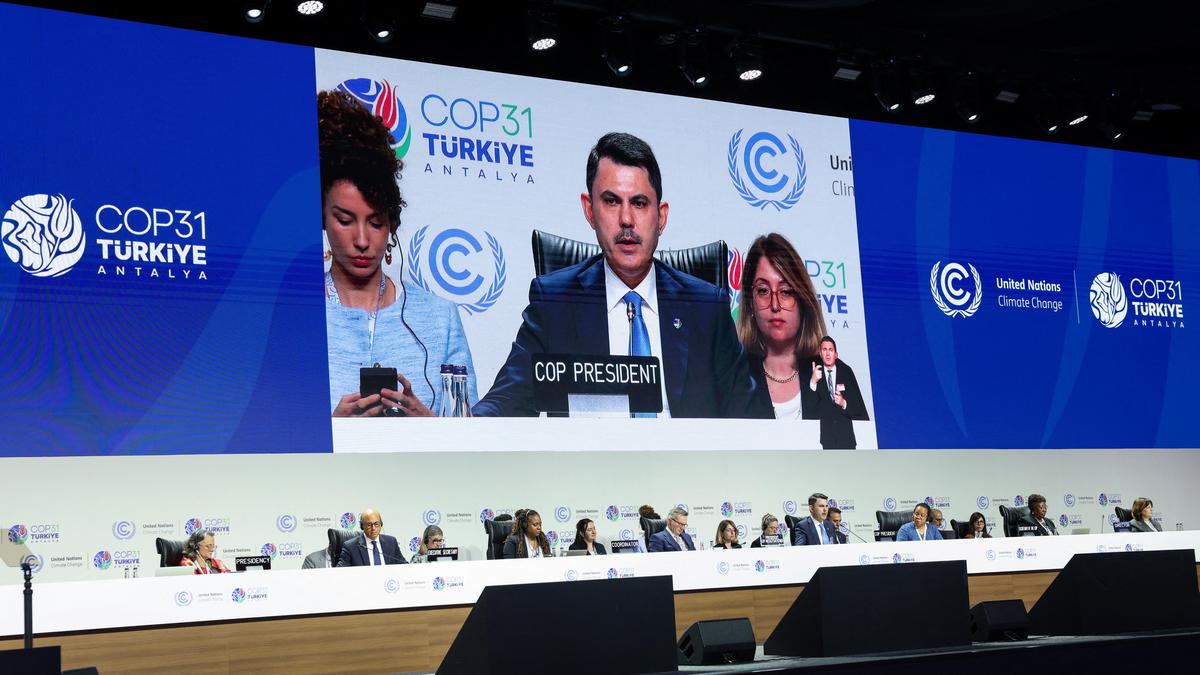
Photo from the source report: COP31 Deadlock: Fossil Fuel Phase-out, Climate Finance and India’s Equity Case
Image: The Hindu
Why in news
The Hindu reports that COP31 concluded on November 22, 2026, without adoption of its proposed Antalya Pact, despite extended negotiations. The EU and other parties opposed the absence of explicit fossil fuel transition language, while India and the Like Minded Developing Countries stressed equity and means of implementation.
About 130
Countries reportedly backing fossil fuel language
48 hours
Overtime reported in the news account
35%
Proposed electricity share in final energy by 2035
1.5°C
Paris temperature goal central to the dispute
Background
The United Nations Framework Convention on Climate Change provides the institutional foundation for international climate cooperation. Its Conference of the Parties brings governments together to negotiate collective action, while the Paris Agreement combines common temperature goals with nationally determined contributions. Equity and common but differentiated responsibilities and respective capabilities recognise that countries differ in historical responsibility, resources and development needs. Developed countries have obligations to provide financial resources to assist developing countries with mitigation and adaptation. A COP cover decision supplies overarching political direction; it is distinct from the underlying treaties and from decisions adopted on individual agenda items.
What failed at COP31—and what did not
The reported breakdown concerned the overarching cover decision, referred to as the Antalya Pact. The EU, Panama and other parties rejected a draft that lacked explicit language on moving away from fossil fuels. India, China and Saudi Arabia opposed prescriptive fossil fuel targets and were willing to proceed with the proposed text, notwithstanding concerns about finance and equity.
The editorial reports some progress on the Just Transition track but provides no detailed provisions. It also describes a proposed electrification target under which electricity would account for 35% of global final energy consumption by 2035. This must be treated as a proposal, not an adopted COP31 commitment.
- The absence of a cover decision is a political setback, not the legal dissolution of the Paris Agreement.
- The supplied material does not establish that every negotiating track failed.
- The electrification proposal concerned final energy consumption, not the renewable share of electricity generation.
Infographic
Ambition
Maintain a science-based direction for emissions reductions.
Equity
Reflect historical responsibility, capability and development needs.
Finance
Provide predictable mitigation and adaptation support.
Just transition
Protect workers, livelihoods and affordable energy access.
Delivery
Convert national pathways into measurable implementation.
AI-assisted infographic by Pragnya IAS Academy, based on the cited sources.
Consensus: inclusive legitimacy, constrained ambition
Consensus gives developing countries and vulnerable states a meaningful voice in decisions that affect their economies and survival. It also helps prevent powerful states from imposing transition obligations without addressing development needs or financing costs.
However, formal objections can prevent adoption even when a large coalition supports stronger action. Negotiators may therefore gravitate towards ambiguous language or a lowest-common-denominator outcome. Consensus is not the same as a recorded unanimous vote: the practical test is whether a decision can be adopted without a sustained formal objection.
The COP31 dispute also shows that resistance to consensus is not necessarily resistance to climate action. Parties may reject a weak text to protect environmental integrity, while others may resist prescriptive targets because they consider the accompanying support inadequate.
- No country possesses a specially allocated veto comparable to that in the UN Security Council.
- Consensus can nevertheless give an objecting party substantial blocking power.
- Improved negotiation design can reduce deadlock, but procedural changes cannot substitute for agreement on costs and responsibilities.
Equity and finance: the missing bridge
India and the Like Minded Developing Countries argued that the draft inadequately reflected historical responsibility and differentiated obligations. Their central claim was that a shrinking global carbon budget cannot be discussed independently of the emissions that depleted it and the unequal capacities available for transition.
This is not a blanket exemption from mitigation. Under the Paris framework, all parties participate through nationally determined contributions, while differentiation recognises national circumstances and capacities. Equity requires developed countries to lead and provide support; environmental effectiveness requires credible action by all major emitters.
Finance is therefore a condition of implementation, not a separate diplomatic concession. Renewable deployment requires investment in grids, storage, land and system integration. Adaptation finance addresses a different need: protecting people and infrastructure against climate impacts that emissions reductions alone cannot immediately prevent.
- The supplied reports identify uncertainty over adaptation finance but do not establish a new agreed finance amount.
- Predictability, accessibility and the terms of finance matter alongside its headline volume.
- Historical responsibility and present mitigation capability should inform burden-sharing together.
Fossil fuels, electrification and carbon capture
A fossil fuel phase-out signals eventual elimination of specified fossil fuel use, whereas a phase-down signals progressive reduction without necessarily fixing an endpoint. The scope, timetable, treatment of residual emissions and financing arrangements determine the practical meaning of either commitment.
Electrification can reduce direct fossil fuel use in transport, industry and buildings. Its climate benefit, however, depends on the electricity supply becoming cleaner, alongside efficiency gains and reliable infrastructure. An electricity-share target alone is not equivalent to a fossil fuel phase-out.
Panama criticised the draft’s reliance on carbon capture, utilisation and storage, while the editorial cautioned against dismissing carbon capture altogether. A balanced assessment treats CCUS as a potentially useful tool for selected hard-to-abate activities, not a substitute for reducing avoidable fossil fuel dependence.
- CCUS performance depends on capture effectiveness, energy requirements, lifecycle emissions and durable storage.
- Utilising captured carbon does not automatically ensure permanent sequestration.
- Technology-neutral assessment should not become an excuse for technology-based delay.
Implications for India’s transition strategy
India’s reported position linked ambition to finance, technology and capacity-building, while insisting that energy transitions remain nationally determined, just and equitable. The reports also identify food security, livelihoods and cultural practices as concerns reflected in discussions on methane.
India must reconcile affordable and reliable energy with lower-emission development. Its strongest negotiating position would combine demands for developed-country support with credible domestic implementation through clean power, storage, grid modernisation, efficiency and worker-centred transition planning.
India should avoid treating all fossil fuel dependence as identical. Development needs, energy access and employment vulnerabilities require a different policy response from avoidable carbon lock-in. Defending policy space is most persuasive when accompanied by a transparent account of transition needs, financing gaps and measurable progress.
- Seek support for adaptation as well as mitigation, rather than allowing clean-energy investment to dominate finance discussions.
- Protect coal-dependent workers, local communities and affected regional economies.
- Evaluate methane measures in light of agricultural livelihoods while pursuing feasible emissions reductions.
- Build issue-based coalitions with vulnerable countries on accessible finance and equitable implementation.
| Issue | Positions reported | Possible bridge |
|---|---|---|
| Fossil fuel language | EU and other parties sought explicit transition language; India, China and Saudi Arabia opposed prescriptive targets. | A clear collective direction with differentiated national pathways and implementation support. |
| Historical responsibility | LMDC argued that equity and developed-country obligations were inadequately reflected. | Connect mitigation expectations with responsibility, capability and development needs. |
| Climate finance | Developing countries raised concerns about means of implementation and adaptation finance. | Predictable support, transparent accounting and easier access for vulnerable countries. |
| Electrification | The presidency pursued an electricity-share proposal as a headline outcome. | Link electrification with cleaner electricity, efficiency, storage and grid investment. |
| CCUS | Panama criticised excessive reliance on CCUS; the editorial opposed dismissing carbon capture outright. | Use independently assessed applications without substituting them for direct emissions reductions. |
- 1. Countries seek a collective signal for stronger emissions reductions.
- 2. Parties disagree over prescriptive fossil fuel transition language.
- 3. Developing countries demand stronger equity provisions and implementation support.
- 4. Unresolved finance concerns weaken trust in the proposed compromise.
- 5. Formal objections prevent consensus on the cover decision.
- 6. National implementation and separate negotiating tracks remain relevant despite the political impasse.
Early in COP31 proceedings
According to the editorial, the leadership advanced a cover text centred on a global electrification proposal.
During concluding negotiations
The EU and other parties demanded explicit fossil fuel language, while LMDC stressed equity, historical responsibility and implementation support.
November 22, 2026
The supplied news report states that COP31 ended without consensus on the cover decision after extended negotiations.
Significance, challenges & way forward
Significance
- The impasse exposes the limits of negotiating ambition without resolving who finances implementation.
- The dispute tests whether consensus can deliver credible climate action while protecting equitable participation.
- The rejection of a weak text highlights the tension between securing an agreement and preserving its environmental integrity.
- For India, the outcome reinforces the need to combine diplomatic demands for equity with demonstrable domestic transition progress.
- The distinction between a failed cover decision and continuing treaty obligations prevents misleading claims that global climate law has collapsed.
Challenges
- Historical responsibility, present emissions and development needs generate competing interpretations of a fair transition.
- Unclear finance commitments weaken confidence that stronger mitigation obligations can be implemented equitably.
- Renewable integration requires complementary spending on storage, transmission, distribution and system flexibility.
- Poorly managed transition policies can disrupt employment, public revenues and livelihoods in fossil-dependent regions.
- Overreliance on future technological solutions can prolong carbon-intensive investment.
- Fragmented cooperation outside the COP process may leave poorer countries without adequate influence or support.
Way forward
- Negotiate mitigation ambition and implementation support as a connected package rather than sequential bargains.
- Retain a science-based collective direction while allowing differentiated national pathways consistent with equity and rising ambition.
- Strengthen finance transparency by clearly identifying grant support, lending terms, accessibility and delivery.
- Give adaptation finance greater predictability and align access procedures with the capacities of vulnerable countries.
- Use transparent consultations and earlier text development to narrow disagreements before the closing plenary.
- Allow voluntary sectoral cooperation to complement, not replace, the inclusive UN climate framework.
- For India, integrate clean-energy expansion with grid investment, efficiency, livelihood protection and credible monitoring.
Key terms
- Cover decision
- An overarching COP political decision that frames the conference outcome rather than resolving only one agenda item.
- Consensus
- A decision-making practice based on adoption without a sustained formal objection, rather than a majority vote.
- CBDR-RC
- Common but differentiated responsibilities and respective capabilities recognise shared climate duties alongside unequal responsibilities and capacities.
- Means of implementation
- Finance, technology development and transfer, and capacity-building that enable climate action.
- Global carbon budget
- The cumulative carbon dioxide emissions compatible with a specified warming limit and likelihood, subject to scientific assumptions.
- Just transition
- A shift towards a low-emission economy that protects workers, communities, livelihoods and equitable access to opportunities.
- Final energy consumption
- Energy consumed by end users, distinguished from primary energy supply and electricity generation.
- CCUS
- Carbon capture, utilisation and storage involves capturing carbon dioxide for use or storage; climate benefits depend on lifecycle performance and permanence.
Link with static syllabus
Prelims practice MCQs
Q1. With reference to COP cover decisions, consider the following statements: 1. They provide overarching political direction to a climate conference outcome. 2. Failure to adopt a cover decision automatically terminates the Paris Agreement. 3. Their non-adoption necessarily means that no progress occurred on any separate negotiating track. Which of the statements given above is/are correct?
Q2. Consider the following statements about common but differentiated responsibilities and respective capabilities: 1. It recognises differences in countries’ responsibilities and capacities. 2. It permanently exempts developing countries from all mitigation action under the Paris Agreement. 3. It is relevant to debates over developed-country leadership and climate finance. Which of the statements given above are correct?
Q3. An increase in electricity’s share of final energy consumption necessarily establishes which of the following?
Q4. With reference to carbon capture, utilisation and storage, consider the following statements: 1. Utilisation of captured carbon dioxide always results in permanent storage. 2. Capture processes may require additional energy. 3. Climate benefits depend partly on lifecycle emissions and storage permanence. Which of the statements given above are correct?
Mains practice questions
GS 3 · 15 marks · 250 words
The reported COP31 deadlock demonstrates that climate ambition cannot be separated from equitable implementation. Discuss the limits of consensus-based negotiations and suggest an approach for India.
Frequently asked questions
Did the reported COP31 failure end the Paris Agreement?
No. Failure to adopt an overarching cover decision does not terminate the Paris Agreement or automatically invalidate decisions taken on separate agenda items.
Why did India resist prescriptive fossil fuel targets?
The reports describe India as seeking nationally determined, just and equitable transitions backed by finance, technology and capacity-building. Its position linked stronger ambition to development needs and credible means of implementation.
Was the proposed electrification target adopted?
The supplied editorial describes a proposal for electricity to provide 35% of global final energy consumption by 2035. Because the cover text was not adopted, it should not be presented as an agreed COP31 commitment.
Does consensus give every country a formal veto?
There is no specially allocated veto of the kind found in the UN Security Council. However, a sustained formal objection can prevent consensus and give an individual party substantial blocking power.
Sources
- The Hindu: COP31 talks fail as EU, others reject any climate deal without language on a fossil fuel phase-out
- The Hindu: Fatal disagreement: on the COP31 summit
- The Hindu: COP31 ends without a deal: Is global climate diplomacy breaking? | The Hindu Analysis
- Indian Express: COP31 ends without climate deal. Why, and what does that mean for India?
Analysis prepared by the Pragnya IAS Academy current-affairs desk with AI assistance from the cited reports. Verify figures with the original sources.
Turn current affairs into marks
Join Pragnya IAS Academy's mentorship for daily answer-writing evaluation on stories like this — classroom programmes from a trusted name in IAS coaching in Hyderabad.