
COP31 Deadlock: Fossil-Fuel Transition, Climate Finance and India’s Equity Stand
Revise the static topic: UPSC Environment notes
In short: According to the supplied reports, COP31 in Antalya, Türkiye, ended without agreement on its overarching cover decision after the EU, Panama and other parties opposed the omission of explicit fossil-fuel transition language. India supported the proposed text while seeking stronger recognition of equity and implementation support, exposing the unresolved bargain between mitigation ambition, development needs and climate finance.
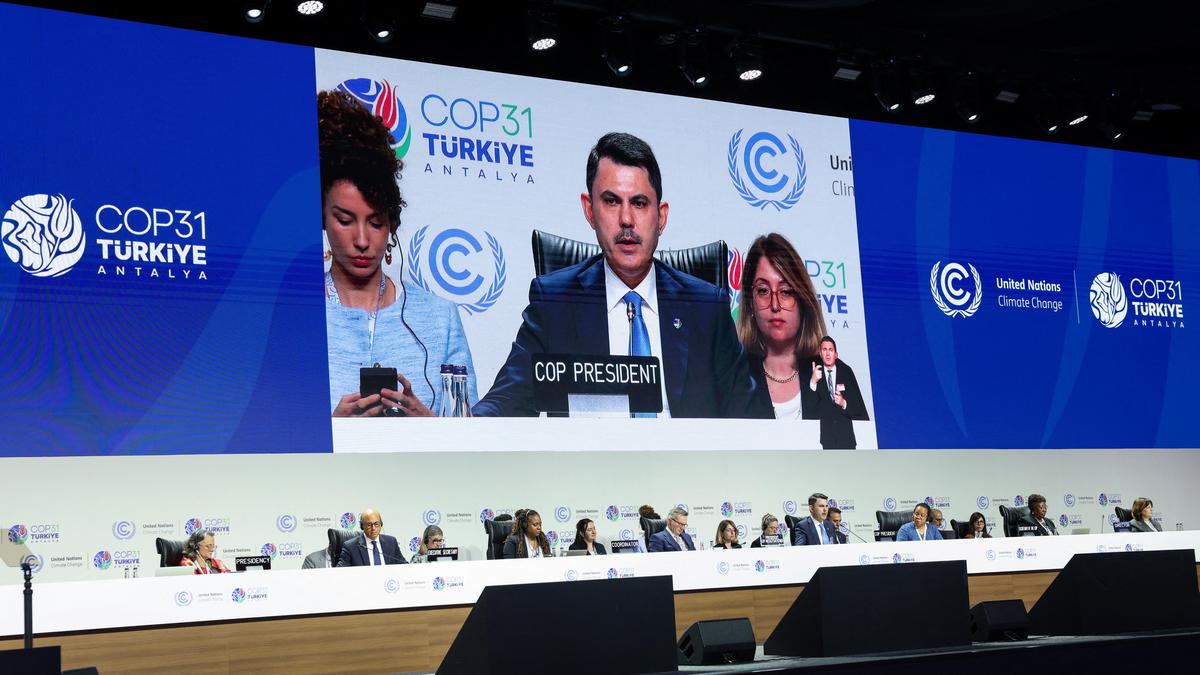
Photo from the source report: COP31 Deadlock: Fossil-Fuel Transition, Climate Finance and India’s Equity Stand
Image: The Hindu
Why in news
The supplied reports state that objections prevented adoption of the proposed Antalya Pact on November 22, 2026, despite extended negotiations. Disputes centred on fossil fuels, adaptation finance and the responsibilities of developed and developing countries.
About 130
Parties reportedly backing objections
48 hours
Overtime reported at the conclusion
35%
Proposed electricity share in final energy consumption by 2035
About 21%
Current electricity share cited in the report
$120 billion
Adaptation-finance target reportedly removed from the draft
1.5°C
Paris Agreement warming limit pursued
Background
The United Nations Framework Convention on Climate Change provides the institutional foundation for international climate cooperation. Its Conference of the Parties brings governments together to review implementation and negotiate collective action. The Paris Agreement combines nationally determined contributions with transparency, periodic global assessment and support for developing countries. Equity and common but differentiated responsibilities and respective capabilities recognise that countries share responsibility for climate protection but differ in historical contributions, capacities and development circumstances. The global stocktake outcome agreed in Dubai in 2023 called for transitioning away from fossil fuels in energy systems in a just, orderly and equitable manner.
What failed: the overarching political bargain
The immediate failure concerned the proposed cover decision, called the Antalya Pact. A cover decision frames the overall political outcome of a climate conference; it is not itself a replacement for the UNFCCC or the Paris Agreement. Its non-adoption does not terminate existing treaty obligations, nor does it establish that every separate negotiating item failed.
The EU and Panama formally objected because the draft did not explicitly mention fossil fuels or provide the transition signal they considered necessary. India, China and Saudi Arabia supported moving forward with the text, while also raising concerns about finance and the treatment of equity.
- The draft recalled the United Arab Emirates Consensus without explicitly restating its fossil-fuel transition language.
- It proposed expanding electrification and carbon capture, but these provisions did not resolve the dispute over reducing fossil-fuel dependence.
- The removal of a proposed adaptation-finance target and uncertainty over the baseline for increasing support deepened developing-country dissatisfaction.
Infographic
Ambition
Clear transition direction and measurable emissions reductions.
Equity
Differentiate pathways by responsibility, capability and development needs.
Finance
Deliver predictable support with clear baselines and accounting.
Implementation
Combine clean power, technology, capacity-building and livelihood protection.
Trust
Use inclusive negotiations and transparent reporting to sustain consensus.
AI-assisted infographic by Pragnya IAS Academy, based on the cited sources.
UNFCCC consensus: legitimacy without an easy fallback
Substantive climate decisions are generally adopted by consensus. The draft procedural rule governing voting on substantive matters remains unresolved, leaving no generally accepted majority-voting fallback for ordinary substantive decisions. Consensus ordinarily means adoption without a sustained formal objection; it is not a recorded affirmative vote by every party.
No country holds a special veto comparable to that of a permanent member of the UN Security Council. Nevertheless, an explicit objection can obstruct consensus in practice. This distinction explains how the EU and Panama could prevent adoption without possessing a separately conferred veto power.
Consensus protects sovereign equality and gives vulnerable and developing countries a voice. However, it can also encourage lowest-common-denominator wording, prolonged bargaining and the withholding of agreement across linked issues. Moving towards voting would itself require a difficult procedural agreement.
- Consensus is a decision-making practice, not proof that every party finds every clause satisfactory.
- A quorum concerns the minimum participation needed to conduct business; it is distinct from the method of adopting a decision.
- Transparent drafting and early consultation can improve consensus-building without weakening participation.
Fossil fuels, electrification and carbon capture
The dispute was not merely semantic. Explicit fossil-fuel language can guide national planning, investment and accountability. However, the previously agreed formulation of transitioning away from fossil fuels is not identical to a universal phase-out deadline. A scientifically credible agreement must address emissions while recognising different national starting points.
The proposed electrification goal concerned electricity’s share in total final energy consumption, not the renewable share of electricity generation. Electrification can improve efficiency and enable cleaner energy use, but its climate benefit depends on the electricity mix, the technology replaced and system-wide emissions.
Carbon capture and storage can address some difficult industrial emissions, but it cannot be treated as a universal substitute for reducing fossil-fuel use. Its contribution depends on capture performance, energy requirements, costs, reliable storage and monitoring. Capturing emissions at an industrial source is also different from removing carbon dioxide already present in the atmosphere.
- Pair electrification with cleaner generation, transmission, storage and demand-side efficiency.
- Assess carbon capture through verified emissions avoided rather than installed capacity alone.
- Avoid presenting a reference to an earlier decision as equivalent to a new implementation pathway.
Climate finance: obligation, adequacy and accountability
Under the Paris Agreement, developed-country parties shall provide financial resources to assist developing-country parties with mitigation and adaptation, continuing their obligations under the Convention. Other parties are encouraged to provide support voluntarily. This differentiated legal structure should not be confused with an identical financing obligation for all countries.
The reports identify the removal of a proposed $120 billion adaptation-finance target and the absence of a clear baseline for scaling up adaptation support. These were negotiating demands and draft provisions, not a newly adopted obligation. Without a baseline, timeframe and accounting method, a promise to multiply finance is difficult to verify.
For developing countries, the quality of finance matters alongside its volume. Predictable, accessible support is particularly important for adaptation, where many essential public investments do not generate commercial returns. Mobilised private capital cannot automatically substitute for developed-country public support.
- Distinguish finance promised, finance committed and finance actually disbursed.
- Clarify the balance between grants and loans and between mitigation and adaptation.
- Treat technology transfer and capacity-building as integral means of implementation.
India’s position: equitable transition, not exemption from action
India argued that ambition must be accompanied by finance, technology and capacity-building. Its stated position favoured nationally determined, just and equitable energy transitions, while seeking protection for food security, livelihoods and cultural practices in methane-related action.
Speaking for the Like Minded Developing Countries, India’s delegation questioned whether the draft adequately reflected historical responsibility and the unequal use of the global carbon budget. These concerns draw on equity and common but differentiated responsibilities and respective capabilities.
India’s development and energy-access concerns are not identical to the commercial interests of fossil-fuel exporters, even where negotiating positions overlap. A credible Indian approach should combine differentiated responsibilities with measurable domestic decarbonisation, resilience and support for workers and communities affected by transition.
- Equity concerns the fair distribution of effort; it does not remove the responsibility of developing countries to act.
- Nationally determined pathways operate within the Paris Agreement’s collective goals and accountability framework.
- India can bridge negotiating divides by linking transition commitments to credible delivery of implementation support.
| Issue | Reported division | UPSC analytical takeaway |
|---|---|---|
| Fossil-fuel language | EU and Panama sought explicit action; India, China and Saudi Arabia accepted the proposed wording. | Transition direction, implementation pathways and phase-out deadlines are different negotiating questions. |
| Consensus | Formal objections blocked the proposed cover decision. | There is no special national veto, but objections can prevent consensus. |
| Electrification | The draft proposed increasing electricity’s share without an explicit renewable-only condition. | Electricity consumption share is not the same as renewable generation share. |
| Adaptation finance | Developing countries criticised removal of a target and unclear scaling baselines. | Finance commitments require measurable baselines, delivery schedules and transparent accounting. |
| Carbon capture | The draft promoted capture technologies; critics feared continued fossil-fuel dependence. | Targeted industrial use must be distinguished from economy-wide decarbonisation. |
| Equity | LMDC sought stronger recognition of historical responsibility and implementation support. | Differentiation should enable greater ambition rather than become a justification for indefinite delay. |
- 1. Parties negotiate positions across mitigation, adaptation, finance and implementation support.
- 2. The presidency consolidates proposals into a draft cover decision.
- 3. Consultations seek to resolve objections and balance linked demands.
- 4. The draft is presented to the plenary for consensus adoption.
- 5. Without sustained formal objections it can be adopted; unresolved objections require further negotiation or leave it unadopted.
2023
The Dubai global stocktake outcome called for transitioning away from fossil fuels in energy systems.
November 20, 2026
COP31 was scheduled to conclude, according to the supplied reports, but negotiations continued.
November 21, 2026
Walkout threats prompted efforts by Türkiye and Australia to broker a compromise between the EU and Saudi Arabia.
November 22, 2026
A revised cover text omitted explicit fossil-fuel language; objections prevented its adoption.
Significance, challenges & way forward
Significance
- The deadlock exposes the inseparability of fossil-fuel transition commitments and credible implementation support.
- Failure to reaffirm a clear transition direction risks weakening confidence in the continuity of collective climate commitments.
- Adaptation-finance uncertainty has immediate implications for vulnerable communities facing climate impacts.
- The dispute highlights India’s potential role in connecting climate ambition with development-sensitive burden-sharing.
- Existing treaties remain in force despite the failure of the proposed cover decision.
Challenges
- Consensus protects participation but allows entrenched disagreements to obstruct collective action.
- Countries differ in energy access, fiscal capacity, fossil-fuel dependence and historical emissions.
- Finance pledges without clear baselines and delivery rules can conceal implementation gaps.
- Electrification without parallel power-sector decarbonisation may retain substantial emissions.
- Overreliance on uncertain future carbon capture can delay readily available emissions reductions.
- A temporary exceedance of a warming threshold must not be confused with a definitive assessment of long-term warming under the Paris temperature goal.
Way forward
- Combine explicit transition direction with differentiated national pathways, implementation milestones and support for affected communities.
- Specify adaptation-finance baselines, delivery periods, access arrangements and transparent accounting rules.
- Prioritise predictable public and grant-based support for adaptation needs that cannot attract commercial investment.
- Link electrification with clean generation, grid modernisation, storage and energy efficiency.
- Apply rigorous monitoring and permanence safeguards to carbon storage and prioritise genuinely hard-to-abate applications.
- Publish negotiating texts earlier and use inclusive consultations to reduce last-minute procedural confrontation.
- India should pair its equity-based diplomacy with credible domestic progress on clean energy, resilience and a just transition.
Key terms
- Cover decision
- An overarching political decision that frames a climate conference’s outcome rather than resolving only one agenda item.
- Consensus
- A mode of decision-making generally involving adoption without a sustained formal objection rather than a majority vote.
- CBDR-RC
- Common but differentiated responsibilities and respective capabilities recognise shared duties alongside differences in responsibility, capacity and circumstances.
- Means of implementation
- Finance, technology development and transfer, and capacity-building that enable climate action.
- Global carbon budget
- The cumulative carbon dioxide emissions consistent with limiting warming to a specified level with a given probability.
- Adaptation finance
- Financial support for reducing vulnerability and strengthening resilience to climate impacts.
- CCUS
- Carbon capture, utilisation and storage involves capturing carbon dioxide for use or storage; its climate benefit depends on lifecycle emissions and storage durability.
- Final energy consumption
- Energy used by end consumers, distinct from primary energy inputs and energy consumed or lost during transformation.
Link with static syllabus
Prelims practice MCQs
Q1. With reference to decision-making under the UNFCCC, consider the following statements: 1. Consensus ordinarily requires a recorded affirmative vote by every party. 2. A sustained formal objection can obstruct adoption of a substantive decision. 3. Certain developed countries possess a special veto under the UNFCCC. Which of the statements given above is/are correct?
Q2. With reference to climate finance under the Paris Agreement, consider the following statements: 1. Developed-country parties shall provide financial resources to assist developing-country parties with mitigation and adaptation. 2. Other parties are encouraged to provide support voluntarily. 3. Every party has an identical legal obligation to provide climate finance. Which of the statements given above are correct?
Q3. Consider the following statements about electrification and carbon capture: 1. Increasing electricity’s share in final energy consumption does not necessarily increase the renewable share of electricity generation. 2. Capturing carbon dioxide at an industrial source is necessarily the same as removing carbon dioxide already in the atmosphere. 3. The emissions benefit of electrification depends partly on the electricity generation mix. Which of the statements given above are correct?
Q4. With reference to common but differentiated responsibilities and respective capabilities, consider the following statements: 1. It recognises shared responsibility while allowing differentiation based on responsibility and capability. 2. It exempts developing countries from all climate action. 3. Under the Paris Agreement, it is considered in the light of different national circumstances. Which of the statements given above are correct?
Mains practice questions
GS 3 · 15 marks · 250 words
The climate negotiation impasse reflects a crisis of implementation and equity as much as a deficit of ambition. Discuss with reference to the reported COP31 deadlock and India’s position.
Frequently asked questions
Did the reported COP31 failure end the Paris Agreement?
No. Failure to adopt an overarching cover decision does not terminate the Paris Agreement or existing obligations, and does not by itself establish that every separate negotiating item failed.
Does every country have a veto at UN climate talks?
No country has a specially conferred veto. However, because substantive decisions are generally adopted by consensus, a sustained formal objection can obstruct adoption.
Why did India support the proposed cover text?
India emphasised nationally determined, just and equitable transitions backed by finance, technology and capacity-building. It also sought stronger recognition of historical responsibility and safeguards for food security and livelihoods.
Was the proposed electrification target adopted?
The supplied reports describe it as a provision in the unadopted cover text, not an agreed COP31 commitment. It concerned electricity’s share in final energy consumption, not a mandatory renewable share in generation.
Sources
- The Hindu: COP31 talks fail as EU, others reject any climate deal without language on a fossil fuel phase-out
- The Hindu: EU will ‘not endorse’ climate deal, throwing COP31 outcome into doubt
- The Hindu: COP31: Turkiye's final draft doesn't mention the words ‘fossil fuels’ that cause global warming
- The Hindu: COP31 extends into overtime in Turkiye meeting
Analysis prepared by the Pragnya IAS Academy current-affairs desk with AI assistance from the cited reports. Verify figures with the original sources.
Turn current affairs into marks
Join Pragnya IAS Academy's mentorship for daily answer-writing evaluation on stories like this — classroom programmes from a trusted name in IAS coaching in Hyderabad.