
Vindhyagiri Delivery Completes Project 17A: Naval Modernisation and Indigenisation
Revise the static topic: UPSC Internal Security notes
In short: GRSE handed over Vindhyagiri, the seventh and final Project 17A stealth frigate, to the Indian Navy in Kolkata on November 27, 2026, completing the programme’s ship deliveries. The milestone strengthens India’s multi-role naval capability and indigenous shipbuilding ecosystem, although delivery must be distinguished from commissioning and full operational readiness.
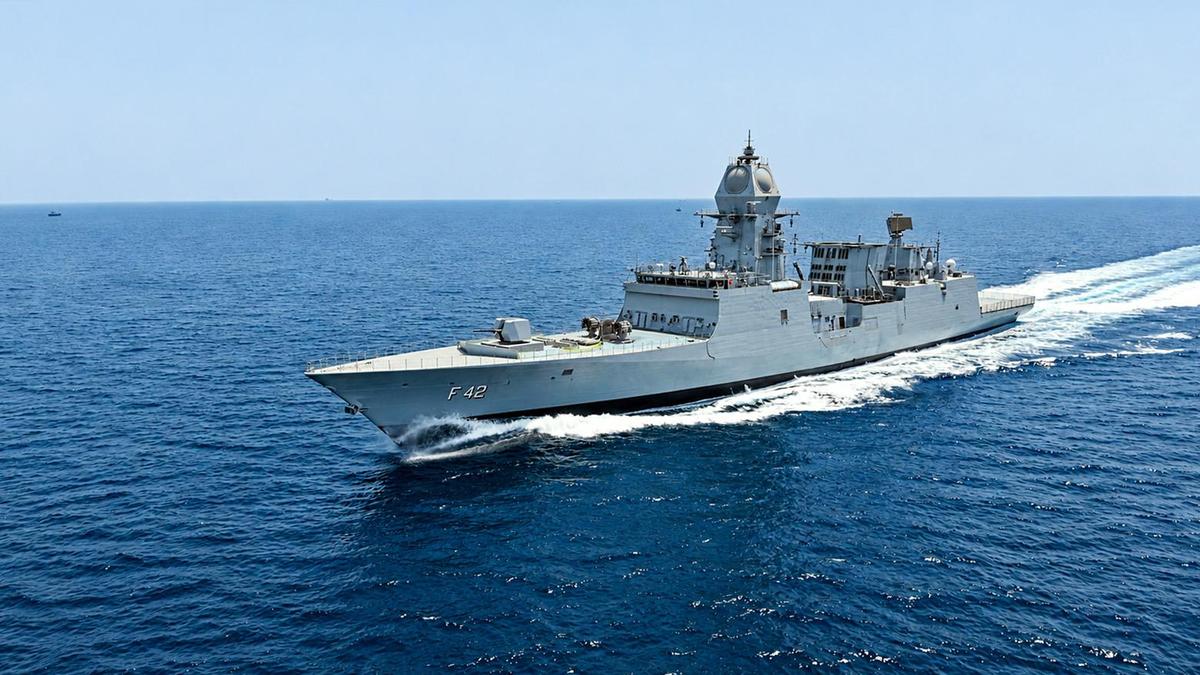
Photo from the source report: Vindhyagiri Delivery Completes Project 17A: Naval Modernisation and Indigenisation
Image: The Hindu
Why in news
Vindhyagiri is the third and final Project 17A frigate built by Garden Reach Shipbuilders and Engineers Ltd. Its handover completes delivery of the seven-ship Nilgiri-class programme, according to the supplied report citing the Defence Ministry.
7
Project 17A ships delivered
3
Project 17A frigates built by GRSE
75%
Programme indigenous content
More than 200
MSMEs involved
68 months
Vindhyagiri construction period
84 months
First-of-class Nilgiri construction period
Background
Frigates are surface combatants used for escort, surveillance and warfare against surface, air and underwater threats. Project 17A, the Nilgiri class, follows the Indian Navy’s Project 17 Shivalik-class frigates and advances indigenous warship design and construction. For India, a peninsula adjoining major Indian Ocean shipping routes, capable surface forces support maritime security, protection of sea lines of communication and sustained naval presence. Indigenous construction also creates a domestic base for maintenance, upgrades and future ship development.
What the Vindhyagiri handover establishes
GRSE delivered Vindhyagiri, Yard 3024, in Kolkata on November 27, 2026. It is the final vessel in the seven-ship Project 17A delivery programme and the third vessel of the programme constructed by GRSE.
The Navy’s Warship Design Bureau designed these frigates, while the report identifies the Warship Overseeing Team in Kolkata as the oversight body. The milestone therefore reflects both indigenous design capability and the ability to translate complex designs into completed warships.
Completion of ship deliveries is not equivalent to confirmation that every ship is commissioned or fully combat-ready. The supplied report establishes Vindhyagiri’s handover, but does not establish its commissioning date or operational deployment status.
- The delivery programme began with the handover of the first ship, Nilgiri, on December 20, 2024.
- Vindhyagiri takes its name from the Vindhyagiri mountain range in Karnataka.
- The earlier INS Vindhyagiri was a Leander-class frigate that served from July 8, 1981, to June 11, 2012.
Infographic
Fleet modernisation
Seven Nilgiri-class frigates delivered.
Multi-role capability
Anti-surface, anti-air and anti-submarine warfare.
Industrial ecosystem
75% indigenous content; more than 200 MSMEs.
Production learning
Vindhyagiri built in 68 months against Nilgiri’s 84 months.
Readiness imperative
Delivery must translate into trained, integrated and sustainably supported forces.
AI-assisted infographic by Pragnya IAS Academy, based on the cited sources.
How Project 17A strengthens maritime operational capability
The frigates are multi-mission platforms equipped with weapons and sensors for anti-surface, anti-air and anti-submarine warfare. This combination supports flexible tasking: a ship can contribute to surface engagements, defence against aerial threats and protection against submarines rather than being confined to a single role.
Stealth aims to reduce a warship’s detectability; it does not make the ship invisible. Combined with sensors, weapons and survivability features, reduced signatures can improve tactical options, although the report does not provide quantified stealth or combat-performance data.
The ships use Combined Diesel or Gas propulsion and an Integrated Platform Management System. CODOG permits diesel or gas-turbine propulsion according to operating requirements, while platform management integrates monitoring and control of ship machinery and related systems.
- Multi-role frigates can strengthen escort operations and protection of maritime traffic.
- Additional modern hulls can expand options for naval presence and task-group deployment.
- Operational outcomes depend on crew proficiency, maintenance, logistics and integration with wider naval forces.
Indigenous shipbuilding: ecosystem depth and production learning
The report states that Project 17A achieved 75% indigenous content and involved more than 200 MSMEs. It generated employment for approximately 4,000 personnel directly and over 10,000 indirectly, illustrating the industrial linkages of complex warship construction.
Vindhyagiri’s construction period was 68 months, compared with 84 months for the first-of-class Nilgiri. The report attributes this improvement to experience gained from preceding ships, demonstrating the value of repeat production and accumulated shipbuilding knowledge.
Indigenous content is an important indicator, but it is not a complete measure of technological autonomy. The source does not identify the remaining non-indigenous components or explain the calculation method; conclusions about dependence on specific foreign systems would therefore be unwarranted.
- Domestic design capability helps retain institutional knowledge for future modifications and ship classes.
- MSME participation broadens the industrial base beyond the principal shipyard.
- Serial construction can improve production planning and coordination, provided quality and safety remain protected.
Strategic assessment: from delivered platforms to sustained readiness
Project 17A contributes to naval modernisation by combining contemporary combat platforms with a stronger domestic construction ecosystem. Its strategic value lies not merely in the number of ships delivered, but in their ability to remain available, supported and adaptable throughout service.
India’s maritime responsibilities require more than individual surface combatants. Effective operations depend on coordination with submarines, aircraft, maritime surveillance assets, communications networks and replenishment support.
The next policy priority should be to preserve production learning while strengthening through-life support and critical technology capability. Faster construction is valuable only when matched by reliability, maintainability and operational effectiveness.
- Assess fleet capability through availability and mission readiness, not delivery counts alone.
- Treat indigenisation as control over design, integration, repair and upgrades as well as domestic production.
- Link future procurement to sustained supplier capability and predictable industrial workloads.
| Feature | Contribution | Important qualification |
|---|---|---|
| Multi-mission weapons and sensors | Support anti-surface, anti-air and anti-submarine warfare | The source does not establish specific weapon ranges or engagement performance |
| Stealth design | Seeks to reduce detectability and improve tactical survivability | Stealth does not mean invisibility |
| CODOG propulsion | Provides a choice between diesel and gas-turbine propulsion | It is distinct from combined diesel and gas operation |
| Integrated Platform Management System | Integrates monitoring and control of machinery and platform systems | It should not be equated with a combat management system |
| 75% indigenous content | Demonstrates substantial domestic industrial participation | It does not establish complete technological self-reliance |
| Completion of ship deliveries | Marks fulfilment of the programme’s handover milestone | It does not by itself establish commissioning or full combat readiness |
- 1. Naval requirements guide indigenous warship design.
- 2. Shipyards and suppliers translate designs into integrated platforms.
- 3. Construction experience improves subsequent production.
- 4. Trials, acceptance and handover establish the delivered platform.
- 5. Commissioning, crew work-up and fleet integration build operational capability.
- 6. Maintenance, spares and upgrades sustain capability through service.
July 8, 1981
The earlier Leander-class INS Vindhyagiri began its naval service.
June 11, 2012
The earlier INS Vindhyagiri’s service ended.
December 20, 2024
The first Project 17A ship, Nilgiri, was delivered.
November 27, 2026
GRSE handed over Vindhyagiri, completing delivery of all seven Project 17A frigates.
Significance, challenges & way forward
Significance
- Project 17A adds modern multi-role frigates capable of addressing surface, aerial and underwater threats.
- Indigenous design and construction strengthen India’s capacity to develop and support complex naval platforms.
- MSME participation distributes industrial opportunities and technical learning across the supply chain.
- The shorter construction period reported for Vindhyagiri demonstrates the value of experience accumulated through serial production.
- A stronger domestic shipbuilding ecosystem can support strategic autonomy by improving control over support and future upgrades.
Challenges
- Delivery milestones do not automatically translate into sustained deployment availability or full combat readiness.
- The indigenous-content figure alone cannot reveal dependence on critical technologies or external lifecycle support.
- Integration of propulsion, sensors, weapons and platform systems requires rigorous testing and configuration control.
- Production gains may be difficult to retain without continuity in skilled manpower, supplier capacity and future orders.
- Long-term readiness depends on maintenance infrastructure, spares, training and logistics as much as on new construction.
Way forward
- Report delivery, commissioning and operational readiness as distinct milestones to enable accurate capability assessment.
- Prioritise indigenisation according to technological criticality and lifecycle dependence rather than aggregate content alone.
- Institutionalise lessons from Project 17A across shipyards, design teams and supplier networks.
- Strengthen MSME quality assurance, skills and access to predictable procurement opportunities.
- Build through-life maintenance, repair, upgrade and spare-parts plans alongside acquisition programmes.
- Integrate new frigates with maritime surveillance, aviation, submarine and logistics capabilities for effective fleet operations.
Key terms
- Project 17A
- The Indian Navy’s seven-ship Nilgiri-class stealth frigate programme.
- Frigate
- A surface combatant commonly employed in escort, surveillance and multi-role naval warfare.
- Stealth
- Design and operational measures intended to reduce detectability by limiting a platform’s signatures.
- CODOG
- Combined Diesel or Gas propulsion, using diesel engines or gas turbines according to operating requirements.
- Integrated Platform Management System
- An integrated system for monitoring and controlling ship machinery and related platform functions.
- Indigenous content
- The share identified as domestically sourced under the programme’s applicable calculation method.
- Sea lines of communication
- Maritime routes used for trade, transport and logistical movement.
- Operational readiness
- The condition in which personnel, equipment and support arrangements enable a unit to perform assigned missions.
Link with static syllabus
Prelims practice MCQs
Q1. With reference to Project 17A, consider the following statements: 1. It comprises Nilgiri-class stealth frigates. 2. Vindhyagiri is the third and final Project 17A frigate built by GRSE. 3. All ships under the programme were constructed by GRSE. Which of the statements given above are correct?
Q2. In naval propulsion terminology, CODOG refers to:
Q3. Consider the following pairs: 1. Warship Design Bureau — Design of Project 17A frigates 2. Integrated Platform Management System — Monitoring and control of ship machinery and platform functions 3. Stealth — Complete invisibility to all detection systems Which of the pairs given above are correctly matched?
Q4. With reference to the assessment of naval modernisation, consider the following statements: 1. Delivery of a warship does not by itself establish its full operational readiness. 2. Indigenous-content percentage alone is insufficient to establish complete technological autonomy. 3. Experience from successive ships can help reduce construction time. Which of the statements given above are correct?
Mains practice questions
GS 3 · 15 marks · 250 words
Assess Project 17A’s contribution to naval modernisation and indigenous warship-building capacity. Why must ship-delivery milestones be distinguished from sustained maritime operational capability?
Frequently asked questions
Why is Vindhyagiri’s delivery significant?
It completes delivery of all seven Project 17A frigates to the Indian Navy. It also marks delivery of the third and final frigate built by GRSE under the programme.
Does the handover mean Vindhyagiri has been commissioned?
Not necessarily: handover and commissioning are distinct milestones. The supplied report confirms delivery but does not establish Vindhyagiri’s commissioning date.
How does Project 17A support defence indigenisation?
The programme combines indigenous naval design with reported indigenous content of 75% and participation by more than 200 MSMEs. This supports domestic manufacturing and technical capability, but does not establish complete technological self-reliance.
What makes Project 17A frigates multi-mission platforms?
Their weapons and sensors support anti-surface, anti-air and anti-submarine warfare. This enables them to address threats across surface, aerial and underwater domains.
Sources
Analysis prepared by the Pragnya IAS Academy current-affairs desk with AI assistance from the cited reports. Verify figures with the original sources.
Turn current affairs into marks
Join Pragnya IAS Academy's mentorship for daily answer-writing evaluation on stories like this — classroom programmes from a trusted name in IAS coaching in Hyderabad.