
Antarctic Ozone Hole: Annual Variability, Long-Term Recovery and the Montreal Protocol
Revise the static topic: UPSC Environment notes
In short: The Antarctic ozone hole reached 27.3 million sq. km on September 20, 2026, making it among the largest observed through satellite monitoring. This does not negate long-term recovery: annual meteorological conditions influence ozone depletion, while levels of ozone-depleting substances have been declining under the Montreal Protocol.
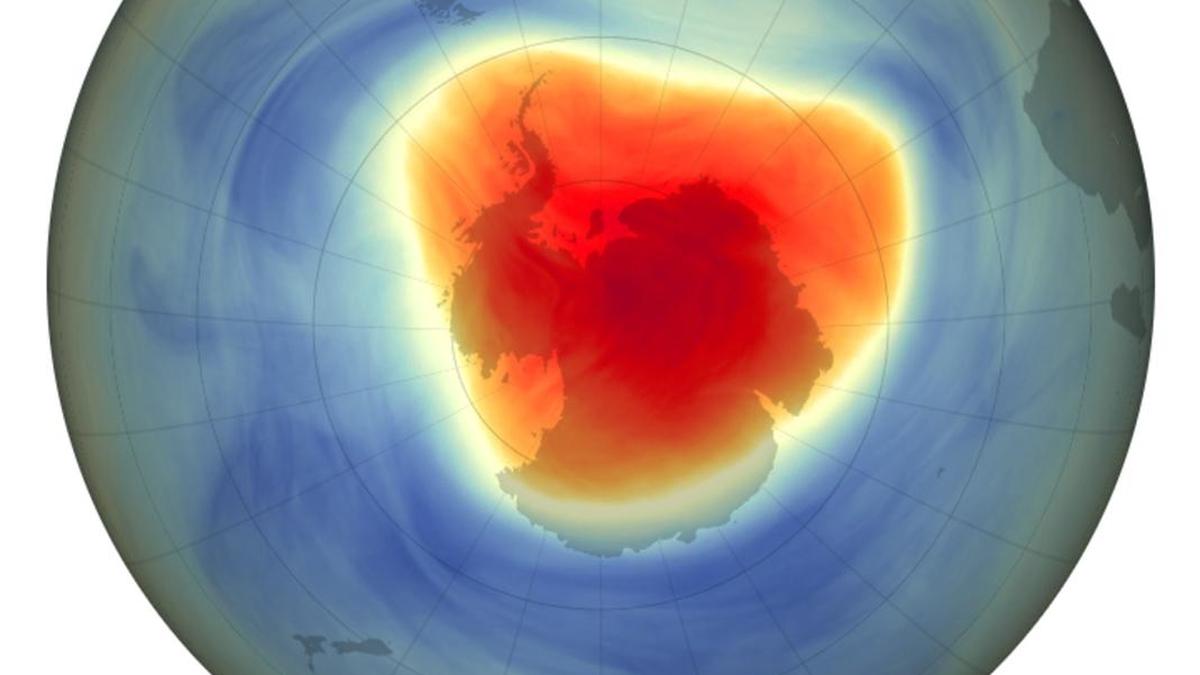
Photo from the source report: Antarctic Ozone Hole: Annual Variability, Long-Term Recovery and the Montreal Protocol
Image: The Hindu
Why in news
The Hindu reported on November 26 that the European Space Agency had identified an unusually large Antarctic ozone hole in 2026, contrasting with a comparatively small hole in 2025. Scientists emphasised that this annual fluctuation does not overturn the longer-term recovery trajectory.
27.3 million sq. km
Ozone-hole area on September 20
31%
Above the corresponding two-decade average
25 million sq. km
Average area during September 7–October 13
Seventh largest
Recorded rank for that averaging period
15–35 km
Approximate altitude of the ozone layer
Background
The ozone layer is a region of relatively high ozone concentration in the stratosphere that absorbs much of the Sun’s harmful ultraviolet radiation. British Antarctic Survey scientists reported seasonal ozone depletion over Antarctica in 1985. Subsequent research identified chlorofluorocarbons and other ozone-depleting substances as the principal human-made drivers. The Vienna Convention provides the framework for international cooperation on ozone protection, while the Montreal Protocol establishes controls on ozone-depleting substances. Its effectiveness must be assessed through sustained reductions in these substances and long-term ozone observations, rather than the size of the hole in any single year.
What the latest observations show
Copernicus data put the Antarctic ozone-hole area at 27.3 million sq. km on September 20, around 31% above the average for the corresponding time of year over the preceding two decades. NASA and NOAA separately reported an average area of 25 million sq. km during September 7–October 13, ranking it seventh largest for that observation period.
These measurements are complementary, not contradictory. A daily observation and an average over a longer period describe different aspects of the same seasonal event. Neither should be presented as directly interchangeable with the other.
- The source describes the 2026 hole as among the largest observed, not as the largest ever.
- The contrast with the relatively small 2025 hole illustrates substantial year-to-year variability.
- A single year’s area measurement cannot establish whether the long-term recovery trend has reversed.
Infographic
Observed event
27.3 million sq. km on September 20.
Seasonal influence
Cold polar conditions, cloud chemistry and returning sunlight shape depletion.
Long-term driver
Ozone-depleting substances are declining under the Montreal Protocol.
Correct inference
Annual expansion alone does not establish reversal of recovery.
Policy priority
Sustain compliance, monitoring and life-cycle refrigerant management.
AI-assisted infographic by Pragnya IAS Academy, based on the cited sources.
Why Antarctica experiences intense seasonal ozone depletion
During the southern hemisphere winter, strong winds form a polar vortex around Antarctica. This circulation limits the entry of warmer air and helps maintain very cold stratospheric conditions. Reactions on particles in polar stratospheric clouds convert chlorine-containing compounds into forms capable of rapidly destroying ozone when sunlight returns.
In the Antarctic spring, sunlight enables rapid ozone destruction. Chlorine participates in catalytic reactions: it destroys ozone but is regenerated, allowing repeated destruction of ozone molecules. The ozone hole is therefore a region of severe seasonal depletion, not a literal opening in the atmosphere.
- The location and season matter: Antarctic spring runs from September to November.
- Cold conditions, polar isolation, reactive halogens and returning sunlight act together.
- The polar vortex influences the meteorological setting; ozone-depleting substances supply the harmful chemical agents.
Annual variability is not the same as long-term recovery
The observed ozone hole reflects both the atmospheric burden of ozone-depleting substances and the meteorological conditions of a particular season. A cold, persistent and isolated polar stratosphere can favour severe depletion even while the overall burden of harmful substances is declining.
Long-term recovery does not imply that the hole must shrink every successive year. Equally, one unusually small hole does not establish that the problem has been solved. The source does not provide a detailed attribution of the specific meteorological drivers of the 2026 event; these should not be inferred solely from its size.
- Separate short-term variability from sustained changes across repeated observations.
- Use comparable dates, averaging periods and measurement methods when comparing years.
- Read ozone observations alongside trends in ozone-depleting substances and stratospheric conditions.
What the Montreal Protocol has achieved—and why recovery takes time
The Montreal Protocol uses binding controls on the production and consumption of ozone-depleting substances, supported by reporting, scientific assessment and international cooperation. Its Multilateral Fund assists eligible developing countries in meeting their obligations through financial and technical support.
The supplied report attributes declining levels of ozone-harming substances to the Protocol. However, many such substances are long-lived, and existing equipment and stored materials can remain potential sources of emissions. Reducing production and consumption therefore does not produce immediate atmospheric recovery.
- The relevant policy test is sustained reduction in harmful substances, not uninterrupted annual shrinkage of the hole.
- Compliance, servicing practices, recovery and safe disposal remain important after production controls take effect.
- The Protocol demonstrates how science, binding obligations and implementation support can reinforce one another.
India and the ozone–climate policy connection
For India, ozone protection requires continued implementation of controls on ozone-depleting substances and sound management of refrigerants across their life cycle. The transition should include trained technicians, effective enforcement and accessible alternatives.
Ozone depletion and climate change are distinct environmental problems, although some refrigerants connect them. Hydrofluorocarbons do not deplete stratospheric ozone but many are potent greenhouse gases; the Kigali Amendment addresses their phasedown. Refrigerant choices should therefore consider ozone safety, climate impact, energy efficiency and operational safety together.
- Do not equate an ozone-safe refrigerant with a climate-neutral refrigerant.
- India’s Environment (Protection) Act and ozone-depleting-substance rules provide relevant domestic legal context.
- Public communication should avoid presenting a large annual ozone hole as proof of treaty failure.
| Dimension | Annual variability | Long-term recovery |
|---|---|---|
| Main question | Why is this season’s ozone hole unusually large or small? | Is the atmosphere recovering as ozone-depleting substances decline? |
| Key influences | Temperature, polar vortex, cloud chemistry and sunlight | Sustained reductions in harmful substances, alongside atmospheric variability |
| Useful evidence | Seasonal area, ozone observations and meteorological conditions | Long-term ozone records and trends in ozone-depleting substances |
| Interpretation of 2026 | An unusually large seasonal depletion event | Not, by itself, evidence that recovery has reversed |
| Policy implication | Maintain observation and explain seasonal conditions | Sustain treaty compliance and manage remaining sources of emissions |
- 1. Long-lived ozone-depleting substances reach the stratosphere.
- 2. Ultraviolet radiation breaks down CFCs, releasing chlorine.
- 3. The winter polar vortex isolates Antarctic air and sustains very cold conditions.
- 4. Reactions on polar stratospheric cloud particles activate chlorine-containing compounds.
- 5. Returning spring sunlight enables catalytic ozone destruction.
- 6. The resulting depletion varies with both the chemical burden and seasonal meteorological conditions.
1985
British Antarctic Survey scientists reported seasonal ozone depletion over Antarctica.
2025
The Antarctic ozone hole was among the smallest in more than three decades, according to the supplied report.
September 20, 2026
Copernicus data recorded an ozone-hole area of 27.3 million sq. km.
November 4, 2026
NASA and NOAA reported that the average area during September 7–October 13 ranked seventh largest on record for that period.
November 26, 2026
The ESA assessment was reported, alongside scientists’ clarification that annual fluctuations do not negate long-term recovery.
Significance, challenges & way forward
Significance
- Stratospheric ozone protection limits harmful ultraviolet exposure and supports human health and ecosystem functioning.
- The episode demonstrates why environmental policy must be evaluated through long-term evidence rather than isolated annual outcomes.
- Declining ozone-depleting substances underline the value of binding international controls backed by scientific assessment and implementation support.
- The refrigerant transition creates an opportunity to integrate ozone protection, climate mitigation and energy efficiency.
Challenges
- Long-lived ozone-depleting substances delay recovery even after production and consumption are reduced.
- Remaining substances in equipment and stored materials require careful recovery, recycling or destruction.
- Meteorological variability can obscure the recovery signal and encourage misleading claims of policy failure or complete success.
- Maintaining compliance requires effective reporting, enforcement and refrigerant-management capacity.
- Refrigerant alternatives must balance affordability, climate impact, energy performance and safety.
Way forward
- Sustain Montreal Protocol implementation rather than treating declining harmful substances as a reason to relax controls.
- Maintain satellite and ground-based monitoring of ozone, atmospheric composition and relevant meteorological conditions.
- Publish clearly labelled daily and seasonal measurements so that comparisons use equivalent indicators.
- Strengthen technician training, leak prevention, refrigerant recovery and environmentally sound disposal.
- Coordinate ozone-protection measures with Kigali implementation and energy-efficient cooling strategies.
- Explain uncertainty honestly: annual ozone-hole expansion can coexist with long-term recovery, but continued monitoring remains essential.
Key terms
- Stratospheric ozone
- Ozone in the stratosphere that absorbs much of the Sun’s harmful ultraviolet radiation.
- Ozone hole
- A region of severe seasonal ozone depletion, particularly over Antarctica, rather than a physical gap in the atmosphere.
- Ozone-depleting substances
- Chemicals that release ozone-destroying chlorine or bromine in the stratosphere.
- Polar vortex
- A large circulation of strong winds around a polar region that can isolate cold polar air.
- Polar stratospheric clouds
- Clouds formed in very cold polar stratospheric conditions whose particle surfaces facilitate chlorine-activating reactions.
- Catalytic ozone destruction
- A reaction process in which an agent such as chlorine destroys ozone while being regenerated for further reactions.
- Montreal Protocol
- The international agreement controlling the production and consumption of ozone-depleting substances.
- Kigali Amendment
- An amendment to the Montreal Protocol providing for the phasedown of hydrofluorocarbons because of their climate impact.
Link with static syllabus
Prelims practice MCQs
Q1. With reference to Antarctic ozone depletion, consider the following statements: 1. The winter polar vortex limits the intrusion of relatively warmer air into the Antarctic polar region. 2. Reactions on polar stratospheric cloud particles help convert chlorine compounds into forms capable of rapid ozone destruction when sunlight returns. 3. A large ozone hole in a particular year necessarily establishes that atmospheric ozone-depleting substances are increasing. Which of the statements given above are correct?
Q2. Consider the following pairs: 1. Vienna Convention: Framework for international cooperation on ozone protection 2. Montreal Protocol: Controls on ozone-depleting substances 3. Kigali Amendment: Phasedown of hydrofluorocarbons Which of the pairs given above are correctly matched?
Q3. Which of the following best explains why chlorine can cause extensive stratospheric ozone destruction?
Q4. The most appropriate approach to assessing long-term recovery of the Antarctic ozone layer is to:
Mains practice questions
GS 3 · 15 marks · 250 words
An unusually large Antarctic ozone hole does not necessarily imply failure of the Montreal Protocol. Explain the scientific basis of this statement and evaluate the lessons for environmental governance.
Frequently asked questions
Does a larger Antarctic ozone hole mean the Montreal Protocol has failed?
No. Annual meteorological conditions influence ozone-hole size, whereas the Protocol addresses the underlying burden of ozone-depleting substances, which the report says has been declining.
Why are the reported areas of 27.3 million and 25 million sq. km different?
The first is an observation for September 20, while the second is the average during September 7–October 13. They refer to different measurement periods and should not be treated as interchangeable.
Why does severe Antarctic ozone depletion occur in spring?
Cold winter conditions and polar stratospheric cloud chemistry prepare chlorine-containing compounds for rapid ozone destruction. Returning spring sunlight enables the destructive reactions.
Are ozone depletion and climate change the same problem?
No; they involve different processes, although some chemicals affect both. HFCs illustrate the distinction: they do not deplete stratospheric ozone, but many have substantial warming effects.
Sources
Analysis prepared by the Pragnya IAS Academy current-affairs desk with AI assistance from the cited reports. Verify figures with the original sources.
Turn current affairs into marks
Join Pragnya IAS Academy's mentorship for daily answer-writing evaluation on stories like this — classroom programmes from a trusted name in IAS coaching in Hyderabad.