
Chandrayaan-5/LUPEX: India–Japan Partnership to Investigate Lunar Polar Water
Revise the static topic: UPSC Science & Technology notes
In short: Japan’s space agency JAXA has unveiled and demonstrated a rover prototype for Chandrayaan-5/LUPEX, a joint lunar exploration mission with ISRO scheduled for launch in 2028. The mission will investigate water and other volatile materials near a permanently shadowed region at the lunar south pole, strengthening scientific understanding and informing future assessments of lunar resource use.
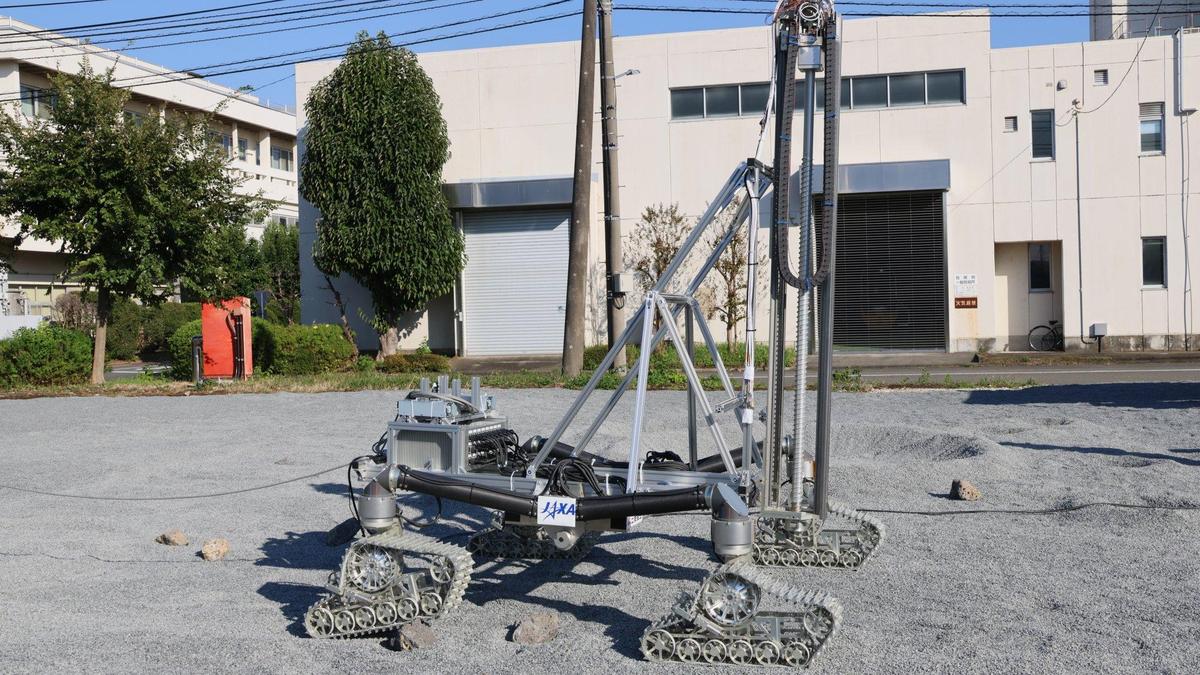
Reference image of the Chandrayaan-5/LUPEX rover prototype. The joint India–Japan mission aims to investigate water and other volatile materials near a permanently shadowed region at the lunar south pole.
Image: The Hindu
Why in news
JAXA unveiled the rover prototype at the Chofu Aerospace Centre in Japan on November 25 and conducted a test demonstration. This is a development milestone, not the unveiling of a flight-ready mission or evidence of newly discovered lunar water.
2028
Scheduled mission launch
5th
Mission in the Chandrayaan series
2040
Stated goal for an Indian on the Moon
Background
The Chandrayaan programme spans orbital observation, surface exploration and planned sample return. Chandrayaan-1 contributed to evidence of water-related signatures on the Moon; Chandrayaan-2 provided an orbiter platform for lunar investigation, while Chandrayaan-3 demonstrated soft landing and rover-based exploration. Lunar polar regions are scientifically important because the Moon’s small axial tilt and local crater topography leave some locations permanently shaded. Extremely cold areas within these regions can preserve water ice and other volatile substances that would be less stable on warmer, sunlit surfaces.
What the prototype unveiling establishes
Chandrayaan-5/LUPEX, or Lunar Polar Exploration, is an ISRO–JAXA collaboration to study lunar volatile materials, including water, in the vicinity of a permanently shadowed region at the lunar south pole. The supplied report identifies 2028 as the scheduled launch year and Japan’s H3-24L as the launch vehicle.
The Union government granted financial sanction for the mission on March 10, 2025. The rover prototype demonstration indicates progress in development, but it does not establish flight readiness, the final landing location or a completed resource assessment.
- ISRO will develop the lunar lander and contribute scientific instruments.
- JAXA will develop the rover, with launch planned on a Japanese vehicle.
- Scientific instruments will come from ISRO, JAXA, ESA and NASA.
- Chandrayaan-4 is the planned Indian lunar sample-return mission; LUPEX is centred on polar exploration and in-situ analysis.
Infographic
Partnership
ISRO lander and JAXA rover, with international payload contributions.
Destination
Vicinity of a permanently shadowed region at the lunar south pole.
Investigation
Water, other volatiles and the lunar exosphere.
Scientific tools
Neutron measurements and mass spectrometry support complementary inquiries.
Resource caution
A water-related signal does not establish recoverable or commercially viable reserves.
AI-assisted infographic by Pragnya IAS Academy, based on the cited sources.
Why lunar polar water matters scientifically
The lunar south pole is not uniformly dark or uniformly ice-rich. Permanent shadow depends on local topography and illumination geometry, while sufficiently cold locations can act as cold traps. Investigating these environments helps explain where volatiles accumulate, how they are retained and how they interact with the lunar surface.
Water and other volatiles can provide clues to the Moon’s environmental history and processes involving impacts, solar-wind interactions and movement of molecules across the surface. Local measurements are valuable because orbital observations cannot, by themselves, fully establish the form, concentration and accessibility of a potential resource.
- A permanently shadowed region is a location without direct sunlight, not the entire lunar polar region.
- The presence of hydrogen is an indicator relevant to water searches, but it does not by itself establish a usable water-ice deposit.
- Scientific detection, resource characterisation and economically viable extraction are distinct stages.
How the instruments contribute to the water investigation
NASA’s Neutron Spectrometer will be carried on the rover to search for water beneath the lunar surface. Neutron measurements are sensitive to hydrogen in surface and subsurface material; interpretation alongside complementary observations is necessary to distinguish possible explanations and assess water occurrence.
ESA’s Exploration Mass Spectrometer for LUPEX, or EMS-L, will investigate the Moon’s extremely thin exosphere. Studying its atoms and molecules can complement investigations of surface volatiles by improving understanding of exchanges between the lunar surface and its surrounding environment.
- Neutron spectroscopy supports the search for hydrogen-bearing material below the surface.
- Mass spectrometry helps identify atoms and molecules through their mass-to-charge characteristics.
- In-situ observations provide local context for interpreting broader orbital evidence.
- The supplied report does not specify a recoverable water quantity or demonstrate extraction feasibility.
Strategic value and the limits of the resource narrative
LUPEX combines Indian landing capability with Japanese rover development and launch support, alongside international scientific payloads. This division of responsibilities makes the mission both a scientific partnership and a test of systems integration, shared operations and data coordination.
If sufficiently abundant and accessible, lunar water could potentially support life-support systems and the production of oxygen and hydrogen. However, these are prospective applications rather than confirmed LUPEX outcomes: extraction, purification, power supply and storage would all require separate technological and economic validation.
The mission can contribute knowledge relevant to sustained lunar exploration and India’s stated goal of sending an Indian to the Moon by 2040. Neither the prototype demonstration nor a successful water detection would, by itself, establish the feasibility of a lunar settlement or commercial mining.
- International cooperation can pool complementary capabilities while creating cross-agency dependencies.
- Resource investigations should preserve the scientific value of polar environments and minimise contamination.
- Water is the central resource discussed in the report; no specific metallic or fuel-mineral reserves are established.
| Partner | Reported contribution |
|---|---|
| ISRO | Lunar lander and some scientific instruments |
| JAXA | Lunar rover; launch planned using Japan’s H3-24L vehicle |
| NASA | Neutron Spectrometer to support the search for subsurface water |
| ESA | EMS-L to investigate the lunar exosphere |
- 1. Identify promising polar environments using existing lunar observations.
- 2. Obtain local surface, subsurface-sensitive and exospheric measurements.
- 3. Interpret hydrogen indicators alongside complementary evidence of volatiles.
- 4. Characterise occurrence and local environmental conditions.
- 5. Assess whether further exploration and extraction-technology testing are justified.
2008
Chandrayaan-1 was launched.
2019
Chandrayaan-2 was launched, providing an orbiter platform for lunar exploration.
2023
Chandrayaan-3 undertook lander-rover-based lunar exploration.
March 10, 2025
Chandrayaan-5/LUPEX received Union government approval through financial sanction.
November 25, as reported
JAXA unveiled and demonstrated the LUPEX rover prototype at the Chofu Aerospace Centre.
2028, scheduled
LUPEX is scheduled for launch on Japan’s H3-24L vehicle.
2040, stated goal
India aims to send an Indian to the Moon.
Significance, challenges & way forward
Significance
- LUPEX can strengthen the evidence base on the distribution and behaviour of lunar polar volatiles.
- Local measurements can help distinguish a remotely detected water-related signal from a potentially accessible resource.
- The mission deepens India–Japan space cooperation through complementary lander, rover and launch responsibilities.
- International payload contributions can support more comprehensive scientific interpretation.
- Polar exploration can inform the planning of future robotic and human lunar missions.
Challenges
- Extreme cold in shadowed terrain can threaten electronics, batteries and mechanical systems.
- Low illumination and rugged terrain complicate navigation, hazard avoidance and access to scientifically valuable sites.
- Power and communication arrangements must accommodate local terrain and illumination constraints.
- Hydrogen-sensitive measurements require careful interpretation because they do not independently prove recoverable water ice.
- Coordinating lander, rover, launcher and payload interfaces across agencies creates integration and scheduling risks.
- Contamination from spacecraft operations could affect sensitive volatile measurements.
Way forward
- Validate rover mobility and system performance under conditions representative of lunar terrain, vacuum and thermal extremes.
- Integrate payload measurements with orbital observations rather than relying on any single water indicator.
- Prioritise landing and exploration choices that balance scientific value, illumination, communication and operational safety.
- Establish clear inter-agency arrangements for interfaces, calibration, mission operations and scientific data access.
- Separate water detection from claims about resource abundance, recoverability and commercial viability.
- Build contamination control and preservation of scientifically valuable polar environments into mission planning.
Key terms
- LUPEX
- Lunar Polar Exploration, the joint ISRO–JAXA mission identified as Chandrayaan-5.
- Volatiles
- Substances that readily enter the gaseous phase under suitable conditions, including water and other materials retained in cold environments.
- Permanently shadowed region
- A location that receives no direct sunlight because of the combined effects of illumination geometry and local topography.
- Cold trap
- An environment cold enough to retain particular volatile substances over long periods.
- Lunar exosphere
- The Moon’s extremely tenuous surrounding population of atoms and molecules, in which collisions are rare.
- Neutron spectroscopy
- Measurement of neutron characteristics to infer properties of material, including the presence of hydrogen.
- In-situ analysis
- Scientific examination at the location where the material or phenomenon occurs.
- In-situ resource utilisation
- Use of locally available space resources to support exploration rather than transporting every input from Earth.
Link with static syllabus
Prelims practice MCQs
Q1. With reference to Chandrayaan-5/LUPEX, consider the following statements: 1. ISRO is responsible for developing the lunar lander. 2. JAXA is responsible for developing the rover. 3. The mission is scheduled to be launched using an Indian launch vehicle. Which of the statements given above are correct?
Q2. Consider the following statements about lunar polar environments: 1. The entire lunar south polar region is permanently shadowed. 2. Local topography helps determine whether a location receives direct sunlight. 3. Sufficiently cold locations can retain water ice and other volatiles. Which of the statements given above are correct?
Q3. With reference to the instruments reported for LUPEX, consider the following pairs: 1. NASA’s Neutron Spectrometer — Search for water beneath the lunar surface 2. ESA’s EMS-L — Investigation of the lunar exosphere 3. EMS-L — Return of lunar samples to Earth How many of the pairs given above are correctly matched?
Q4. Which of the following best explains why a hydrogen signal alone cannot establish the commercial viability of lunar water extraction?
Mains practice questions
GS 3 · 15 marks · 250 words
Chandrayaan-5/LUPEX links lunar science with international cooperation and prospective resource utilisation. Discuss its significance and the challenges in translating lunar water detection into usable resources.
Frequently asked questions
What is Chandrayaan-5/LUPEX?
It is a joint ISRO–JAXA lunar polar exploration mission to study water and other volatiles near a permanently shadowed region at the lunar south pole. The supplied report schedules its launch for 2028.
What are India’s and Japan’s responsibilities?
ISRO will develop the lunar lander and some scientific instruments, while JAXA will develop the rover. Launch is planned on Japan’s H3-24L vehicle.
Why investigate water near permanently shadowed regions?
Sufficiently cold shadowed environments can preserve water ice and other volatile materials. Their investigation can reveal lunar environmental processes and help assess the potential for future resource use.
Is LUPEX a sample-return or water-mining mission?
The reported objectives concern polar exploration and in-situ analysis, not demonstrated water mining. Chandrayaan-4 is identified separately as India’s planned first lunar sample-return mission.
Sources
Analysis prepared by the Pragnya IAS Academy current-affairs desk with AI assistance from the cited reports. Verify figures with the original sources.
Turn current affairs into marks
Join Pragnya IAS Academy's mentorship for daily answer-writing evaluation on stories like this — classroom programmes from a trusted name in IAS coaching in Hyderabad.