
Measles Resurgence: Why Low Deaths Do Not Guarantee Elimination
Revise the static topic: UPSC Social Justice notes · UPSC Science & Technology notes
In short: WHO reports that measles deaths reached a historic low in 2025, yet Bolivia, Mexico and the United States have lost their measles elimination status in the current reporting month. The divergence shows that reduced mortality does not guarantee interrupted transmission: sustained vaccination, equitable coverage and sensitive surveillance remain essential.
Reference image: A girl receives a measles vaccine during a vaccination campaign in Lebanon. Sustained, equitable vaccination is essential to interrupt transmission, even when measles deaths decline.
Image: UN News
Why in news
According to the supplied UN News report, WHO estimates that measles caused 72,000 deaths in 2025, while previously measles-free countries are again experiencing endemic transmission. The findings highlight how vaccination gaps can reverse public-health gains even when global mortality falls.
72,000
Estimated measles deaths in 2025
91%
Reduction in deaths since 2000
More than 60 million
Lives saved by vaccination since 2000
84%
Global first-dose coverage in 2025
77%
Global second-dose coverage in 2025
More than 29 million
Unvaccinated or under-immunised children in 2025
Background
Measles is a highly contagious viral disease transmitted through the air. It can cause serious complications, including pneumonia, encephalitis and blindness. Vaccination is the principal preventive intervention, and completing the recommended two-dose schedule strengthens population protection. Elimination refers to interruption of endemic transmission within a defined geographical area, supported by adequate surveillance; eradication refers to permanent worldwide interruption of natural transmission. Measles has not been eradicated, so even countries that achieve elimination remain exposed to imported infections.
What the WHO findings establish
The report presents substantial progress alongside renewed vulnerability. Estimated deaths declined by 91 per cent between 2000 and 2025, and vaccination saved more than 60 million lives over that period. Nearly 10 million people were infected in 2025, among the lowest reported levels, but regional trends differed sharply.
In the Americas, cases rose eightfold compared with 2000, reaching 73,000 in 2025. The region lost its elimination status for a second time after endemic transmission was re-established in Canada in October 2025. The latest losses of status in Bolivia, Mexico and the United States bring the number of verified elimination countries down to 92 from 95 at the end of 2025.
- Mortality reduction and interruption of transmission measure different dimensions of disease control.
- Large or disruptive outbreaks affected 59 countries in 2025, including countries across income groups.
- Eleven outbreaks occurred in countries previously declared measles-free, demonstrating that elimination gains can be reversed.
Infographic
Complete vaccination
Reach every child and complete both measles vaccine doses.
Close local gaps
Identify susceptible communities hidden by coverage averages.
Detect transmission
Connect case reporting, investigation and laboratory confirmation.
Respond rapidly
Contain outbreaks before transmission becomes established.
Sustain public trust
Pair accessible services with credible community engagement.
AI-assisted infographic by Pragnya IAS Academy, based on the cited sources.
Elimination is not eradication
Elimination is geographically bounded and must be maintained. An imported case does not automatically mean that elimination has been lost; the central concern is whether endemic transmission becomes re-established. Surveillance must therefore distinguish importations and limited transmission chains from sustained circulation.
Eradication is a worldwide endpoint. Smallpox is the established example of an eradicated human disease. By contrast, measles elimination does not justify ending vaccination or relaxing outbreak preparedness because the virus continues to circulate elsewhere.
- Low deaths do not prove elimination: infections may continue even where survival improves.
- An absence of reported cases does not establish absence of transmission if surveillance is weak.
- Elimination status reflects transmission conditions, not permanent immunity from future outbreaks.
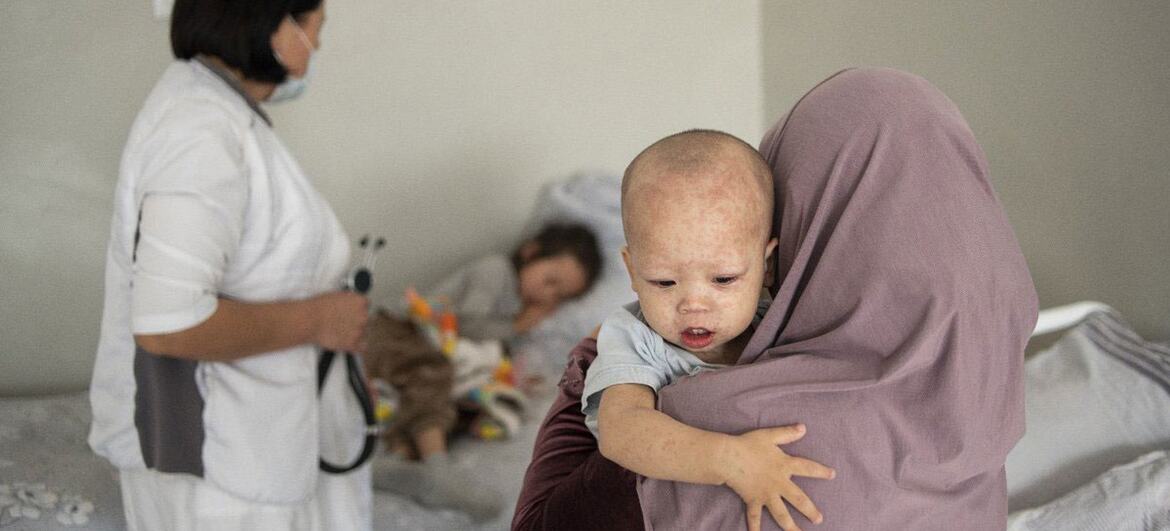
Reference image: A mother holds an infant with a visible measles rash in a hospital room. Lower mortality does not mean that infections have stopped; elimination concerns interrupted transmission rather than the absence of deaths.
Image: UN News
Why coverage averages conceal outbreak risk
Global coverage in 2025 stood at 84 per cent for the first dose and 77 per cent for the second. Low-income countries reported substantially lower coverage than high-income countries, while children in conflict and crisis settings remained less likely to receive vaccines. Both access barriers and incomplete schedules leave susceptible children unprotected.
Nearly half of reported cases occurred in WHO's South-East Asia Region despite first-dose coverage of 96 per cent, the highest regional average. This does not establish vaccine failure: regional averages conceal differences between countries and localities, while first-dose coverage does not measure completion of the full schedule.
The report links large North American outbreaks to clusters of unvaccinated people and the mobility of vaccine-hesitant groups. For a highly contagious infection, concentrated susceptibility matters: high coverage elsewhere cannot reliably shield an inadequately vaccinated community.
- Assess coverage at district, settlement and community levels rather than relying only on national averages.
- Separate children missing all measles vaccine doses from those missing the second dose.
- Distinguish vaccine hesitancy from failures of access, supply or service continuity.
Surveillance and India's policy priorities
Surveillance is necessary both to detect outbreaks early and to substantiate elimination. Weak reporting, delayed specimen collection or limited laboratory access can allow transmission to continue unnoticed. The supplied report does not quantify surveillance weaknesses country by country; nevertheless, adequate surveillance is fundamental to interpreting low case counts.
For India, the Universal Immunisation Programme provides the platform for measles-rubella vaccination, while Mission Indradhanush supports efforts to reach children missed by routine services. The policy priority is to combine reliable routine vaccination with targeted catch-up, community engagement and laboratory-supported case surveillance.
WHO's South-East Asia Region is an institutional grouping, not simply a geographical label. Its aggregate disease burden cannot be treated as India's burden, and the supplied report does not provide India-specific coverage or case estimates.
- Track missed doses and completion of the vaccination schedule through local microplanning.
- Provide portable vaccination records and flexible outreach for mobile and migrant families.
- Link frontline workers, health facilities and laboratories for rapid notification and investigation.
- Use trusted community interlocutors to address concerns without stigmatising particular groups.
| Concept | Meaning | Continuing public-health requirement |
|---|---|---|
| Mortality reduction | Fewer deaths from a disease; transmission may continue | Maintain prevention, surveillance and effective clinical care |
| Elimination | Interruption of endemic transmission in a defined geographical area | Sustain vaccination and surveillance; prevent imported infections from establishing transmission |
| Eradication | Permanent worldwide interruption of natural transmission | Routine disease-specific interventions may no longer be necessary, although residual safeguards can remain |
- 1. Access barriers, disrupted services or vaccine hesitancy leave children unvaccinated or incompletely vaccinated.
- 2. Susceptible individuals accumulate in connected communities.
- 3. An imported infection enters an under-protected population.
- 4. Delayed detection or response allows transmission chains to expand.
- 5. Endemic transmission becomes re-established, threatening elimination status.
2000
Baseline year for the report's comparison of measles mortality and vaccination benefits.
October 2025
Re-establishment of endemic transmission in Canada caused the Americas to lose regional measles elimination status for a second time.
End of 2025
WHO recorded 95 countries as verified to have eliminated measles.
Current reporting month
Bolivia, Mexico and the United States lost elimination status, reducing the verified country total to 92.
Significance, challenges & way forward
Significance
- Historically low mortality demonstrates the life-saving value of vaccination rather than the disappearance of measles risk.
- Loss of elimination status shows that public-health achievements require continuing investment and accountability.
- Outbreaks across income groups establish that national wealth cannot substitute for equitable immunisation coverage.
- The gap between regional averages and local vulnerability makes disaggregated health data essential for policy.
Challenges
- Children missed by routine services can remain invisible in aggregate coverage indicators.
- Incomplete vaccination schedules weaken protection even where first-dose uptake is high.
- Conflict, displacement and disrupted services make timely vaccination difficult.
- Vaccine hesitancy can create concentrated susceptibility within otherwise well-covered populations.
- Weak surveillance can delay outbreak detection and make apparent absence of disease misleading.
- Cross-border mobility can connect local immunity gaps and spread outbreaks beyond their place of origin.
Way forward
- Prioritise completion of both measles vaccine doses through dependable routine services and active follow-up.
- Map missed children and susceptible communities using granular, quality-assured coverage data.
- Use targeted catch-up vaccination to close gaps without weakening routine immunisation.
- Strengthen case notification, specimen transport, laboratory confirmation and outbreak investigation.
- Tailor interventions to the barrier: improve service access where delivery fails and trusted communication where confidence is low.
- Protect immunisation services during emergencies and coordinate surveillance across borders.
- Evaluate progress through equity, schedule completion and surveillance quality, not mortality reduction alone.
Key terms
- Endemic transmission
- Continuing circulation of an infection within a population or geographical area.
- Measles elimination
- Interruption of endemic measles transmission in a defined area, demonstrated through adequate surveillance.
- Eradication
- Permanent worldwide interruption of natural transmission of an infectious agent through deliberate efforts.
- Imported case
- An infection acquired outside the area in which it is detected.
- Population immunity
- Collective protection that limits transmission when enough people are immune.
- Under-immunised child
- A child who has not received all recommended vaccine doses appropriate to their age.
- Case-based surveillance
- Detection, reporting and investigation of individual suspected cases, supported by appropriate laboratory testing.
Link with static syllabus
Prelims practice MCQs
Q1. With reference to measles elimination, consider the following statements: 1. Elimination refers to interruption of endemic transmission within a defined geographical area. 2. Every imported measles case automatically causes loss of elimination status. 3. Vaccination and surveillance remain necessary after elimination. Which of the statements given above are correct?
Q2. Which of the following provides the strongest basis for concluding that a disease has been eradicated?
Q3. According to the supplied WHO findings, consider the following statements: 1. Global second-dose measles vaccine coverage was lower than first-dose coverage in 2025. 2. High regional first-dose coverage necessarily rules out substantial measles transmission. 3. Large or disruptive outbreaks occurred only in low-income countries in 2025. Which of the statements given above is/are correct?
Q4. A region reports high average measles vaccination coverage but experiences repeated outbreaks in particular communities. Which is the most appropriate public-health response?
Mains practice questions
GS 2 · 15 marks · 250 words
“Measles elimination is an achievement to be defended, not a finish line.” Distinguish elimination from eradication and examine the implications of the recent resurgence for India's public-health strategy.
Frequently asked questions
How can measles deaths fall while elimination status is lost?
Deaths and transmission are different indicators. Global mortality can decline while sustained transmission returns in particular countries or communities.
Does an imported measles case automatically end elimination status?
No. The key issue is whether endemic transmission becomes re-established, not simply whether an infection is imported.
Why are high vaccination averages insufficient?
Averages can conceal unvaccinated communities and incomplete two-dose schedules. These immunity gaps allow outbreaks despite strong coverage elsewhere.
Does the report establish India's measles burden?
No. It gives regional and global findings but no India-specific case or coverage estimate; WHO's South-East Asia regional total must not be presented as India's total.
Sources
Analysis prepared by the Pragnya IAS Academy current-affairs desk with AI assistance from the cited reports. Verify figures with the original sources.
Turn current affairs into marks
Join Pragnya IAS Academy's mentorship for daily answer-writing evaluation on stories like this — classroom programmes from a trusted name in IAS coaching in Hyderabad.