
Two-Child Electoral Penalties: Supreme Court Seeks Review Amid Falling Fertility
Revise the static topic: UPSC Polity notes · UPSC Governance notes
In short: The Supreme Court has called for reconsideration of its earlier approval of two-child electoral disqualifications, citing declining fertility and reproductive autonomy. The reported judgment questions whether excluding parents from local elected office remains constitutionally justified, but does not establish a nationwide invalidation of such laws.
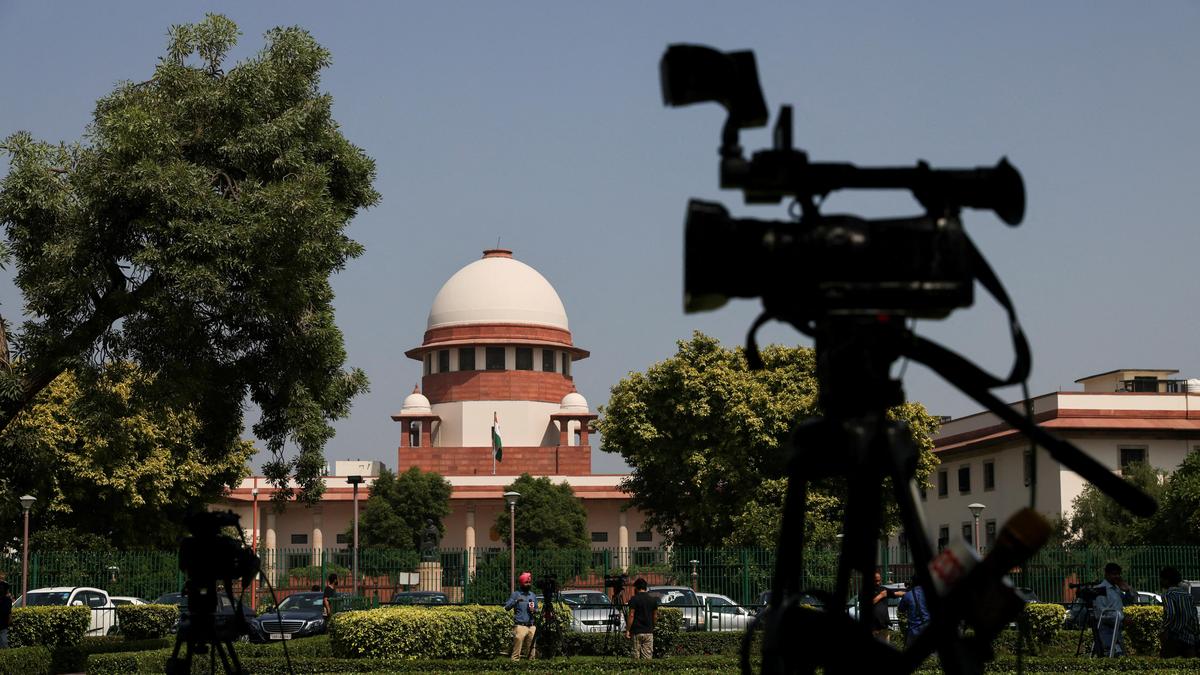
The Supreme Court has called for reconsideration of two-child electoral disqualifications in light of declining fertility and reproductive autonomy; the reported judgment does not invalidate such laws nationwide.
Image: The Hindu
Why in news
On November 4, 2026, the Supreme Court sought reconsideration by a larger Bench of Javed versus State of Haryana, which upheld a two-child electoral disqualification in 2003. It allowed Mangala Bhimrao Ingle to continue as Sarpanch of Kakoda gram panchayat in Maharashtra while staying proceedings against her.
3.02
Earlier TFR cited by the court
1.9
Lower TFR cited by the court
2.1
Replacement-level fertility benchmark
About 8.3%
Population aged 60 and above, 2014
9.7%
Population aged 60 and above, 2024
Nearly 15%
Projected elderly population share, 2036
Background
Some State laws link eligibility for local elected office to family size. In Javed versus State of Haryana, the Supreme Court upheld a two-child disqualification for panchayat office in 2003. Article 243F permits disqualifications for panchayat membership under State legislation, but such laws remain subject to fundamental-rights scrutiny. The present controversy concerns Section 14(1)(j-1) of the Maharashtra Village Panchayats Act, 1959. It brings together the statutory regulation of electoral eligibility, the constitutional protection of reproductive choice and the changing demographic rationale for population-control measures.
What the Supreme Court said and what remains undecided
According to The Hindu report, a Bench comprising Justices P.S. Narasimha and Alok Aradhe questioned the continuing relevance of laws penalising parents for having more than two children. It considered the demographic premise underlying such restrictions substantially weakened and sought a larger-Bench reconsideration of Javed.
Mangala Bhimrao Ingle’s election as Sarpanch had been set aside after authorities and lower courts found that she had a third child in 2014 and subsequently contested and won the panchayat election in 2022. The Supreme Court permitted her to continue in office and stayed proceedings against her.
The distinction between judicial criticism, individual relief and invalidation of a statutory provision is crucial. The supplied reporting supports a call to revisit precedent and relief to the appellant; it does not establish that every two-child disqualification across India has been struck down.
- The immediate dispute concerns eligibility for panchayat office, not a general prohibition on having children.
- Reconsideration by a larger Bench would address the continuing authority of the earlier precedent.
- The reported Article 21 reasoning centres on the coercive choice between childbearing and democratic participation.
Infographic
Demographic evidence
Reassess the population-control rationale against fertility, ageing and regional variation.
Proportionality
Test effectiveness, less restrictive alternatives and the balance of benefits against rights costs.
Reproductive autonomy
Avoid forcing a choice between childbearing and political participation.
Gender equity
Examine unequal reproductive agency and barriers to women’s representation.
Legal position
A call to revisit precedent is not equivalent to nationwide invalidation.
AI-assisted infographic by Pragnya IAS Academy, based on the cited sources.
Demographic transition weakens the original policy rationale
The court cited a decline in India’s Total Fertility Rate from 3.02 to 1.9, below the replacement benchmark of 2.1. The supplied material does not identify the reference years or statistical series for these TFR figures; they should therefore be presented as figures cited by the court.
Below-replacement fertility does not mean that total population immediately begins to fall. Population momentum, arising from the existing age structure, can sustain growth even as fertility declines. Over time, sustained low fertility tends to reduce the relative size of younger cohorts and increase population ageing.
The reported rise in the elderly population share strengthens the case for shifting policy attention towards health, skills, productive employment and social protection. However, national averages cannot substitute for State-level demographic assessment, and ageing does not justify replacing anti-natalist coercion with coercion to have more children.
- Policy must distinguish the rate of population growth from the absolute size of the population.
- The demographic dividend depends on health, education and employment, not merely a large working-age population.
- Ageing requires preparation through elder care, income security and accessible healthcare.
Constitutional proportionality: testing means against ends
Article 243F provides a constitutional basis for State legislation on panchayat disqualifications; it does not immunise those laws from Articles 14 and 21. Although the right to contest an election is statutory rather than an unrestricted fundamental right, eligibility conditions can still be examined for arbitrariness and unconstitutional burdens on protected freedoms.
A proportionality analysis asks whether the restriction pursues a legitimate objective, is rationally connected to that objective, is necessary in the absence of less restrictive alternatives, and strikes a fair balance between public benefit and rights costs. Population stabilisation may be a legitimate policy concern, but that alone cannot establish the validity of every coercive instrument.
The central question is whether excluding a parent from public office meaningfully advances a current demographic objective and whether this benefit justifies the restriction on reproductive autonomy and political inclusion. Voluntary contraception, reproductive healthcare and education offer less restrictive policy routes whose effectiveness must be assessed.
- Article 14 scrutiny concerns the justification for distinguishing candidates by family size and its connection to public-office eligibility.
- Article 21 scrutiny concerns dignity, privacy and reproductive choice.
- Changed circumstances can justify renewed examination of a law’s rationale, but do not automatically invalidate it.
- A present-day assessment should examine both evidence of policy effectiveness and the severity of the rights burden.
Gender equity and representative local government
A family-size condition may be formally gender-neutral while producing unequal burdens. Women may have limited control over contraception and childbearing within unequal household relationships, yet lose access to elected office because of reproductive outcomes. These are risks requiring evidence-based assessment, not outcomes established for every affected candidate.
Article 243D provides for women’s reservation in Panchayati Raj institutions. A disqualification linked to motherhood can work against the broader constitutional objective of widening women’s participation, even though reservation does not itself exempt candidates from otherwise valid eligibility rules.
The court’s reasoning also raises a democratic question: family size has little apparent connection to a candidate’s integrity or ability to govern. Disqualification affects both the candidate and the electorate’s choice, making careful scrutiny particularly important.
- Gender-impact assessment should examine actual decision-making power within households rather than assume equal reproductive agency.
- Policy design should avoid incentives for reproductive coercion or concealment of births.
- Women’s political inclusion and voluntary reproductive healthcare should be treated as complementary governance objectives.
| Test | Question for constitutional scrutiny |
|---|---|
| Legitimate objective | What current population or public-welfare objective does the restriction pursue? |
| Rational connection | Does disqualification from panchayat office demonstrably advance that objective? |
| Necessity | Could voluntary healthcare, contraception and education achieve the objective with a smaller rights burden? |
| Balancing | Does the demonstrated public benefit outweigh restrictions on reproductive autonomy and political inclusion? |
| Equality | Is the family-size classification justified, and does its operation impose disproportionate burdens on women? |
- 1. Identify the original population-control objective of the disqualification.
- 2. Examine current fertility, age structure and regional demographic conditions.
- 3. Assess whether electoral exclusion actually advances the stated objective.
- 4. Compare less restrictive, voluntary policy alternatives.
- 5. Balance demonstrated benefits against autonomy, equality and democratic inclusion.
- 6. Determine the law’s validity through the appropriate judicial process or pursue legislative reform.
1959
The Maharashtra Village Panchayats Act provides the statutory framework involved in the present dispute; this year should not be assumed to be the insertion date of the two-child provision.
2003
The Supreme Court upheld a two-child panchayat electoral disqualification in Javed versus State of Haryana.
2014
Authorities and lower courts found that Mangala Bhimrao Ingle gave birth to a third child.
2022
Ingle contested and won the panchayat election; her election was subsequently set aside under the Maharashtra law.
November 4, 2026
The Supreme Court sought reconsideration of Javed by a larger Bench and permitted Ingle to continue as Sarpanch while staying proceedings against her.
Significance, challenges & way forward
Significance
- The case illustrates how changed social conditions can prompt reconsideration of the factual basis of an earlier constitutional ruling.
- It connects reproductive autonomy with access to democratic participation rather than treating childbearing solely as a private health issue.
- It places substantive gender equality at the centre of local-government eligibility rules.
- It encourages a shift from numerical population restraint towards human development and preparation for ageing.
- It reinforces that statutory electoral qualifications remain subject to constitutional scrutiny.
Challenges
- National fertility averages can conceal regional differences and are insufficient by themselves to design State-level policy.
- The supplied reporting does not identify the statistical series and reference years underlying the cited TFR decline.
- Reconsideration of precedent must follow judicial discipline; criticism by a Bench should not be mistaken for nationwide repeal.
- Disentangling the effects of electoral penalties from education, healthcare access and broader social change requires credible evidence.
- Removing a disqualification alone cannot overcome unequal reproductive agency or structural barriers to women’s political participation.
Way forward
- State legislatures should review population-linked electoral disqualifications against current demographic evidence and fundamental-rights standards.
- Any continued restriction should be supported by a clearly stated objective, evidence of effectiveness and examination of less restrictive alternatives.
- Expand voluntary contraception, informed reproductive counselling and accessible maternal healthcare without conditioning political participation on family size.
- Undertake gender-impact assessments of eligibility rules, including their effects on women with limited reproductive decision-making power.
- Plan simultaneously for regional reproductive-health needs and the growing requirements of an ageing population.
- Clearly communicate the scope of judicial orders so that individual relief is not confused with general statutory invalidation.
Key terms
- Total Fertility Rate
- The average number of children a woman would bear over her reproductive lifetime if prevailing age-specific fertility rates continued.
- Replacement-level fertility
- The fertility level at which a generation replaces itself, commonly approximated at 2.1 children per woman in low-mortality populations, excluding migration.
- Population momentum
- Continued population growth resulting from the existing age structure even after fertility reaches or falls below replacement level.
- Reproductive autonomy
- The freedom to make informed decisions about reproduction without coercion, protected through dignity, privacy and personal liberty.
- Proportionality
- A constitutional standard examining whether a rights restriction is suitable, necessary and balanced in relation to a legitimate objective.
- Substantive equality
- An approach to equality that examines real-world disadvantage and unequal effects rather than only identical treatment.
- Demographic dividend
- The potential economic benefit of a favourable working-age population share when supported by health, skills and productive employment.
Link with static syllabus
Prelims practice MCQs
Q1. With reference to fertility and population change, consider the following statements: 1. Total Fertility Rate is a measure based on age-specific fertility rates. 2. Fertility below replacement level necessarily causes an immediate decline in total population. 3. Population momentum is influenced by the existing age structure. Which of the statements given above are correct?
Q2. Consider the following pairs: 1. Article 243D: Reservation in Panchayats 2. Article 243F: Disqualifications for panchayat membership 3. Article 21: Protection of life and personal liberty Which of the pairs given above are correctly matched?
Q3. Which of the following best expresses the necessity component of constitutional proportionality?
Q4. With reference to the reported Supreme Court proceedings on two-child electoral penalties in November 2026, consider the following statements: 1. The Court sought reconsideration of Javed versus State of Haryana by a larger Bench. 2. The Court permitted the appellant to continue in her elected position as Sarpanch. 3. The supplied reporting establishes that all two-child electoral disqualifications across India were invalidated. Which of the statements given above are correct?
Mains practice questions
GS 2 · 15 marks · 250 words
Declining fertility requires a reassessment of population-linked electoral disqualifications. Examine with reference to constitutional proportionality, reproductive autonomy and gender equity.
Frequently asked questions
Has the Supreme Court abolished all two-child electoral penalties?
The supplied reporting does not establish nationwide abolition. It reports a call to reconsider Javed through a larger Bench and relief allowing the appellant to continue as Sarpanch.
Why does falling fertility matter for constitutional review?
It can weaken the factual justification for a restriction originally defended as necessary for population control. Courts must still examine the restriction’s objective, effectiveness, alternatives and rights burden.
Is contesting an election a fundamental right?
The right to contest an election is statutory, not an unrestricted fundamental right. However, statutory eligibility conditions remain subject to constitutional standards, including equality and personal liberty.
Does below-replacement fertility mean India’s population is already declining?
No. Population momentum can sustain growth despite low fertility, while sustained fertility decline gradually changes the population’s age composition.
Sources
- The Hindu: Falling fertility rate makes two-child penalties outdated in India, says Supreme Court
- Times of India: TFR down, need relook at popn control laws like 2-child norm for polls: SC
Analysis prepared by the Pragnya IAS Academy current-affairs desk with AI assistance from the cited reports. Verify figures with the original sources.
Turn current affairs into marks
Join Pragnya IAS Academy's mentorship for daily answer-writing evaluation on stories like this — classroom programmes from a trusted name in IAS coaching in Hyderabad.