
VISTAR: Statistical Modernisation, AI and Better Measurement of India’s GDP
Revise the static topic: UPSC Economy notes
In short: The Union Cabinet has approved VISTAR, a ₹4,371 crore scheme for 2026-27 to 2030-31 to modernise India’s statistical system at the Central and State levels. It combines expanded surveys, digitalisation and AI, State statistical capacity-building, and the 8th Economic Census to improve data quality and support better estimation of the unorganised sector’s contribution to GDP.
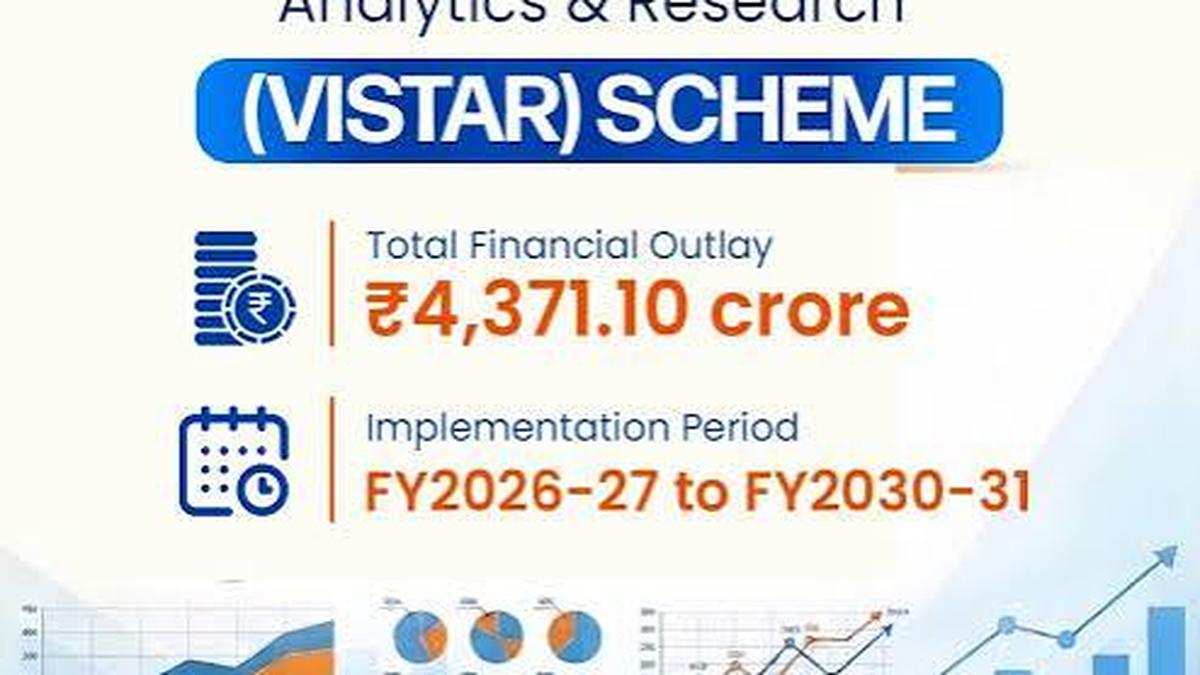
VISTAR aims to modernise India’s statistical system through expanded surveys, digitalisation, AI and stronger State-level capacity, supporting better GDP estimation.
Image: The Hindu
Why in news
The Cabinet has approved the Viksit Bharat Initiative for Statistical Transformation, Analytics & Research (VISTAR). Its emphasis on granular enterprise data and technology-enabled statistical processes makes it important for GDP estimation and evidence-based policymaking.
₹4,371 crore
Approved scheme outlay
2026-27 to 2030-31
Scheme period
59
Surveys proposed
43
Major surveys conducted previously
8th
Economic Census to be undertaken
Background
Official statistics provide the evidence base for national accounts, development planning and policy evaluation. The National Statistical Office under the Ministry of Statistics and Programme Implementation compiles India’s national accounts, while State statistical agencies contribute to sub-national economic statistics. GDP measures the value of final goods and services produced within the domestic territory during a given period; under the production approach, it is derived from gross value added and net taxes on products. Measuring dispersed, small and unincorporated economic activities requires reliable survey frames and representative data because comprehensive enterprise accounts are not always available.
What the Cabinet has approved
VISTAR seeks to create a more timely, granular, interoperable and AI-ready official statistical architecture. Its design combines stronger statistical operations, support for States and Union Territories, and a fresh Economic Census.
MoSPI has proposed 59 surveys during the 16th Finance Commission cycle, compared with 43 major surveys conducted previously. A larger survey programme can address information gaps, but its effectiveness will depend on coverage, questionnaire design, field quality and timely dissemination.
- Comprehensive statistical operations and strengthening of the ecosystem will cover surveys, digitalisation and technology integration.
- Support for Statistical Strengthening will fund State statistical capacity through a redesigned, deliverable-linked framework.
- The Economic Census will provide granular information on non-farm establishments and workers hired.
Infographic
Survey renewal
Expanded statistical operations to address information gaps.
Digital and AI tools
Faster processing and validation with human oversight.
State capacity
Granular local data through stronger statistical institutions.
Enterprise coverage
Economic Census and Business Register to strengthen survey frames.
Statistical trust
Transparent methods, confidentiality and quality assurance.
AI-assisted infographic by Pragnya IAS Academy, based on the cited sources.
How better enterprise data can strengthen GDP estimation
MoSPI will undertake the 8th Economic Census with States and Union Territories to obtain establishment and employment information down to gram panchayat and ward levels. The findings will serve as the baseline for developing the National Statistical Business Register, which can support targeted enterprise surveys.
An Economic Census does not, by itself, calculate GDP. Its principal contribution is to improve knowledge of the establishment population and the sampling frame. Subsequent surveys can estimate output and intermediate consumption more reliably, improving estimates of value added where direct accounting information is limited.
- Better coverage can reduce the risk of omitting small, home-based or otherwise difficult-to-identify establishments.
- Updated activity classifications and establishment information can improve the representativeness of enterprise samples.
- Fresh benchmarks can reduce reliance on outdated structural assumptions when combined with appropriate follow-up surveys.
- Better measurement may revise estimates upwards or downwards; it does not guarantee a higher GDP figure.
AI and alternative data: Complementing, not replacing, surveys
VISTAR proposes end-to-end digitalisation and the use of Artificial Intelligence and Machine Learning primarily in data processing, validation and analysis. MoSPI also intends to mainstream alternative sources such as mobile phones, scanners and e-commerce data to complement traditional surveys and reduce respondent burden.
These tools can potentially flag inconsistencies, assist classification and accelerate processing. However, digital records are generated through participation in particular technologies or markets; they cannot automatically be treated as representative of the entire economy.
- AI-assisted validation should retain human review and auditable decision trails.
- Alternative datasets should be tested for coverage bias, duplication and consistency with statistical concepts.
- Common classifications and metadata are necessary before different datasets can be meaningfully combined.
- Faster processing must not come at the cost of confidentiality or methodological transparency.
State capacity and local evidence-based policymaking
The Support for Statistical Strengthening component envisages Central funding to improve statistical capabilities across States and Union Territories. Its stated priorities include high-quality district-level and other disaggregated data, indigenous data-processing capabilities and locally relevant policy applications.
Granular information can help governments identify spatial differences in enterprise activity and employment rather than relying only on national or State averages. Deliverable-linked support offers an opportunity to connect funding with measurable improvements, provided weaker-capacity States receive adequate technical assistance.
- Comparable district data can help identify infrastructure, credit and skill-development needs.
- Shared standards can improve Centre–State comparability while preserving room for locally relevant surveys.
- Capacity-building should cover field investigators, statisticians, data engineers and officials who use the findings.
Credibility is the central test of statistical modernisation
The scheme’s success should be assessed through improvements in completeness, accuracy, timeliness and usability, not merely the number of surveys or digital tools deployed. The supplied report does not specify detailed AI safeguards, funding conditions or a methodology for translating Economic Census findings into GDP estimates.
Statistical confidentiality and professional integrity therefore remain essential implementation priorities. The Collection of Statistics Act, 2008 provides a statutory framework for collecting statistics and protecting information collected under it; technology adoption must be supported by appropriate safeguards and transparent statistical practices.
- Publish methodologies, coverage limitations and revision explanations.
- Provide anonymised research access with safeguards against re-identification.
- Distinguish genuine economic change from changes caused by improved coverage or methodology.
- Maintain the Business Register so that its usefulness does not decline as establishments open, close or change activity.
| Component | Reported measures | Expected contribution |
|---|---|---|
| Comprehensive statistical operations and ecosystem strengthening | Expanded surveys, end-to-end digitalisation, AI/ML and alternative data sources | More timely and better-validated information across sectors |
| Support for Statistical Strengthening | Deliverable-linked funding and capacity-building for States and Union Territories | More granular and comparable sub-national statistics |
| Economic Census | Enumeration of non-farm establishments and workers hired; baseline for the Business Register | Improved enterprise survey frames and evidence on the unorganised sector |
- 1. Enumerate non-farm establishments through the Economic Census.
- 2. Use the findings as a baseline for the National Statistical Business Register.
- 3. Develop better enterprise sampling frames and conduct targeted surveys.
- 4. Estimate output, intermediate consumption and value added using validated survey evidence.
- 5. Incorporate improved evidence into national accounts with transparent methods and revision explanations.
2026-27 to 2030-31
Approved implementation period for VISTAR, covering statistical operations, State capacity-building and the Economic Census component.
Significance, challenges & way forward
Significance
- Updated establishment information can strengthen measurement of economic activity that is inadequately captured by regular enterprise accounts.
- Granular data can support geographically targeted interventions instead of policies based only on broad averages.
- Digital workflows and AI-assisted checks can improve processing speed and consistency when supported by human oversight.
- Stronger State statistical systems can improve the quality and comparability of sub-national development indicators.
- Reliable and accessible statistics can strengthen public scrutiny, policy evaluation and confidence in economic assessments.
Challenges
- Mobile, seasonal, home-based and frequently changing establishments may be difficult to identify and revisit.
- Uneven staffing and technical capacity across States may produce uneven data quality.
- Mobile-phone and e-commerce datasets may under-represent people and establishments with limited digital participation.
- Combining datasets without reliable linkage rules can create duplication, omissions or misclassification.
- Opaque AI models and inadequate confidentiality safeguards can weaken statistical credibility and respondent trust.
- More surveys can increase respondent and administrative burdens unless their design and scheduling are coordinated.
Way forward
- Prioritise survey design, investigator training and independent quality checks alongside digital infrastructure.
- Measure deliverables through data quality, timeliness and usability rather than survey counts alone.
- Adopt common definitions, classifications and metadata standards across Central and State statistical systems.
- Validate alternative data against representative surveys before using it in official estimation.
- Keep AI applications auditable and subject to human oversight, with clear documentation of errors and limitations.
- Establish regular Business Register updates and publish transparent explanations of resulting statistical revisions.
- Build local analytical capacity so that district-level data translates into identifiable policy decisions.
Key terms
- VISTAR
- Viksit Bharat Initiative for Statistical Transformation, Analytics & Research, the approved scheme to modernise India’s statistical system.
- Economic Census
- An enumeration of establishments that provides information on their activities and employment, supporting economic statistics and survey design.
- Statistical Business Register
- A structured register of business units and their characteristics used to organise and support enterprise statistics.
- Sampling frame
- The operational list or framework from which units are selected for a sample survey.
- Gross value added
- The value of output minus intermediate consumption, measuring the value created by production.
- Unorganised sector
- A category broadly associated with unincorporated household enterprises; its precise coverage depends on the statistical definition used.
- Interoperability
- The ability of datasets and systems to exchange and meaningfully combine information using compatible standards.
- Coverage bias
- Systematic distortion arising when a data source inadequately represents parts of the population being studied.
Link with static syllabus
Prelims practice MCQs
Q1. With reference to VISTAR, consider the following statements: 1. It includes support for strengthening the statistical capabilities of States and Union Territories. 2. It proposes using AI and Machine Learning primarily for data processing, validation and analysis. 3. It seeks to replace traditional surveys entirely with e-commerce data. Which of the statements given above are correct?
Q2. Consider the following statements about the Economic Census proposed under VISTAR: 1. It will collect granular information on non-farm establishments. 2. It will serve as the baseline for developing the National Statistical Business Register. 3. It directly measures GDP solely by counting establishments and workers. Which of the statements given above are correct?
Q3. Under the production approach to national income accounting, gross value added is:
Q4. With reference to alternative digital data in official statistics, consider the following statements: 1. E-commerce data may inadequately represent establishments that operate predominantly offline. 2. A larger volume of digital records automatically eliminates coverage bias. 3. Common classifications and metadata facilitate meaningful integration of datasets. Which of the statements given above are correct?
Mains practice questions
GS 3 · 15 marks · 250 words
Assess how VISTAR can strengthen GDP estimation and evidence-based policymaking in India. Discuss the safeguards required for integrating AI and alternative data into official statistics.
Frequently asked questions
What is VISTAR?
VISTAR stands for Viksit Bharat Initiative for Statistical Transformation, Analytics & Research. It is a ₹4,371 crore scheme approved for 2026-27 to 2030-31 to strengthen India’s statistical system at Central and State levels.
How can the Economic Census improve GDP estimates?
It can provide updated establishment information and a baseline for the Business Register, improving the sampling frames used in enterprise surveys. Those surveys can supply better evidence for estimating output, intermediate consumption and value added.
Will VISTAR replace surveys with AI?
No. The reported design uses AI mainly for processing, validation and analysis, while alternative datasets are intended to complement traditional surveys.
Does improved coverage of the unorganised sector necessarily increase GDP?
No. Updated data may correct omissions, duplication or outdated assumptions, so estimates can move in either direction; the objective is accuracy rather than a predetermined increase.
Sources
Analysis prepared by the Pragnya IAS Academy current-affairs desk with AI assistance from the cited reports. Verify figures with the original sources.
Turn current affairs into marks
Join Pragnya IAS Academy's mentorship for daily answer-writing evaluation on stories like this — classroom programmes from a trusted name in IAS coaching in Hyderabad.