
₹14,500-Crore Energy Storage VGF Scheme: Financing Grid Flexibility
Revise the static topic: UPSC Economy notes
In short: The Union Cabinet has approved a ₹14,500-crore viability-gap funding scheme to support 92 GWh of new grid-scale energy storage during 2026-27 to 2030-31. Covering pumped hydro, batteries and alternative technologies, it seeks to improve project viability and help shift renewable electricity from surplus periods to periods of higher demand.
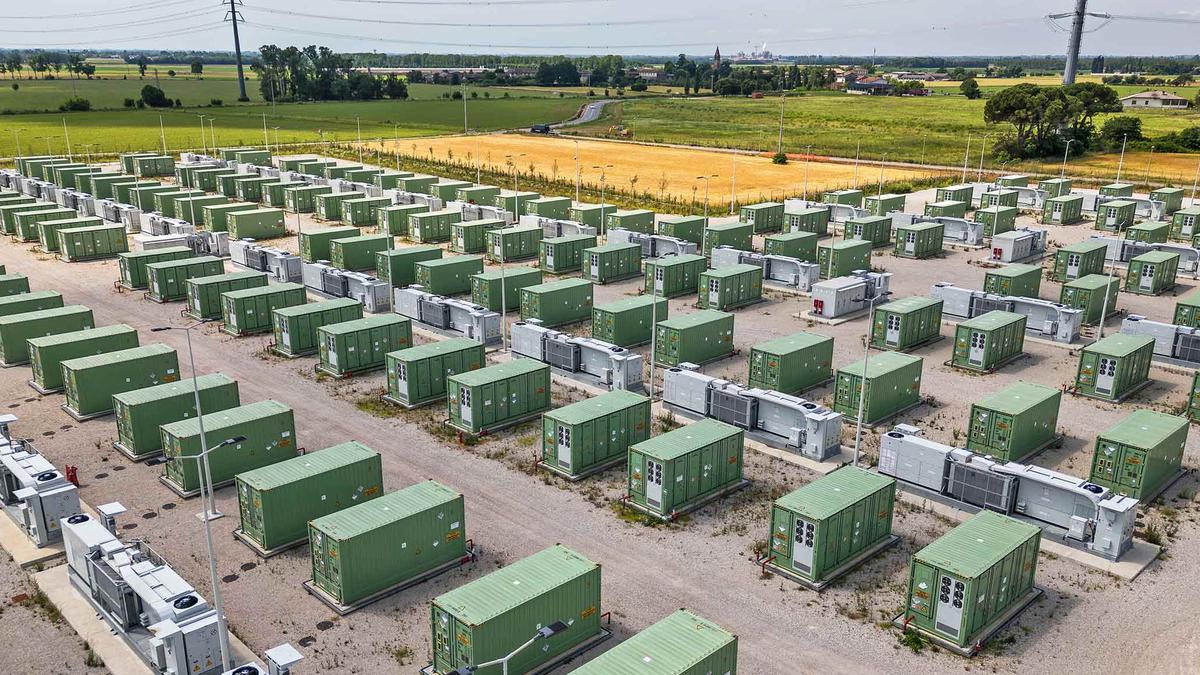
India’s ₹14,500-crore viability-gap funding scheme aims to support 92 GWh of new grid-scale storage, helping shift surplus renewable electricity to periods of higher demand.
Image: The Hindu
Why in news
The Cabinet approved the scheme on November 4, 2026, with tariff-based competitive allocation and a minimum domestic content requirement of 40% for battery energy storage projects. The decision brings storage financing, renewable-energy integration and domestic battery manufacturing into a common policy framework.
₹14,500 crore
Approved VGF outlay
92 GWh
New storage capacity supported
60 GWh
Pumped-storage allocation
30 GWh
Battery-storage allocation
2 GWh
Alternative-technology allocation
40%
Minimum BESS domestic content
Background
Solar and wind generation vary with weather and time, whereas electricity supply and demand must remain balanced in real time. Energy storage absorbs electricity, stores it in another form and returns it when required, subject to conversion losses. Pumped storage uses water held at different elevations, while batteries store energy electrochemically. Viability-gap funding is public financial support intended to make socially or economically desirable infrastructure commercially viable. In electricity, storage complements transmission, flexible generation and demand management rather than replacing them.
What the Cabinet has approved
The scheme covers fresh, yet-to-be-commissioned grid-scale storage capacity during 2026-27 to 2030-31. Its planned technology mix comprises 60 GWh of hydro pumped storage, 30 GWh of battery energy storage systems and 2 GWh through alternative technologies, with total estimated investment of ₹97,600 crore.
Capacity will be allocated through tariff-based competitive bidding. Both public and private sector electricity distribution companies are eligible for VGF support for battery and pumped-storage projects; alternative-technology projects will also be implemented by public and private sector entities.
The government states that the additional capacity is equivalent to 170% of present-day grid-scale storage capacity and will help meet a requirement of 411 GWh by 2031-32. This is a contribution towards the projected requirement, not a claim that the scheme alone will fulfil it.
- BESS projects must meet a minimum domestic content requirement of 40%.
- The supplied announcement does not specify a uniform project-level subsidy rate, disbursement schedule or detailed domestic-content accounting method.
- The ₹97,600-crore figure is estimated total investment, not the approved government funding outlay.
Infographic
Public catalyst
₹14,500 crore in VGF to improve project viability.
Technology portfolio
92 GWh across pumped hydro, batteries and alternatives.
Competitive allocation
Tariff-based bidding backed by deliverable contracts.
Domestic capability
Minimum 40% domestic content for BESS projects.
System outcomes
Reliable peak supply, balancing and better renewable utilisation.
AI-assisted infographic by Pragnya IAS Academy, based on the cited sources.
Why viability-gap funding matters—and where it falls short
Storage can create system-wide benefits through peak supply, renewable integration and grid support, but a project's contracted revenues may not capture all these benefits. High initial investment, uncertain utilisation and unclear remuneration for different services can therefore restrict financing.
VGF can reduce the funding gap and improve project bankability. Competitive bidding can help translate public support into lower tariffs, provided contracts specify comparable performance obligations and realistically allocate construction, operating and payment risks.
However, financial assistance cannot by itself correct weak payment security, poor site selection or unremunerative operating arrangements. Storage economics also depend on charging-power costs, conversion losses, battery replacement requirements and the availability of dependable buyers.
- Public support should enable additional, useful capacity rather than subsidise projects that would proceed without assistance.
- Low bid tariffs must be assessed alongside deliverability, service quality and lifecycle costs.
- Clear rules for earning revenue from multiple compatible grid services can strengthen viability without indefinite subsidy.
Pumped storage and batteries are complementary
Pumped-storage plants use electricity to move water to an upper reservoir and generate electricity when water flows back through turbines. They can support bulk energy shifting and long asset lives, but feasibility depends on topography, water arrangements, civil works and environmental and social safeguards.
Battery systems can respond rapidly and can be located closer to substations, renewable projects or demand centres. Their usefulness for balancing and peak support must be weighed against degradation, thermal safety, replacement costs and end-of-life management.
Technology choice should follow the service required, location and lifecycle cost rather than a universal preference. The alternative-technology allocation creates room for other storage approaches, although the supplied announcement does not identify the eligible technologies.
- GWh measures the quantity of energy stored; GW measures the rate at which power can be delivered.
- Storage duration depends on both energy capacity and discharge power, so a GWh target alone does not establish hours of supply.
- Environmental impacts of pumped storage depend on project design, including whether existing reservoirs or new impoundments are used.
Renewable integration requires more than storage capacity
CREA data cited in the pre-decision report recorded about 1,835 million units of renewable-energy curtailment during July and August 2026, comprising 1,462 million units of solar and 373 million units of wind electricity. These figures highlight an integration challenge but do not establish that all the curtailed electricity could have been recovered through storage.
Storage can absorb surplus generation and discharge during evening peaks or other periods of scarcity. Yet its effectiveness depends on location, charging opportunities, transmission access and dispatch coordination. A storage asset cannot resolve every network bottleneck merely by adding energy capacity.
Electricity-market and regulatory arrangements must therefore recognise storage's charging and discharging functions and compensate the services it actually supplies. Better forecasting, transmission reinforcement and demand response remain essential complements.
- Measure success through reliable delivery, availability and useful renewable-energy absorption, not installed capacity alone.
- Storage shifts energy across time; it is not a primary energy source.
- Its emissions benefit depends partly on the electricity used for charging and the generation displaced during discharge.
Domestic manufacturing: demand certainty with implementation risks
The minimum 40% domestic content requirement for BESS seeks to connect storage deployment with domestic manufacturing. The source also reports an existing production-linked incentive scheme for 50 GWh of advanced chemistry cell manufacturing capacity, of which 10 GWh would account for grid-scale stationary storage.
Demand-side procurement support and supply-side manufacturing incentives can reinforce each other. However, domestic content does not automatically establish domestic cell production, mineral security or technological capability; outcomes depend on which components and value addition qualify.
A separate proposal for capital expenditure support for critical-mineral processing was reported as coming before the Cabinet. The supplied material does not confirm its approval, and its reported possible support rate must not be treated as a provision of the storage VGF scheme.
- Transparent domestic-content verification can limit token localisation and misreporting.
- Procurement should balance domestic capability-building with quality, safety, cost and timely delivery.
- Battery recycling and responsible mineral sourcing should accompany manufacturing expansion.
| Dimension | Hydro pumped storage | Battery energy storage |
|---|---|---|
| Scheme allocation | 60 GWh | 30 GWh |
| Storage mechanism | Gravitational potential energy of water | Electrochemical energy |
| Typical strengths | Bulk energy shifting and long asset life | Rapid response, modularity and flexible siting |
| Key constraints | Suitable sites, civil works, water arrangements and clearances | Degradation, thermal safety, replacement and material supply chains |
| Financing concern | Construction risk and long-term revenue certainty | Lifecycle replacement costs and service-revenue certainty |
| Environmental priorities | Site-specific ecological and social safeguards | Responsible sourcing, safe operation and recycling |
- 1. Identify storage services and locations needed by the electricity system.
- 2. Allocate capacity through tariff-based competitive bidding under the scheme.
- 3. Use VGF to improve project financial viability alongside credible contracts.
- 4. Finance, construct and commission storage with appropriate safeguards.
- 5. Charge when electricity is available and discharge when the system requires it.
- 6. Verify service delivery, reliability and integration benefits.
July–August 2026
CREA data cited by The Hindu recorded about 1,835 million units of renewable-energy curtailment.
November 4, 2026
The Union Cabinet approved the ₹14,500-crore grid-scale energy storage VGF scheme.
2026-27 to 2030-31
The approved scheme period covers support for 92 GWh of new storage capacity.
2031-32
The government identifies a grid-scale storage requirement of 411 GWh, towards which the scheme will contribute.
Significance, challenges & way forward
Significance
- The scheme shifts policy attention from renewable generation capacity towards the flexibility needed to use that generation reliably.
- Public financial support can help mobilise investment where storage's system benefits exceed revenues captured by individual projects.
- A mixed technology portfolio can address different grid services and reduce dependence on a single storage pathway.
- Domestic procurement requirements can create demand visibility for Indian battery manufacturers and component suppliers.
- Well-sited storage can improve peak supply and reduce avoidable renewable-energy curtailment.
Challenges
- Uncertain service revenues and weak buyer payment security can undermine bankability even after VGF support.
- Pumped-storage projects can face geological, construction, environmental and rehabilitation risks.
- Battery projects must manage degradation, fire risks, replacement costs and end-of-life waste.
- Poorly located storage may remain underused or fail to relieve the network constraints causing curtailment.
- Domestic-content requirements may raise procurement challenges if qualifying supplies are insufficient or verification is weak.
- Aggressive tariff bidding can produce financially fragile projects unless performance and risk allocation are credible.
Way forward
- Publish clear eligibility rules, funding limits, disbursement milestones and domestic-content verification procedures.
- Plan procurement around location, discharge power, energy capacity, duration and required grid services.
- Standardise bankable contracts with payment security and enforceable availability and delivery obligations.
- Design transparent remuneration for compatible storage services while preventing double payment for the same obligation.
- Apply project-specific environmental safeguards for pumped storage and lifecycle safety and recycling requirements for batteries.
- Track commissioned capacity, actual availability, delivered energy, integration benefits and public support used.
Key terms
- Viability-gap funding
- Public financial support intended to bridge the commercial viability gap of an otherwise desirable infrastructure project.
- Pumped-storage plant
- A system that pumps water to a higher elevation for storage and releases it through turbines to generate electricity.
- Battery energy storage system
- An integrated battery-based installation that stores electricity electrochemically and supplies it when required.
- Curtailment
- Reduction of electricity generation below what could otherwise have been produced.
- Round-trip efficiency
- The proportion of charging energy recovered as usable electricity after storage and discharge.
- Domestic content requirement
- A condition requiring a specified minimum domestic contribution under the applicable procurement rules.
- Ancillary services
- Services supporting secure electricity-system operation, including frequency control and reserves.
- Revenue stacking
- Earning income from multiple compatible services provided by the same storage asset.
Link with static syllabus
Prelims practice MCQs
Q1. With reference to the approved grid-scale energy storage VGF scheme, consider the following statements: 1. It supports pumped storage, battery storage and alternative storage technologies. 2. Battery energy storage projects are subject to a minimum domestic content requirement of 40%. 3. Only public sector electricity distribution companies are eligible for support for battery and pumped-storage projects. Which of the statements given above are correct?
Q2. Consider the following statements about energy storage: 1. GWh expresses energy capacity, whereas GW expresses power capacity. 2. Pumped storage stores energy by moving water to a higher elevation. 3. Battery systems can provide rapid-response grid services. Which of the statements given above are correct?
Q3. Which of the following best explains the economic rationale for viability-gap funding in energy storage?
Q4. Consider the following pairs relating to capacity supported under the approved scheme: 1. Hydro pumped storage: 30 GWh 2. Battery energy storage: 60 GWh 3. Alternative energy storage technologies: 2 GWh Which of the pairs given above is/are correctly matched?
Mains practice questions
GS 3 · 15 marks · 250 words
Viability-gap funding can accelerate energy storage deployment, but cannot substitute for electricity-sector reforms. Examine with reference to pumped storage and battery systems.
Frequently asked questions
What does the energy storage VGF scheme support?
It supports 92 GWh of fresh, yet-to-be-commissioned storage: 60 GWh of pumped hydro, 30 GWh of batteries and 2 GWh of alternative technologies. The approved VGF outlay is ₹14,500 crore for 2026-27 to 2030-31.
Will VGF alone make storage projects financially viable?
Not necessarily. Projects also need credible revenues, payment security, appropriate charging-power arrangements and realistic provision for construction, operating and replacement costs.
Can storage eliminate renewable-energy curtailment?
Storage can reduce curtailment when it can absorb surplus electricity and discharge usefully later. Network constraints, unsuitable locations and operational limitations mean that it cannot eliminate every instance of curtailment.
Does the announcement specify a uniform subsidy percentage for storage projects?
The supplied announcement does not specify one. The possible support rate reported for a separate critical-mineral processing proposal should not be applied to the storage scheme.
Sources
- The Hindu: Union Cabinet approves ₹14,500 crore VGF scheme to develop large scale energy storage in India
- The Hindu: Union Cabinet to discuss capex support for critical mineral processing, VGF for RE grid-scale storage system
Analysis prepared by the Pragnya IAS Academy current-affairs desk with AI assistance from the cited reports. Verify figures with the original sources.
Turn current affairs into marks
Join Pragnya IAS Academy's mentorship for daily answer-writing evaluation on stories like this — classroom programmes from a trusted name in IAS coaching in Hyderabad.