
Delhi GRAP Stage 2: Emergency Pollution Response and the Case for Airshed Governance
Revise the static topic: UPSC Environment notes
In short: The Commission for Air Quality Management has invoked GRAP Stage 2 after Delhi’s average Air Quality Index reached 324, entering the very poor category. The response strengthens dust control, public transport and measures to discourage private vehicle use, but sustained improvement requires coordinated emission reduction across the wider airshed.
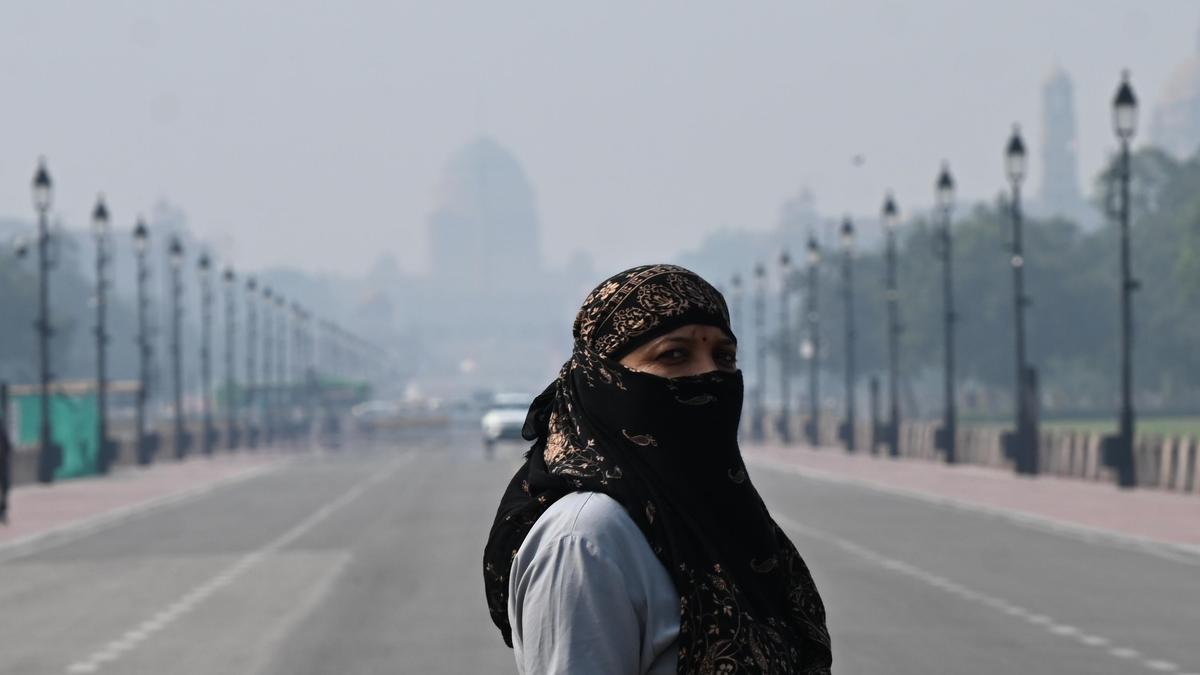
Delhi’s GRAP Stage 2 response strengthens dust control and public transport measures after average AQI reaches 324, in the very poor category.
Image: The Hindu
Why in news
The supplied report records a sharp deterioration in Delhi’s AQI from 117 on October 31, 2026, to 324 on November 2, 2026. With very poor air quality expected to persist, CAQM invoked Stage 2 of the Graded Response Action Plan.
324
Delhi AQI on November 2
261
Delhi AQI on November 1
117
Delhi AQI on October 31
301–400
Very poor AQI band for Stage 2
Background
Delhi’s air pollution reflects the interaction of local emissions, pollution transported from surrounding areas and meteorological conditions that influence dispersion. Vehicular exhaust, road and construction dust, industrial activity, waste burning and seasonal agricultural residue burning can contribute in varying proportions. GRAP is an emergency response framework for deteriorating air quality in Delhi-NCR, while CAQM is a statutory body established under the Commission for Air Quality Management in National Capital Region and Adjoining Areas Act, 2021. An airshed approach addresses the connected geographical area within which pollutants originate, move and accumulate, rather than treating administrative boundaries as atmospheric boundaries.
What Stage 2 activation means
GRAP links progressively stronger interventions to worsening air quality. Stage 2 corresponds to the very poor AQI category and seeks to prevent further deterioration through intensified enforcement and demand-management measures. The framework is cumulative: escalation adds to, rather than replaces, measures already applicable at lower stages.
The report attributes the recent deterioration to unfavourable meteorological conditions. Poor dispersion can raise ambient pollutant concentrations even without a comparable sudden increase in emissions; it does not remove the need to control underlying pollution sources.
- Authorities are to intensify mechanical road cleaning, water sprinkling and dust-control operations.
- Higher parking fees are intended to discourage private vehicle use.
- DMRC has announced additional weekday trips to support a shift towards public transport.
- The report describes staggered timings for public offices and municipal bodies in Delhi and specified NCR districts.
- Open burning of garbage, leaves and municipal solid waste is prohibited.
Infographic
Trigger
AQI 324 places Delhi in the very poor category.
Immediate response
Intensify dust control and discourage private vehicle use.
Accessible alternatives
Expand public transport and improve last-mile access.
Coordinated enforcement
Align CAQM directions with State and local implementation.
Structural prevention
Reduce emissions year-round across the connected airshed.
AI-assisted infographic by Pragnya IAS Academy, based on the cited sources.
Reading vehicle restrictions without conflating legal instruments
The supplied report combines Stage 2 measures with vehicle restrictions attributed to a separate government order. Its vehicle descriptions are internally inconsistent: a caption describes a blanket prohibition on non-BS-VI vehicles, while the body permits certain Delhi-registered BS-IV and higher-standard cars. These statements should not be converted into a definitive vehicle eligibility chart without the operative orders.
The report also gives overlapping ranges for GRAP Stages 3 and 4. The reliable takeaway for this development is the Stage 2 band of AQI 301–400; exact higher-stage thresholds and category-specific restrictions should be checked against CAQM’s current notified schedule.
For examination purposes, distinguish the GRAP stage, any independently applicable vehicle-entry direction, emission-standard requirements and PUC compliance. Possessing a PUC certificate does not by itself override a valid restriction on a vehicle category.
- Vehicle applicability can depend on fuel, emission standard, registration location, vehicle class and exemptions.
- Restrictions associated with a higher GRAP stage should not automatically be attributed to Stage 2.
- Public advisories should identify the issuing authority, applicable area, commencement date and exemptions.
Institutional coordination and the legal foundation
CAQM provides the regional coordination framework, but implementation is distributed across Delhi and NCR State governments, pollution control boards, municipal bodies, transport authorities, traffic police and public transport operators. Effective emergency action therefore depends on consistent directions, operational capacity and shared accountability.
The Air (Prevention and Control of Pollution) Act, 1981, supplies a foundational framework for air pollution control. Constitutional support comes from Article 21 as judicially interpreted to encompass environmental protection, Article 48A on the State’s responsibility to protect the environment, and Article 51A(g) on citizens’ environmental duty.
- Municipal agencies must translate dust-control directions into verifiable street-level operations.
- Transport agencies must expand alternatives when private vehicle use is discouraged.
- Pollution control boards must sustain industrial monitoring and enforcement beyond emergency periods.
- Interstate coordination must prevent pollution control from becoming fragmented at jurisdictional borders.
Why emergency restrictions cannot substitute for airshed management
GRAP is a contingency mechanism, not a complete clean-air strategy. It can limit additional emissions during high-risk episodes, but cannot by itself deliver cleaner industrial production, reliable waste collection, durable road-dust management or a structural shift towards public transport.
Air pollutants move across administrative boundaries. City-only restrictions may therefore have limited effects if emissions continue elsewhere in the connected airshed. Weather also influences measured AQI, making a short-term improvement an unreliable standalone indicator of policy success.
A durable approach requires year-round, source-specific action supported by emission inventories, source-apportionment studies and monitoring. The contribution of individual sources varies across seasons and locations; this report does not establish their relative shares.
- Combine episode management with sustained reductions in transport, industrial, dust and burning-related emissions.
- Evaluate both ambient air quality and verified changes in source emissions.
- Protect vulnerable residents and outdoor workers while ensuring affordable compliance options.
- Treat anti-smog guns and water sprinkling as localised dust-control tools, not substitutes for comprehensive emission reduction.
| Dimension | Emergency GRAP response | Sustained airshed management |
|---|---|---|
| Primary purpose | Limit deterioration during pollution episodes | Reduce underlying emissions and long-term exposure |
| Operational basis | Air-quality conditions, forecasts and stage-specific directions | Emission inventories, source evidence and sectoral plans |
| Typical instruments | Intensified dust control, transport augmentation and temporary restrictions | Cleaner production, reliable public transport, waste systems and durable dust prevention |
| Coordination need | Rapid implementation across enforcement agencies | Continuous cooperation across jurisdictions and sectors |
| Assessment | Timeliness, compliance and episode management | Sustained emission reductions and lower population exposure |
- 1. Monitor ambient air quality and assess meteorological forecasts.
- 2. CAQM assesses deterioration risk and invokes the applicable GRAP stage.
- 3. State and local agencies implement cumulative stage-specific measures.
- 4. Transport operators and enforcement bodies provide alternatives and secure compliance.
- 5. Review air-quality trends and implementation evidence to adjust the response.
1981
The Air (Prevention and Control of Pollution) Act established a foundational statutory framework for air pollution control.
2021
The CAQM Act provided a statutory regional framework for air-quality management in NCR and adjoining areas.
October 31, 2026
Delhi’s AQI was recorded at 117, in the moderate category, according to the supplied report.
November 1, 2026
Delhi’s AQI rose to 261, in the poor category.
November 2, 2026
Delhi’s AQI reached 324, in the very poor category; the report links the deterioration to Stage 2 activation.
Significance, challenges & way forward
Significance
- A graded framework enables coordinated action before pollution deteriorates further.
- Public transport augmentation can make restrictions more feasible and reduce dependence on private vehicles.
- Regional coordination recognises that Delhi’s pollution cannot be governed solely within city boundaries.
- Air-quality management links environmental protection with public health, productivity and equitable urban mobility.
Challenges
- Fragmented responsibility can create gaps between regulatory directions and street-level enforcement.
- Contradictory public descriptions of vehicle restrictions can undermine compliance and public trust.
- Insufficient last-mile connectivity can make higher parking fees and vehicle curbs burdensome for commuters.
- Adverse dispersion conditions can sustain poor air quality despite emergency interventions.
- Temporary restrictions may impose disproportionate costs on small operators and workers without affordable alternatives.
- AQI alone cannot establish which pollution source dominates or how much a particular intervention achieved.
Way forward
- Publish a consolidated, regularly updated advisory separating GRAP measures from independently applicable vehicle orders.
- Pair parking and traffic demand-management measures with reliable, accessible public transport and last-mile services.
- Develop coordinated airshed action plans with clear agency responsibilities and verifiable source-reduction milestones.
- Maintain year-round enforcement against industrial non-compliance, waste burning and preventable dust emissions.
- Use emission inventories, source-apportionment studies and meteorological analysis to prioritise interventions.
- Integrate health advisories and protection for vulnerable groups and outdoor workers into pollution-response planning.
Key terms
- Graded Response Action Plan
- A framework of escalating emergency measures linked to worsening air quality in Delhi-NCR.
- Air Quality Index
- An index that translates monitored pollutant concentrations into categories communicating air-quality conditions and associated health concerns.
- CAQM
- The statutory Commission for Air Quality Management in National Capital Region and Adjoining Areas.
- Airshed
- A geographical area connected by the movement, dispersion and accumulation of air pollutants.
- Source apportionment
- Scientific estimation of the contributions of different sources to measured ambient pollution.
- Emission inventory
- A systematic estimate of pollutants released by different sources within a defined area and period.
- Bharat Stage norms
- Indian standards regulating pollutant emissions from motor vehicles.
- PUC certificate
- A Pollution Under Control certificate indicating compliance with prescribed in-use vehicle emission-test requirements.
Link with static syllabus
Prelims practice MCQs
Q1. With reference to GRAP Stage 2 in the supplied report, consider the following statements: 1. It corresponds to the very poor AQI category of 301–400. 2. Higher parking fees seek to discourage private vehicle use. 3. Its activation automatically establishes a complete ban on all construction activity. Which of the statements given above are correct?
Q2. Consider the following constitutional provisions: 1. Article 48A directs the State to protect and improve the environment. 2. Article 51A(g) places an environmental duty on citizens. 3. Article 21 expressly mentions the Commission for Air Quality Management. Which of the statements given above are correct?
Q3. Which of the following best explains the rationale for an airshed approach to pollution control?
Q4. With reference to air pollution assessment, consider the following statements: 1. An emission inventory estimates releases from different sources. 2. Source apportionment estimates the contributions of sources to ambient pollution. 3. An AQI value by itself identifies the dominant emission source. Which of the statements given above are correct?
Mains practice questions
GS 3 · 15 marks · 250 words
Delhi’s recurring pollution episodes demonstrate that emergency restrictions are necessary but insufficient. Examine the role of GRAP and suggest an airshed-level approach to sustained air-quality improvement.
Frequently asked questions
Why was GRAP Stage 2 invoked in Delhi?
Delhi’s reported AQI reached 324, within the very poor category, and conditions were expected to remain adverse. CAQM invoked Stage 2 to intensify pollution-control measures and limit further deterioration.
Does GRAP Stage 2 mean every older vehicle is automatically banned?
No such blanket conclusion should be drawn from this report, which combines different directions and contains inconsistent vehicle descriptions. Applicability must be checked against current official orders for the relevant vehicle category.
Can emergency restrictions permanently solve Delhi’s air pollution?
They can help manage severe episodes but cannot replace year-round action on transport, industry, dust and burning. Sustained improvement requires coordination across the connected airshed.
What is the difference between an airshed and an administrative region?
An administrative region follows legally defined jurisdictional boundaries. An airshed reflects atmospheric connections and pollutant movement, which may extend across several jurisdictions.
Sources
Analysis prepared by the Pragnya IAS Academy current-affairs desk with AI assistance from the cited reports. Verify figures with the original sources.
Turn current affairs into marks
Join Pragnya IAS Academy's mentorship for daily answer-writing evaluation on stories like this — classroom programmes from a trusted name in IAS coaching in Hyderabad.