
US Fed Holds Rates: Inflation–Growth Trade-off and Implications for India
Revise the static topic: UPSC Economy notes
In short: The US Federal Reserve held its policy rate target range at 3.75–4.00% on October 28, 2026, seeking more evidence before deciding whether further tightening was necessary. The decision highlights the difficulty of containing inflation without unnecessarily weakening growth, while prolonged elevated US rates could influence Indian capital flows, the rupee and the RBI’s policy space.
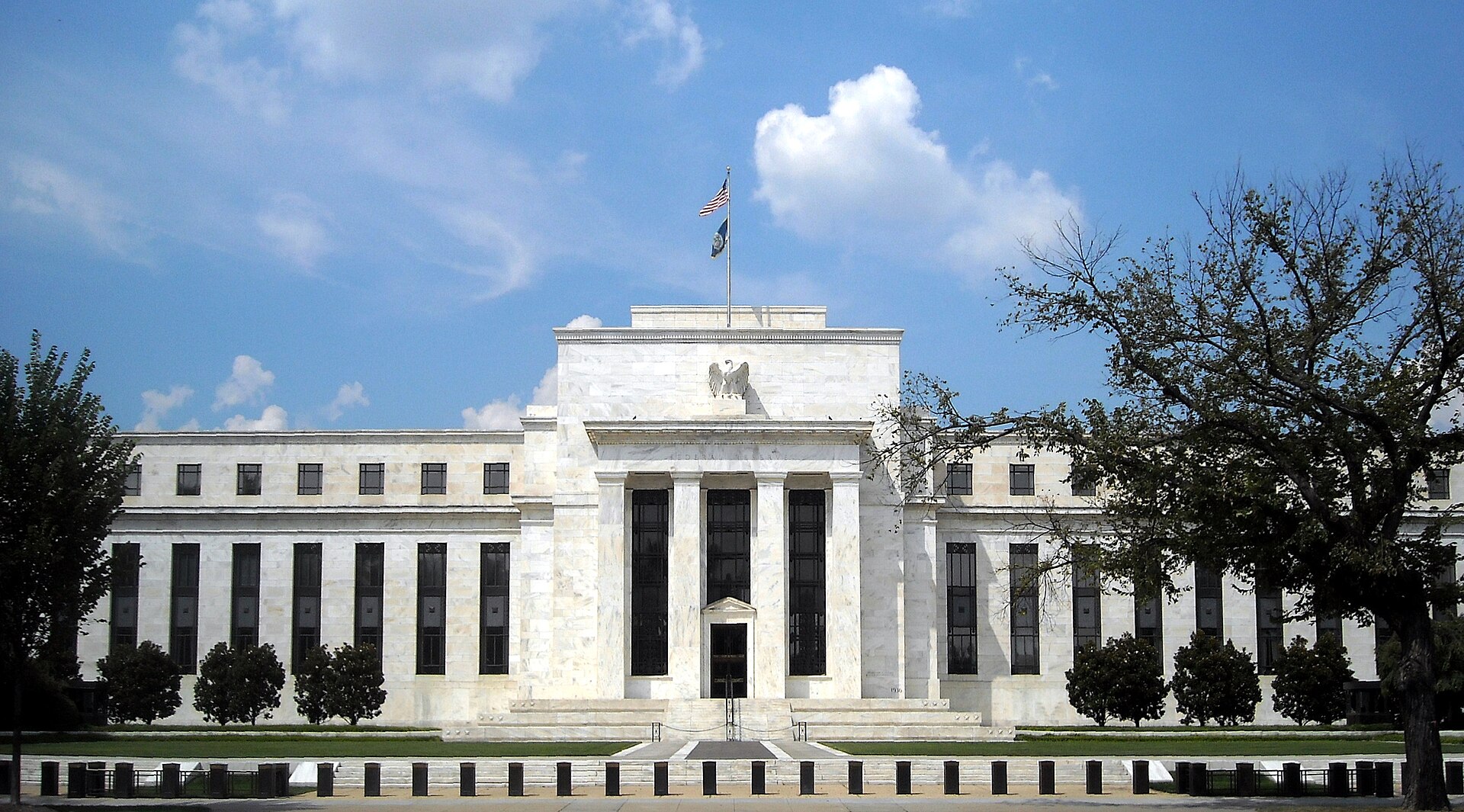
Reference view of the Marriner S. Eccles Federal Reserve Board Building in Washington, D.C., illustrating the institution at the center of the US inflation–growth policy trade-off.
Image: AgnosticPreachersKid · CC BY-SA 3.0
Why in news
According to The Hindu, the Federal Open Market Committee voted 10–2 to leave rates unchanged after a September increase. Two members preferred an immediate rate hike, underscoring disagreement over the urgency of tackling persistent inflation.
3.75–4.00%
Unchanged Fed target range
10–2
FOMC vote to hold rates
3.7%
US consumer inflation in September
2%
Fed’s long-term inflation goal
0.25 percentage point
Rate increase sought by dissenters
Around 4.2%
US unemployment over the past year
Background
The Federal Reserve conducts US monetary policy, with the Federal Open Market Committee setting the target range for the federal funds rate. Its dual mandate concerns maximum employment and stable prices. Policy rates influence credit costs, demand, asset valuations and inflation expectations, but their effects emerge with lags. Because the dollar is central to international finance and trade invoicing, US monetary policy also affects global financial conditions. India’s monetary policy framework, under the Reserve Bank of India Act, makes price stability the primary objective while keeping growth in mind; the Monetary Policy Committee determines the policy rate required to achieve the inflation target.
What the Fed decided—and what a pause means
The Fed maintained its target range at 3.75–4.00%, stating that additional information would help determine the appropriate policy stance. The decision followed a rate increase in September, which the report describes as the first in three years.
A pause is not a rate cut and does not necessarily signal the end of tightening. It leaves the policy rate unchanged while allowing policymakers to assess incoming inflation, employment and activity data. The source reports that the decision was in line with market expectations, so its market impact depends substantially on guidance about the future rate path.
- Governor Lisa Cook and Cleveland Fed President Beth Hammack preferred an immediate increase of 0.25 percentage point.
- The Fed described economic expansion as strong, while the report indicated broadly stable unemployment.
- An unchanged nominal policy rate does not necessarily imply unchanged real monetary conditions, which also depend on expected inflation.
Infographic
Decision
Target range held at 3.75–4.00%; further action remains data-dependent.
Inflation dilemma
Contain persistent price pressures without excessive restraint on growth.
Global finance
US yields and rate expectations influence international portfolio allocation.
India exposure
Capital-flow shifts can affect the rupee, import costs and dollar debt.
RBI response
Retain domestic priorities while managing volatility and liquidity.
AI-assisted infographic by Pragnya IAS Academy, based on the cited sources.
The inflation–growth trade-off
The case for further tightening rests on persistent inflation and resilient activity. September consumer inflation was reported at 3.7%. Continued price pressures can weaken purchasing power and, if expectations become unanchored, make subsequent disinflation more costly.
The case for waiting rests on transmission lags and the composition of inflation. According to the report, energy disruption linked to the war on Iran, tariff policies and investment in artificial intelligence infrastructure have contributed to price pressures. These combine adverse supply and cost shocks with investment-led demand; interest-rate increases cannot directly restore energy supply or remove tariffs.
The central question is whether these shocks remain concentrated in particular prices or spread into persistent inflation through wage demands, pricing behaviour and expectations. Policymakers must weigh the risk of acting too little against the risk of unnecessarily suppressing investment and employment.
- Tightening can moderate demand and prevent second-round inflation, but it cannot directly eliminate supply bottlenecks.
- Waiting helps assess earlier policy action, but prolonged delay can weaken inflation-fighting credibility.
- The Fed’s inflation goal is assessed using the personal consumption expenditures price index; consumer price inflation is a related but distinct measure.
Transmission to India: Capital flows, rupee and imported inflation
If US yields remain elevated relative to Indian returns, dollar assets may become more attractive, potentially moderating portfolio inflows into India or encouraging outflows. However, the interest-rate differential is only one determinant: expected rupee movements, hedging costs, domestic earnings, growth prospects and global risk appetite also matter.
Portfolio outflows or stronger demand for dollars can place depreciation pressure on the rupee. A weaker rupee raises the domestic-currency cost of dollar-priced imports, while higher global energy prices can independently worsen India’s import bill. Together, these channels can complicate inflation management and current-account adjustment.
The effect is not mechanical. An anticipated Fed pause may generate little immediate repricing, whereas unexpected guidance can move markets even without a rate change. The supplied report does not establish any actual Indian capital outflow, rupee movement or RBI response following this decision.
- Debt flows respond to risk-adjusted yields and currency expectations, not merely headline policy rates.
- Equity flows also depend on company earnings and valuations; foreign direct investment is generally less sensitive to short-term rate changes.
- Unhedged dollar borrowers can face higher rupee repayment costs if the domestic currency depreciates.
RBI choices: Domestic mandate with external constraints
The RBI need not mechanically follow the Fed. Its policy-rate decision should reflect domestic inflation prospects, growth conditions and the transmission of external shocks. Nevertheless, exchange-rate pass-through and volatile capital flows can constrain the timing and extent of policy easing.
Different instruments address different problems. The policy rate influences aggregate demand and inflation expectations; foreign-exchange intervention can address disorderly market conditions; liquidity operations can manage the domestic banking-system effects of intervention. Prudential supervision and better corporate hedging can reduce financial vulnerabilities.
- Raising rates solely to defend a particular exchange rate can impose avoidable domestic growth costs.
- Selling foreign exchange can absorb rupee liquidity, requiring separate liquidity management where appropriate.
- Exchange-rate flexibility can absorb external shocks, while intervention can smooth excessive volatility.
- The impossible trinity explains the tension between exchange-rate stability, free capital mobility and independent monetary policy.
Central-bank credibility and the policy mix
The report places the decision amid political pressure on the Fed and approaching US midterm elections. This context makes institutional credibility important, but it does not establish that electoral considerations determined the rate decision.
Central-bank operational autonomy supports credible inflation control, while transparency and accountability help explain difficult trade-offs. Where inflation is driven partly by energy, tariffs or infrastructure bottlenecks, monetary policy works best alongside supply-side measures rather than as a substitute for them.
- Data-dependent communication should explain which developments would justify further tightening or continued restraint.
- Governments should address supply constraints without imposing broad demand stimulus that aggravates inflation.
- For India, coordination should preserve the distinction between monetary-policy decisions and fiscal or administrative responsibilities.
| Channel | Possible transmission | Qualification or policy implication |
|---|---|---|
| Portfolio capital | Attractive dollar returns can moderate Indian inflows or encourage outflows. | Currency expectations, earnings and risk appetite can offset the yield effect. |
| Exchange rate | Outflows and stronger dollar demand can pressure the rupee. | The direction is conditional; an anticipated pause need not cause depreciation. |
| Imported inflation | Rupee depreciation raises the domestic cost of dollar-priced imports. | Pass-through depends on commodity prices, pricing decisions and domestic conditions. |
| Corporate financing | Elevated dollar borrowing costs and depreciation can burden exposed firms. | Debt maturity, refinancing needs and hedging determine vulnerability. |
| RBI policy | External pressures can complicate domestic monetary easing. | The RBI must retain a domestic inflation–growth focus rather than mirror the Fed. |
- 1. US rates remain elevated or guidance raises expected future dollar returns.
- 2. Investors reassess Indian assets against dollar assets, accounting for risk and currency expectations.
- 3. Weaker net portfolio inflows can increase pressure on the rupee.
- 4. Depreciation can raise import costs and the burden of unhedged dollar debt.
- 5. The RBI assesses inflation pass-through, growth and market functioning before choosing its policy response.
September 2026
The Fed raised rates at its previous meeting, according to the report.
September 2026
US consumer inflation registered 3.7%, above market expectations as reported by The Hindu.
October 28, 2026
The FOMC voted 10–2 to retain the 3.75–4.00% target range, with dissenters seeking a rate increase.
Significance, challenges & way forward
Significance
- The decision illustrates that pausing rate changes can be an active risk-management choice rather than a shift towards monetary easing.
- The coexistence of supply shocks and resilient demand makes inflation control more complex than a simple growth-versus-prices choice.
- US monetary policy can influence Indian financial conditions even without any change in India’s policy rate.
- The episode reinforces the importance of central-bank credibility, external buffers and well-hedged foreign-currency exposures.
Challenges
- Delayed monetary transmission makes it difficult to distinguish insufficient tightening from policy effects that have not yet materialised.
- Energy and tariff shocks can raise inflation while weakening real incomes, creating conflicting policy pressures.
- Volatile portfolio flows can transmit global repricing rapidly to domestic bond, equity and currency markets.
- Exchange-rate intervention involves reserve and liquidity-management trade-offs and cannot indefinitely offset persistent fundamentals.
- Political pressure can complicate communication and threaten confidence in rules-based monetary policymaking.
Way forward
- The RBI should base rate decisions on domestic inflation forecasts and growth conditions while explicitly assessing external spillovers.
- Foreign-exchange intervention should address disorderly conditions without committing to an unsustainable exchange-rate level.
- Liquidity operations should be calibrated separately to prevent intervention from unintentionally disrupting monetary transmission.
- Regulators and firms should strengthen monitoring and hedging of foreign-currency debt and refinancing exposure.
- India should reduce vulnerability to imported energy shocks through diversification, efficiency and resilient supply arrangements.
- Clear communication should distinguish a rate pause from easing and explain the conditions that would change the policy stance.
Key terms
- Federal Open Market Committee
- The Federal Reserve body responsible for key US monetary-policy decisions, including the federal funds rate target range.
- Federal funds rate
- The rate on overnight lending of reserve balances between depository institutions in the United States.
- Real interest rate
- An interest rate adjusted for inflation; expected inflation is relevant to forward-looking borrowing and investment decisions.
- Second-round effects
- The spread of an initial price shock into broader wage-setting, pricing behaviour and inflation expectations.
- Exchange-rate pass-through
- The extent to which exchange-rate changes affect import prices and domestic inflation.
- Sterilisation
- Central-bank operations that offset the domestic liquidity impact of foreign-exchange intervention.
- Impossible trinity
- The principle that a fixed exchange rate, free capital mobility and independent monetary policy cannot all be fully maintained simultaneously.
- PCE price index
- The personal consumption expenditures price index, used by the Federal Reserve to assess its inflation goal.
Link with static syllabus
Prelims practice MCQs
Q1. With reference to a central bank’s decision to hold its policy rate unchanged, consider the following statements: 1. It necessarily marks the end of monetary tightening. 2. It allows policymakers to assess the lagged effects of earlier rate changes. 3. An unchanged nominal policy rate can coexist with a change in the real interest rate. Which of the statements given above are correct?
Q2. Consider the following statements about the spillovers of US monetary policy to India: 1. Elevated US yields can influence portfolio allocation towards dollar assets. 2. Rupee depreciation can raise the domestic-currency cost of dollar-priced imports. 3. The RBI is legally required to match every Federal Reserve policy-rate change. Which of the statements given above are correct?
Q3. Which of the following best describes sterilisation in central banking?
Q4. With reference to inflation measurement and monetary policy in the United States, consider the following statements: 1. The Federal Reserve assesses its inflation goal using the personal consumption expenditures price index. 2. Consumer price inflation and PCE inflation are identical measures. 3. Interest-rate increases can directly reverse tariff increases and restore disrupted energy supplies. Which of the statements given above is/are correct?
Mains practice questions
GS 3 · 15 marks · 250 words
Persistent inflation makes monetary-policy pauses a difficult balancing act. Examine this trade-off in the context of the US Federal Reserve’s recent decision and discuss its implications for India’s monetary-policy autonomy.
Frequently asked questions
Why did the Fed hold rates despite inflation pressures?
The Fed said it wanted more information before determining the appropriate policy stance. A pause allows assessment of earlier tightening, although two members considered an immediate increase necessary.
Does the Fed’s pause mean that the rupee will weaken?
No. Rupee movements depend on the decision relative to expectations, future guidance, capital flows, commodity prices and domestic fundamentals; the source provides no evidence of an actual post-decision rupee movement.
Must the RBI follow the Fed’s interest-rate decision?
No. The RBI must pursue its domestic statutory objectives, while accounting for the impact of US policy on capital flows, exchange rates and inflation.
Can higher interest rates solve energy-driven inflation?
They cannot directly restore energy supplies or lower supply-related costs. They can restrain demand and reduce the risk that an energy shock spreads into persistent, broad-based inflation.
Sources
Analysis prepared by the Pragnya IAS Academy current-affairs desk with AI assistance from the cited reports. Verify figures with the original sources.
Turn current affairs into marks
Join Pragnya IAS Academy's mentorship for daily answer-writing evaluation on stories like this — classroom programmes from a trusted name in IAS coaching in Hyderabad.