
Electoral Roll Revision: SIR Legality, Karnataka Deletions and Voter Safeguards
Revise the static topic: UPSC Polity notes · UPSC Governance notes
In short: Karnataka’s final electoral roll after Special Intensive Revision recorded a net reduction of 17.92%, while the Election Commission’s procedures face Supreme Court scrutiny. The central issue is whether roll purification is being conducted within statutory limits, with meaningful safeguards against excluding eligible voters.
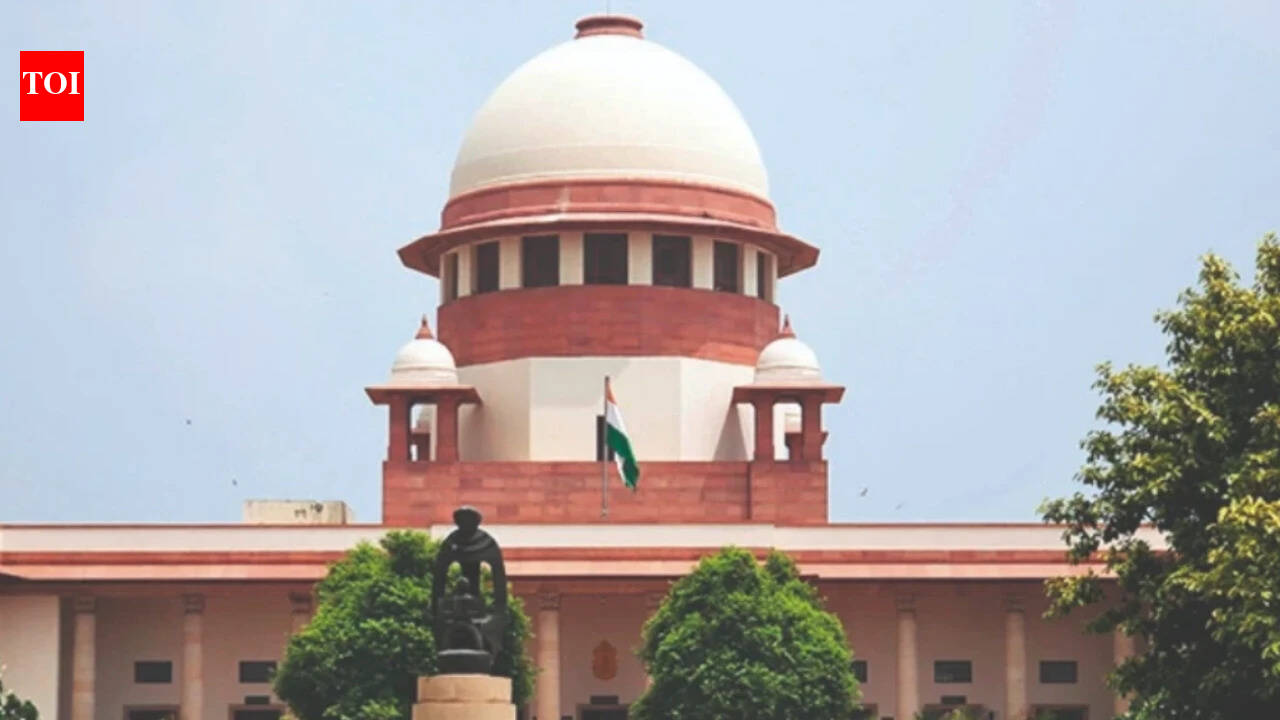
Reference view of the Supreme Court of India. The Court’s scrutiny of Special Intensive Revision procedures concerns statutory limits and safeguards against excluding eligible voters.
Image: Times of India
Why in news
Karnataka’s final roll recorded a net decline of over 99.32 lakh electors, the second-steepest percentage contraction among the 24 States and Union Territories covered in the supplied report. Separately, the Election Commission submitted a Supreme Court affidavit explaining the online Form 6 controversy, SIR decision-making and appeals against voter inclusion in West Bengal.
17.92%
Karnataka roll contraction
Over 99.32 lakh
Karnataka net elector reduction
Over 40%
Bengaluru Urban roll contraction
10.08 lakh
New electors added during claims
61,867
Notified draft electors found ineligible
7.04 crore
Net reduction across 24 States/UTs
Background
The Election Commission of India supervises electoral roll preparation under Article 324, while Article 326 establishes adult suffrage for elections to the Lok Sabha and State Legislative Assemblies. The Representation of the People Act, 1950 governs electoral registration, including eligibility, ordinary residence, revision, correction and inclusion. The Registration of Electors Rules, 1960 prescribe procedures and forms. Special Intensive Revision is a method of revising rolls, not an independent source of power to alter statutory eligibility or dispense with procedural fairness.
Karnataka: A large contraction, not a self-explanatory finding
Karnataka’s electorate declined from 5,54,32,314 before SIR to 4,55,00,011 in the final roll. The reported 17.92% contraction was second only to Arunachal Pradesh’s 22% among the 24 States and Union Territories for which final rolls had been published.
The report identifies absent, shifted, deceased and duplicate entries as categories excluded from the draft. It also records notices to electors already in the draft, subsequent findings of ineligibility and new enrolments during claims and objections. These are distinct administrative stages and should not be merged into a single explanation of the final decline.
A net reduction is not the same as gross deletions because additions also occur. Nor does the scale alone establish either wrongful exclusion or successful removal of ineligible entries. Karnataka’s Chief Electoral Officer said the exercise was lawful and transparent and ruled out mass generation of Form 7.
- Bengaluru Urban’s decline of over 40% warrants closer examination of migration, residence verification and access to registration.
- Temporary absence must not automatically be equated with loss of ordinary residence.
- The CEO reported fewer than 1,000 detected foreigners; the overall contraction cannot therefore be described as a count of non-citizens.
- Published data should reconcile opening rolls, draft exclusions, restorations, additions and final deletions.
Infographic
Lawful authority
Revision must remain within statutory powers and eligibility rules.
Verified grounds
Absence or a software flag is not conclusive proof of ineligibility.
Fair procedure
Provide effective notice, a hearing and a reasoned decision.
Accessible remedies
Enable assisted correction, enrolment and applicable appeals.
Transparent outcomes
Distinguish deletions, additions, restorations and net changes.
AI-assisted infographic by Pragnya IAS Academy, based on the cited sources.
Legal basis: Revision powers are broad but bounded
Section 21(3) of the Representation of the People Act, 1950 permits the Election Commission, for reasons recorded, to direct a special revision of an electoral roll or part of it in the manner it considers appropriate. The existing roll continues in force until completion of that special revision. Article 324 supports electoral administration but does not authorise overriding legislation.
Sections 19 and 20 govern age eligibility and ordinary residence. Section 22 addresses correction, transposition and deletion of entries after verification, while Section 23 governs inclusion. Section 24 provides a statutory appeal framework for specified registration orders. These provisions must be read with the Registration of Electors Rules, 1960.
- An elector does not cease to be ordinarily resident merely because of temporary absence.
- Duplicate registration is prohibited, but duplicate detection must distinguish multiple entries from different individuals with similar details.
- Revision methodology cannot create new eligibility conditions outside the governing law.
- Adverse residence or eligibility findings require the prescribed verification and reasonable opportunity to be heard.
Form 6: A digital interface cannot rewrite a statutory form
The Indian Express reported that a declaration seeking links to an earlier intensive revision roll was inserted into the online Form 6 interface and appeared even where SIR was not underway. Internal objections questioned this change because the statutory form can be amended only by the Central Government through the applicable rule-making process.
In its affidavit, the Commission acknowledged that the online presentation could be construed as an amendment, while maintaining that no amendment had occurred. It described the declaration as a voter-assistance measure intended to reduce documentation requirements where an applicant or family member could be traced to an earlier SIR roll.
The Commission said it decided on October 21 to display Form 6 and the SIR declaration separately. This separates the statutory enrolment application from the additional SIR process; it does not, by itself, settle every legal question concerning that declaration.
- Digital design must faithfully implement statutory requirements rather than introduce hidden substantive conditions.
- The Commission’s assertion that the declaration had been upheld should be distinguished from independently examining the relevant judicial order.
- The EC said SIR initiation decisions were unanimous; internal suggestions and queries should not automatically be treated as final institutional decisions.
Supreme Court scrutiny: Data flags versus lawful adjudication
The supplied Times of India headline reports that the Supreme Court had yet to test the legality of using a “logical discrepancy” in SIR. The accompanying extract contains no substantive judicial reasoning. It therefore supports neither a claim that the Court invalidated the method nor a claim that it conclusively approved it.
The Indian Express report describes a distinct, court-directed process in West Bengal: software selected 60.06 lakh electors for adjudication, and judicial officers ordered deletion of 27.16 lakh names. The Commission subsequently reported appeals both by deleted electors and against orders restoring or including names.
According to the Commission’s affidavit, officers in the West Bengal CEO’s office filed appeals against inclusion under authority derived from the governing law and court orders. The supplied report leaves unresolved the precise number filed by those officers and the reasons for them. This court-directed arrangement should not be presented as the ordinary statutory procedure nationwide.
- A software flag is a trigger for verification, not a self-sufficient legal finding of ineligibility.
- An appeal against inclusion is not equivalent to a completed deletion.
- Judicial scrutiny must distinguish power to revise rolls from legality of particular methods and individual decisions.
Inclusive rolls: Accuracy and participation are complementary
An accurate roll must exclude legally ineligible or duplicate entries while retaining and enrolling every eligible elector. Institutional performance should therefore be assessed by correctness, accessibility and remedies, not by the number of names removed.
Article 14 requires non-arbitrary administration, while Articles 325 and 326 anchor non-discriminatory electoral registration and adult suffrage. The right to vote is regulated by statute within this constitutional framework. Notice, accessible verification and effective remedies make these principles operational.
- Residence verification should account for migrants, tenants, students and people temporarily away for work.
- Assisted offline channels are necessary where digital access or documentary availability is limited.
- Individualised reasons and prompt correction mechanisms are essential to prevent administrative errors from becoming electoral exclusion.
| Provision or instrument | Function | Key limit or safeguard |
|---|---|---|
| Article 324 | Supervision, direction and control of electoral roll preparation | Must operate consistently with governing legislation |
| Section 21(3), RPA 1950 | Special revision for reasons recorded | Existing roll continues until completion of special revision |
| Section 20, RPA 1950 | Determination of ordinary residence | Temporary absence alone does not end ordinary residence |
| Section 22, RPA 1950 | Correction, transposition and deletion | Verification and prescribed opportunity to be heard |
| Form 6 | Application for new voter enrolment | Online presentation cannot amend the statutory form |
| Form 7 | Objection to proposed inclusion or request for deletion | Filing the form does not itself establish grounds for deletion |
- 1. Identify a possible discrepancy through verification or an objection.
- 2. Examine the statutory ground, including ordinary residence and possible duplication.
- 3. Provide specific notice and the prescribed opportunity to respond.
- 4. Assess the response and evidence through individualised verification.
- 5. Issue and communicate a reasoned order through the competent authority.
- 6. Enable the applicable appeal or correction remedy and update the roll accordingly.
June 24, 2025
The Commission ordered SIR in Bihar; its affidavit states that the decision was unanimous.
October 27, 2025
The Commission ordered a subsequent SIR rollout to other States.
May 14, 2026
The Commission issued another SIR rollout order, also described in its affidavit as unanimous.
June 16, 2026
Karnataka’s existing roll on this date formed the reported base for generating enumeration forms.
August 24, 2026
Karnataka’s draft roll was published with 4,46,80,151 electors.
Significance, challenges & way forward
Significance
- Reliable electoral rolls protect both electoral integrity and eligible citizens’ participation.
- Scrutiny of SIR clarifies the boundary between administrative discretion and statutory safeguards.
- The Form 6 controversy shows that digital public infrastructure can affect substantive legal rights through interface design.
- Transparent explanations of large roll changes can strengthen confidence in the Election Commission.
Challenges
- High residential mobility complicates verification and increases the risk of confusing temporary absence with permanent relocation.
- Software-generated discrepancies can misclassify individuals when records contain spelling, age or relationship inconsistencies.
- Documentation burdens and inaccessible notices may disproportionately affect vulnerable eligible electors.
- Large volumes of objections and appeals can weaken individualised scrutiny unless adjudicatory capacity is adequate.
- Aggregate contraction figures cannot establish the legality of individual exclusions without disaggregated reasons and case outcomes.
Way forward
- Publish reconciliation statements distinguishing gross deletions, additions, restorations and net changes, with privacy-protecting category-wise explanations.
- Treat automated flags as preliminary indicators requiring human verification against statutory grounds.
- Ensure effective service of notices, intelligible reasons and accessible hearings before adverse residence or eligibility decisions.
- Provide assisted enrolment and correction facilities through both offline and digital channels.
- Maintain clear separation between statutory forms and supplementary declarations, with legal review of portal changes.
- Disclose the legal basis, authorisation and broad grounds for official appeals against inclusion without prejudicing pending cases.
- Audit unusually large local contractions and measure error correction and eligible-voter inclusion alongside roll-cleaning outcomes.
Key terms
- Special Intensive Revision
- An intensive electoral roll revision exercise conducted under the Election Commission’s statutory revision powers.
- Ordinary residence
- The legally relevant residence connecting an eligible person to a constituency; temporary absence alone does not terminate it.
- Electoral Registration Officer
- The statutory authority responsible for preparing and revising the electoral roll of a constituency.
- ASDD
- Absent, shifted, deceased and duplicate: administrative categories used in the reported Karnataka revision.
- Logical discrepancy
- An apparent inconsistency in elector data flagged for scrutiny, whose legal use in SIR is under examination.
- Claims and objections
- The process for seeking inclusion or correction and contesting entries during electoral roll revision.
- Net contraction
- The fall between opening and final roll totals after accounting for additions and removals.
- Natural justice
- Procedural fairness requiring an unbiased decision and a meaningful opportunity to answer an adverse case.
Link with static syllabus
Prelims practice MCQs
Q1. With reference to special revision under the Representation of the People Act, 1950, consider the following statements: 1. The Election Commission may direct a special revision for reasons recorded. 2. Ordering a special revision immediately renders the existing electoral roll inoperative. 3. The power of special revision permits the Commission to override statutory eligibility requirements. Which of the statements given above is/are correct?
Q2. Consider the following pairs: 1. Article 324 — Supervision of electoral roll preparation 2. Article 325 — Elections based on adult suffrage 3. Article 326 — Prohibition of exclusion from electoral rolls on grounds only of religion, race, caste or sex Which of the pairs given above is/are correctly matched?
Q3. With reference to voter registration, consider the following statements: 1. Form 6 is used for new voter enrolment. 2. Form 7 may be used to seek deletion of a name from an electoral roll. 3. Temporary absence from a place automatically terminates ordinary residence there. Which of the statements given above are correct?
Q4. A final electoral roll contains fewer electors than the pre-revision roll, although new electors were also added during revision. Which conclusion necessarily follows?
Mains practice questions
GS 2 · 15 marks · 250 words
Electoral roll purification must not become electoral exclusion. Examine the legal basis of Special Intensive Revision and suggest safeguards for an accurate and inclusive electoral roll.
Frequently asked questions
Has the Supreme Court declared the logical-discrepancy method illegal?
The supplied material does not establish such a ruling. The available headline says its legality had yet to be tested, while the extract provides no substantive judicial reasoning.
Does Karnataka’s electoral roll decline mean that all removed entries were illegal?
No. Net contraction reflects additions and removals, and each exclusion must be assessed against its legal ground and the procedure followed.
Can a person be removed merely for being temporarily away from home?
Temporary absence alone does not terminate ordinary residence under Section 20 of the Representation of the People Act, 1950. A decision must assess the relevant facts and applicable safeguards.
What was the dispute over online Form 6?
An SIR declaration was displayed in a manner that could appear to amend the statutory form. The Commission acknowledged the presentation concern and said it would separate Form 6 from the SIR declaration.
Sources
- Times of India: Yet to test legality of logical discrepancy in SIR: Supreme Court
- Indian Express: Form 6, voter roll deletions: What Election Commission told the Supreme Court
- Indian Express: Karnataka final roll sees 18% dip after SIR, slide second steepest
Analysis prepared by the Pragnya IAS Academy current-affairs desk with AI assistance from the cited reports. Verify figures with the original sources.
Turn current affairs into marks
Join Pragnya IAS Academy's mentorship for daily answer-writing evaluation on stories like this — classroom programmes from a trusted name in IAS coaching in Hyderabad.