
E100 Vehicle Rules: Emission Testing, Flex-Fuel Compatibility and Biofuel Trade-offs
Revise the static topic: UPSC Environment notes
In short: The Ministry of Road Transport and Highways has amended the Central Motor Vehicles Rules, 1989, to enable certification of vehicles using E100, alongside existing provisions for E85. These fuels are restricted to manufacturer-designed flex-fuel vehicles; the changes neither make ordinary petrol vehicles compatible nor require existing owners to convert them. The environmental outcome depends on vehicle performance, ethanol production methods and the associated land, food and water demands.
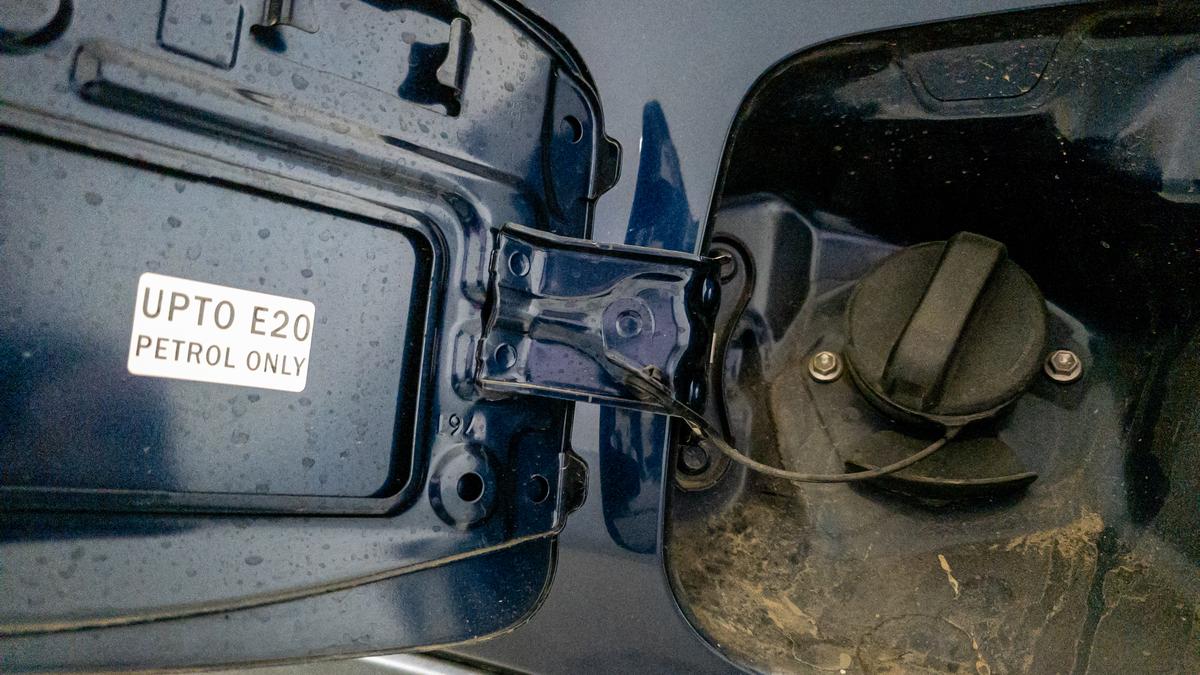
Photo from the source report: E100 Vehicle Rules: Emission Testing, Flex-Fuel Compatibility and Biofuel Trade-offs
Image: The Hindu
Why in news
Amendments to Rules 115 and 115E expand the regulatory framework for ethanol-based vehicle fuels and emission testing. They bring vehicle compatibility, certification and the sustainability of higher ethanol blends into focus.
100%
Ethanol content of E100, subject to fuel specifications
85%
Maximum ethanol content of E85 as described in the source
20%
Ethanol content of E20
2025
E20 target achieved, according to the source
5%
Government-estimated E20 mileage decline cited in the source
Background
The Central Motor Vehicles Rules, 1989, framed under the Motor Vehicles Act, regulate vehicle construction, equipment and emission-related requirements. Ethanol is an alcohol fuel that can be produced from sugar-, starch- or cellulosic feedstocks and used in appropriately designed engines. India's ethanol-blending programme seeks to substitute part of petrol consumption with domestically produced fuel. However, a fuel specification, a vehicle's engineering compatibility and its emission certification are distinct requirements: permission to market or certify a fuel-vehicle combination does not establish that every existing vehicle can use it.
What the amendments change
The amendments modify Rule 115, concerning emission standards and related motor-vehicle requirements, and Rule 115E, containing additional emission-testing provisions. E100 is included alongside E85 in several tables under Rule 115, creating a clearer regulatory pathway for E100 vehicle certification.
An explanatory note limits E85 and E100 use to flex-fuel vehicles designed by original equipment manufacturers. The changes also correct fuel classifications, including replacing an earlier E10 notation with a reference to gasoline blended with E20.
This is an enabling regulatory change, not a compulsory conversion programme. The supplied report does not reproduce the complete notification or numerical emission limits; it therefore does not establish that pollutant limits have been tightened or relaxed.
- The immediate regulatory benefit is a clearer basis for type approval of E100-capable vehicles.
- Authorised testing agencies, such as the Automotive Research Association of India, verify compliance with applicable technical, safety and environmental standards.
- Existing vehicle owners are not required to switch to E85 or modify their vehicles.
Infographic
Regulatory clarity
Rules 115 and 115E support an E100 certification pathway.
Vehicle compatibility
Use only manufacturer-approved flex-fuel vehicles.
Emission integrity
Separate tailpipe compliance from lifecycle climate performance.
Resource safeguards
Protect food supply, water availability and soil health.
Consumer protection
Ensure clear labels, warranties and cost-per-kilometre transparency.
Transition alignment
Complement electrification and public transport.
AI-assisted infographic by Pragnya IAS Academy, based on the cited sources.
Compatibility and testing: approval is specific to the vehicle
Compatibility with E10 or E20 does not establish compatibility with E85 or E100. Higher ethanol concentrations require suitable fuel-system materials, engine calibration and fuel-delivery arrangements. Motorists should rely on the vehicle's fuel-compatibility sticker and the manufacturer's manual rather than assume that all petrol engines can use higher blends.
Ethanol has lower energy density than petrol, making energy delivered per litre important when comparing mileage and cost. Its affinity for water also makes moisture control and fuel-quality assurance important during storage and distribution.
Certification must assess compliance for the intended fuel-vehicle combination. A regulatory route to homologation is necessary for market entry, but it is not evidence that every vehicle will deliver the same fuel economy, durability or environmental performance.
- Pump labelling should clearly distinguish E20, E85 and E100 to reduce misfuelling risks.
- Consumers need vehicle-specific information on permitted fuels, warranty coverage and expected fuel economy.
- Higher blends require compatible storage and dispensing infrastructure.
Tailpipe compliance is not lifecycle climate performance
Emission testing addresses pollutants under prescribed test conditions. Climate assessment asks a wider question: what emissions arise from cultivating feedstock, producing fertilisers, processing and transporting ethanol, and finally using it in a vehicle?
Ethanol combustion releases carbon dioxide. Although feedstock plants absorb carbon during growth, that alone does not make ethanol carbon-neutral: cultivation, processing energy and land-use change can alter the overall balance. Climate benefits must therefore be demonstrated for specific production pathways rather than assumed from the ethanol percentage.
The source records an expert concern that ethanol expansion could distract from electrification. The appropriate policy comparison is lifecycle-based: electric vehicles have no exhaust emissions, but their overall footprint also depends on electricity generation and manufacturing. Ethanol policy should complement, rather than displace, sustained electrification and public-transport investment.
- Separate local air-quality compliance from lifecycle greenhouse-gas assessment.
- Evaluate processing energy and feedstock origin alongside vehicle performance.
- Do not equate a higher ethanol blend automatically with a larger net climate benefit.
The food-water-energy nexus and economic trade-offs
Crop-based ethanol links transport demand to agricultural land, irrigation, fertilisers and food or feed markets. Additional demand can create market opportunities for farmers, but competition for crops and water must be assessed, particularly in water-stressed regions.
Cellulosic residues and suitable wastes can reduce direct competition with food crops, but they are not impact-free. Residues have alternative uses and contribute to soil health; collection, transport and processing also require resources.
Lower petroleum dependence does not guarantee lower retail prices or lower running costs. Ethanol procurement costs, processing and distribution expenses, pricing policy and vehicle mileage all matter. Comparing ethanol and crude oil prices alone is insufficient because they differ in energy content and position in the fuel supply chain.
- Assess feedstock expansion against local water availability and existing food and feed requirements.
- Use cost per kilometre, not merely price per litre, to assess consumer affordability.
- Distinguish gains in energy security from gains in climate mitigation: neither automatically proves the other.
| Fuel | Composition described in the source | Vehicle-use implication |
|---|---|---|
| E10 | Petrol blended with 10% ethanol | E10 compatibility does not establish suitability for higher ethanol blends. |
| E20 | Petrol blended with 20% ethanol | Use requires manufacturer-confirmed compatibility; it does not establish E85 or E100 suitability. |
| E85 | Fuel containing up to 85% ethanol | Restricted to manufacturer-designed flex-fuel vehicles under the explanatory note. |
| E100 | 100% ethanol, subject to applicable fuel specifications | Included alongside E85 in several Rule 115 tables; requires a compatible flex-fuel vehicle. |
- 1. Rules recognise E100 within the relevant emission and testing framework.
- 2. The manufacturer develops a flex-fuel vehicle compatible with the intended fuels.
- 3. An authorised agency tests compliance with applicable technical, safety and emission requirements.
- 4. The vehicle obtains type approval after satisfying the prescribed requirements.
- 5. Compatible fuel distribution, clear labelling and manufacturer guidance support consumer use.
1989
The Central Motor Vehicles Rules establish the regulatory framework subsequently amended for ethanol-related vehicle requirements.
2018
The National Policy on Biofuels provides the policy context for ethanol expansion; the source identifies 2030 as the original E20 target year.
2025
India achieves the E20 blending target, according to the supplied report.
April 2026
The supplied report states that E20 becomes mandatory for petrol sold across India.
Significance, challenges & way forward
Significance
- The amendments provide regulatory clarity for certification and commercial introduction of E100-capable vehicles.
- Domestic ethanol can substitute part of petroleum fuel demand and diversify transport-energy supply.
- Explicit compatibility requirements help distinguish approved flex-fuel vehicles from ordinary petrol vehicles.
- The policy creates an opportunity to integrate agricultural, energy and environmental decision-making rather than pursue blending targets in isolation.
Challenges
- Legacy-vehicle compatibility concerns may translate into maintenance, warranty and consumer-confidence disputes.
- Lower energy density can affect mileage, making price-per-litre comparisons misleading.
- Moisture contamination and incompatible distribution equipment can undermine fuel quality.
- Crop-based feedstock expansion can intensify competition for food, feed, land and irrigation water.
- Lifecycle benefits vary with feedstock, processing energy and land-use impacts, limiting the usefulness of blanket environmental claims.
- Large commitments to ethanol infrastructure could compete with resources needed for electrification and public transport.
Way forward
- Publish accessible, fuel-specific certification requirements and vehicle-model compatibility information.
- Require clear pump labels, transparent warranty terms and communication that existing owners are not mandated to convert to E85.
- Commission independent assessments of mileage, durability and emissions across representative vehicle-fuel combinations.
- Develop lifecycle accounting that includes cultivation, processing, transport and land-use effects.
- Align feedstock procurement with regional water budgets and food-security safeguards.
- Promote suitable waste- and residue-based pathways while protecting soil health and recognising competing residue uses.
- Evaluate policy support through emissions avoided and consumer cost per kilometre, while maintaining investment in electrification and public transport.
Key terms
- E100
- Fuel consisting of 100% ethanol, subject to applicable fuel specifications.
- Flex-fuel vehicle
- A manufacturer-designed vehicle capable of operating on a specified range of petrol-ethanol fuels.
- Homologation
- The official process of establishing that a vehicle or component meets applicable regulatory requirements.
- Type approval
- Regulatory approval of a vehicle type after it meets prescribed standards.
- Lifecycle emissions
- Emissions assessed across production, processing, transport and use, with relevant upstream and land-use effects.
- Energy density
- The energy contained in a given quantity of fuel, relevant to fuel consumption and range.
- Food-water-energy nexus
- The interdependence of food production, water use and energy supply, through which decisions in one sector affect the others.
- Cellulosic ethanol
- Ethanol produced from cellulose-rich material such as agricultural residues rather than directly from sugar or starch.
Link with static syllabus
Prelims practice MCQs
Q1. With reference to the E100 vehicle-rule amendments, consider the following statements: 1. They modify Rules 115 and 115E of the Central Motor Vehicles Rules. 2. E20 compatibility automatically establishes a vehicle's suitability for E85. 3. E85 and E100 use is restricted to manufacturer-designed flex-fuel vehicles under the explanatory note. Which of the statements given above are correct?
Q2. In the context of motor-vehicle regulation, homologation refers to:
Q3. Consider the following statements about ethanol as a transport fuel: 1. Ethanol has lower energy density than petrol. 2. Ethanol's affinity for water makes moisture control relevant to fuel handling. 3. Ethanol combustion releases no carbon dioxide. Which of the statements given above are correct?
Q4. Which of the following are relevant to assessing the lifecycle sustainability of crop-based ethanol? 1. Irrigation demand in the feedstock-growing region 2. Energy used in ethanol processing 3. Land-use change associated with feedstock expansion 4. Competition with food and feed uses Select the correct answer using the code below.
Mains practice questions
GS 3 · 15 marks · 250 words
India's E100 vehicle-rule amendments create a regulatory pathway, not an automatic sustainability guarantee. Discuss with reference to vehicle compatibility, lifecycle emissions and the food-water-energy nexus.
Frequently asked questions
Can an E20-compatible car use E100?
E20 compatibility does not establish E100 suitability. E100 should be used only in a manufacturer-designed flex-fuel vehicle approved for it, following the compatibility sticker and owner's manual.
Do the amendments require existing vehicle owners to convert their vehicles?
No. The Ministry states that the notification does not require existing owners to switch to E85 or modify their vehicles, now or in the future.
Is E100 a zero-emission or automatically carbon-neutral fuel?
No. Ethanol combustion releases carbon dioxide, and its net climate performance depends on cultivation, processing energy, transport and land-use effects.
Will higher ethanol use necessarily reduce driving costs?
No. Running costs depend on fuel prices and vehicle fuel economy; ethanol's lower energy density makes cost per kilometre a better comparison than price per litre alone.
Sources
Analysis prepared by the Pragnya IAS Academy current-affairs desk with AI assistance from the cited reports. Verify figures with the original sources.
Turn current affairs into marks
Join Pragnya IAS Academy's mentorship for daily answer-writing evaluation on stories like this — classroom programmes from a trusted name in IAS coaching in Hyderabad.