
InfoGraphix by Pragnya · Geography · Chapter 20
Manufacturing Industries
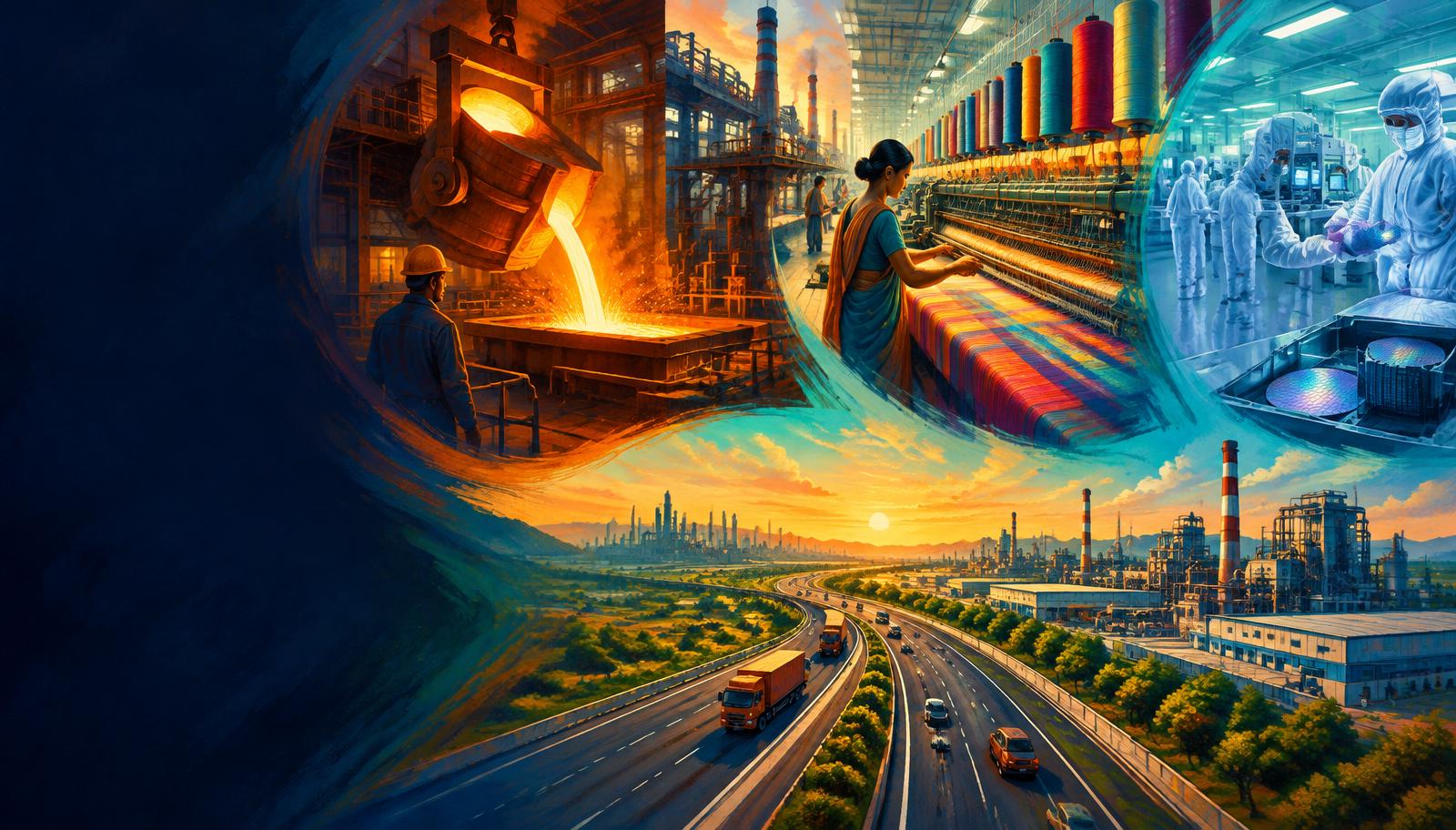
Explain where industries locate, how their production chains work and why industrial regions change. Connect India’s established manufacturing belts with cleaner technology, semiconductor projects and industrial corridors.
- 18 visual topics
- 54 practice MCQs
- 54 flip cards
Three lenses on manufacturing
Topics 1–6
Inputs and location
Classify industry, test Weber’s logic and explain cotton, jute and sugar.
Topics 7–12
Heavy and process industries
Map steel and examine decarbonisation, aluminium, cement and chemicals.
Topics 13–18
New networks and regions
Connect skills, electronics, mobility, regional clusters and industrial corridors.
From raw materials to connected industrial ecosystems
Scroll the ribbon and tap any milestone to open its infographic.
Model
Weber and Least-Cost Location
Start with transport, labour and clustering costs.
Open topic →1854
Cotton Textiles and Textile Parks
Modern cotton mills take root in Mumbai.
Open topic →1855
Jute and the Hooghly Belt
Rishra launches mechanised jute manufacturing.
Open topic →1907 onward
Steel Plant Map and Collaborations
Steel companies and public-sector plants build heavy-industry networks.
Open topic →Feedstock networks
Chemicals, Fertilisers and Refining
Pipelines and ports reshape process-industry locations.
Open topic →Knowledge clusters
IT, Knowledge Clusters and Pharmaceuticals
Talent and institutions anchor IT and life sciences.
Open topic →2024 approvals
Electronics, Semiconductors and PLI
Distinguish wafer fabs from chip packaging projects.
Open topic →Connected nodes
Industrial Corridors and Regional Balance
Corridors link production to logistics and urban services.
Open topic →Low-carbon future
Green Steel and Industrial Transition
Measure emissions and reconfigure energy-intensive production.
Open topic →
Topic index
Follow the numbers in order, or jump to what you need.
0 of 18 revised on this device
- 1Foundations
Classifying Manufacturing
Classifying Manufacturing
Manufacturing transforms materials into products with greater utility or value; classify the same enterprise along several independent axes.
Open infographic - 2Location
Weber and Least-Cost Location
Weber and Least-Cost Location
Weber’s model explains industrial location through transport cost, labour cost and agglomeration, rather than a universal rule of locating beside mines.
Open infographic - 3Location
Location Factors and Agglomeration
Location Factors and Agglomeration
Industrial sites emerge from interacting resource, market and institutional advantages; clustering can strengthen itself through shared suppliers and labour pools.
Open infographic - 4Agro-based
Cotton Textiles and Textile Parks
Cotton Textiles and Textile Parks
Cotton textiles spread from early port-city mills towards inland cotton belts and specialised production clusters as power, transport and technology changed.
Open infographic - 5Agro-based
Jute and the Hooghly Belt
Jute and the Hooghly Belt
Jute manufacturing concentrates along the Hooghly through a combination of river-port infrastructure, labour, enterprise and access to the eastern delta’s fibre.
Open infographic - 6Agro-based
Sugar, Regional Shift and Ethanol
Sugar, Regional Shift and Ethanol
Sugar mills need prompt access to cane; the rising importance of peninsular production reflects climate, recovery, organisation and investment rather than a complete exit from north India.
Open infographic - 7Basic industry
Steel: Inputs, Process and Spatial Change
Steel: Inputs, Process and Spatial Change
Steel links ore and energy regions with construction and engineering markets; technology and ocean freight have diversified its once strongly coalfield-oriented geography.
Open infographic - 8Plant atlas
Steel Plant Map and Collaborations
Steel Plant Map and Collaborations
Pair each steel plant with its state, input connections and historical collaboration; corporate establishment, commissioning and production dates are not interchangeable.
Open infographic - 9Transition
Green Steel and Industrial Transition
Green Steel and Industrial Transition
Steel decarbonisation changes the importance of electricity, hydrogen, scrap and emissions measurement, adding new location pressures to mineral and market geography.
Open infographic - 10Mineral-based
Aluminium: Bauxite Meets Electricity
Aluminium: Bauxite Meets Electricity
Aluminium geography separates bauxite mining, alumina refining and energy-intensive metal smelting; abundant ore alone cannot explain a competitive smelter.
Open infographic - 11Mineral-based
Cement and Limestone Belts
Cement and Limestone Belts
Cement combines limestone-oriented clinker production with market-sensitive grinding and distribution; distinguishing these stages explains its dispersed modern geography.
Open infographic - 12Process industries
Chemicals, Fertilisers and Refining
Chemicals, Fertilisers and Refining
Chemical complexes combine feedstock access, pipelines, ports, markets and safety infrastructure; refineries and fertiliser plants have different raw-material dependencies.
Open infographic - 13Knowledge economy
IT, Knowledge Clusters and Pharmaceuticals
IT, Knowledge Clusters and Pharmaceuticals
IT services are relatively free of bulky inputs but concentrate around talent and networks; pharmaceutical manufacturing adds laboratory, regulatory and process-industry requirements.
Open infographic - 14New manufacturing
Automobiles, Suppliers and Electric Mobility
Automobiles, Suppliers and Electric Mobility
Automobile production clusters around component networks, logistics and large markets; electric mobility adds batteries, power electronics, charging and mineral-supply dependencies.
Open infographic - 15New-age industry
Electronics, Semiconductors and PLI
Electronics, Semiconductors and PLI
Electronics assembly, wafer fabrication and chip packaging are distinct activities; India’s policy push must be assessed through capabilities and project stages, not announcements alone.
Open infographic - 16Regional geography
India’s Major Industrial Regions
India’s Major Industrial Regions
Industrial regions combine several linked centres and sectors; inherited infrastructure and new investment continuously modify their specialisation.
Open infographic - 17Spatial policy
Industrial Corridors and Regional Balance
Industrial Corridors and Regional Balance
Industrial corridors connect productive nodes with high-capacity transport, utilities and urban infrastructure; their success depends on functioning ecosystems rather than roads alone.
Open infographic - 18Revision
Chapter Quick Revision
Chapter Quick Revision
Revise manufacturing through input–process–market linkages, plant maps and changing technology; use policy dates carefully and qualify claims about industry location.
Open infographic
Full reading notes in the Study Library
- Sugar →
- Iron and steel →
- Ports →
- Industrial corridors →
- Cotton textile →
- Jute →
- Irrigation →
- Iron ore →
- Coal →
- Critical minerals →
- Bauxite →
- Cement →
- Limestone →
- Petrochemicals →
- Natural gas →
- Petroleum →
- IT industry →
- Pharmaceuticals →
- Automobiles →
- Semiconductors →
- Urbanisation →
- Tropical cyclones →
Previous year questions